500 Reis
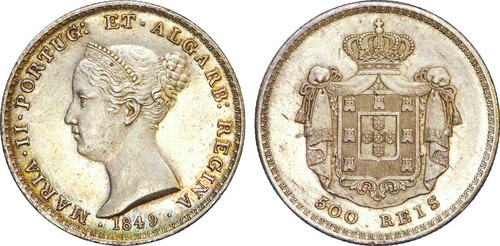
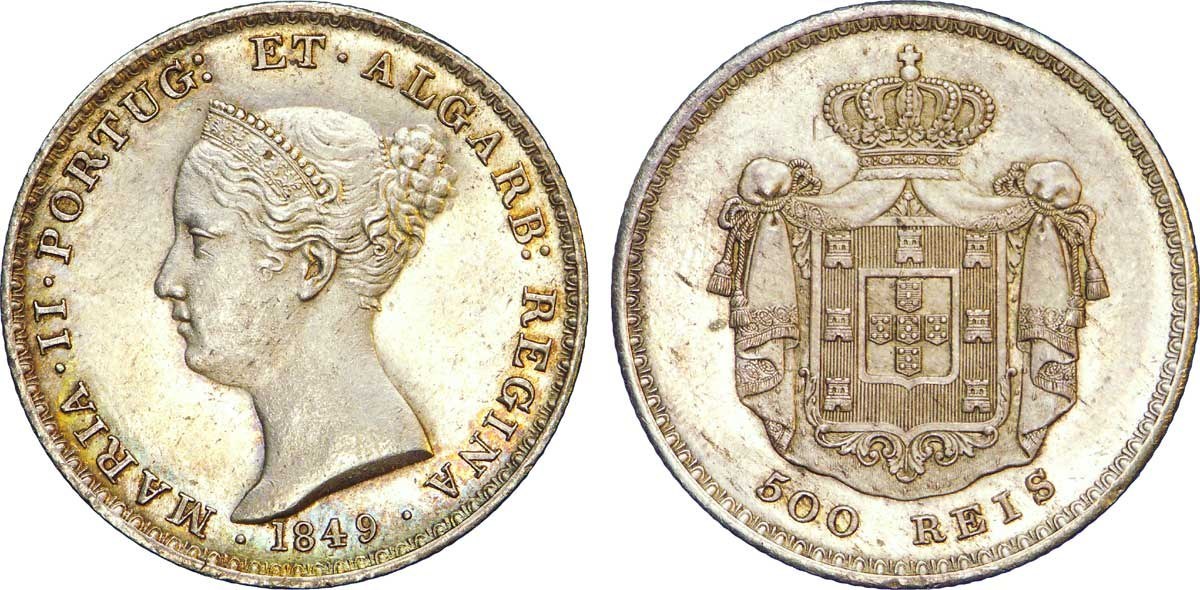
A Portuguese silver 500 Reis of Queen Maria II, with her left-facing draped bust on the obverse and a crowned coat of arms on the reverse.
- Country
- Portugal
- Denomination
- 500 Reis
- Metal
- Silver
Got a coin like this?
Identify any coin from a photo, free.
Overview
The 500 Reis is a silver coin of the Kingdom of Portugal struck during the reign of Queen Maria II. The example shown here is dated 1849 and carries her draped and cuirassed bust facing left, encircled by the legend MARIA II PORTUGAL. The reverse bears a crowned coat of arms with the Portuguese heraldic shield and the value 500 REIS.
The real (plural réis) was Portugal's unit of account, and 500 réis represented half of a milréis, the 1000-réis money-of-account. As one of the larger silver pieces of the series, the 500 Reis sat above the smaller silver and copper coins and below the 1000 Reis, making it a substantial everyday and store-of-value coin of mid-nineteenth-century Portugal.
Its design is typical of the period's monarchical coinage: a realistic royal portrait on one face paired with the crowned national arms on the other. That portrait-and-arms pairing, together with the clear denomination legend, is the quickest way to recognize the type.
History & Background
Maria II ruled Portugal through a turbulent era, reigning from 1834 until her death in 1853 after the country's civil conflict between liberal and absolutist factions had been settled in her favor. Her silver coinage, including the 500 Reis, was issued under a reformed monetary standard that regularized Portugal's réis-based system in the decades before it was eventually replaced by the escudo in 1911.
Coins of this reign were struck at the national mint in Lisbon (Casa da Moeda) and carry dates spread across the 1830s, 1840s, and early 1850s. The 1849 date on the observed coin places it late in the reign, among the more commonly encountered years for the type.
The 500 Reis functioned as a workhorse silver denomination for commerce and savings. Its portrait of the young queen and the crowned arms of Portugal reflect the standard European convention of the age, in which the reigning monarch's likeness legitimized the coinage and the national heraldry identified the issuing state.
How to Identify
Identification rests on the two faces. The obverse shows a left-facing bust of Maria II, draped and cuirassed, with the legend MARIA II PORTUGAL running around the rim; the date, here 1849, is part of the coin's inscription. The reverse displays a coat of arms beneath a royal crown, the shield carrying the Portuguese heraldic devices, with the denomination 500 REIS clearly stated.
The coin is struck in silver and shows the cooler grey-white tone of a silver alloy rather than the yellow of gold or the reddish cast of copper. It is a mid-sized crown-style piece: the 500 Reis is smaller than the 1000 Reis but noticeably larger and heavier than the minor silver denominations of the same reign.
Because the type spans a range of years, the date and small design details are what pin an individual coin to a specific issue. Confirm that the legend names Maria II and Portugal, that the value reads 500 REIS, and that the portrait faces left, matching the observed coin, before attributing it to this denomination and reign.
Value & Collectibility
As a mid-nineteenth-century silver coin, the 500 Reis carries value from both its silver content and its appeal as a portrait coin of a named Portuguese monarch. Its silver gives it a bullion floor, while genuine, identifiable examples of Maria II's reign trade above melt because of their age and collector interest.
Condition is the main driver of price. Heavily worn pieces with flattened portrait detail sit near the lower end, while sharply struck coins retaining fine hair, drapery, and crisp heraldry command clear premiums. Date matters as well: some years of the type are scarcer than others, and rarer dates or higher grades are worth substantially more than common ones.
As with any silver monarch coin, authentication and originality affect value. Original surfaces, honest wear, and, for better pieces, certification by a recognized grading service support stronger prices, whereas cleaned, damaged, or altered coins are discounted. For a precise figure, a coin should be matched to its exact date and grade in current Portuguese coin references.
Frequently asked questions
What does 'Reis' mean on this coin?
Reis (singular real) was the unit of Portugal's currency before the escudo. The 500 Reis was worth 500 réis, or half of a milréis, the 1000-réis money of account used in nineteenth-century Portugal.
Who is shown on the 500 Reis?
The portrait is Queen Maria II of Portugal, shown as a left-facing draped and cuirassed bust. The surrounding legend reads MARIA II PORTUGAL, naming both the monarch and the kingdom that issued the coin.
Is the 500 Reis made of silver?
Yes. This 500 Reis is a silver coin, one of the larger silver denominations of Maria II's reign. Its cool grey-white color and weight distinguish it from the copper minor coins and any gold of the period.
What do the year dates on these coins mean?
The date, such as 1849 on this example, is the year the coin was struck. Maria II's 500 Reis were issued across several years of her 1834 to 1853 reign, and the date helps identify a specific issue and its relative scarcity.
What is on the reverse of the coin?
The reverse shows the Portuguese coat of arms beneath a royal crown, with the shield bearing the national heraldic symbols, alongside the denomination 500 REIS that states the coin's value.
500 Reis guides
In-depth guides for identifying, valuing, and collecting 500 Reis.