50 Korun
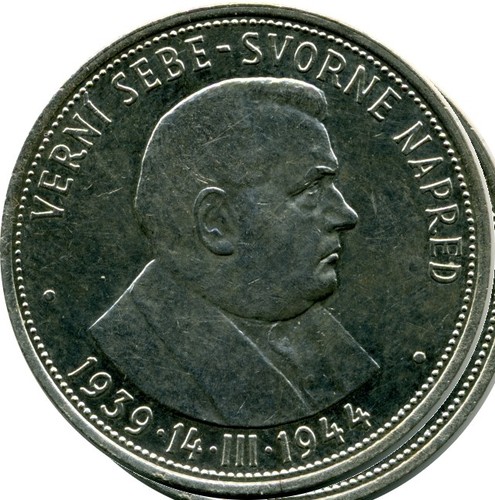
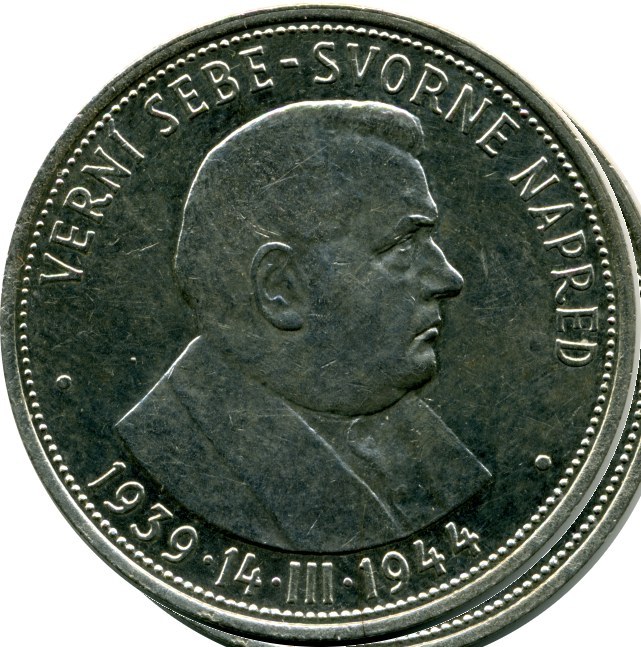
A 1944 silver 50 korun of the wartime Slovak State, showing the profile of Jozef Tiso and a shield with a double cross, struck for the state's fifth anniversary.
- Country
- Slovakia
- Denomination
- 50 Korun
- Metal
- Silver
Got a coin like this?
Identify any coin from a photo, free.
Overview
The 50 Korun dated 1944 is a silver commemorative coin of the wartime Slovak State (Slovensky stat), the German-aligned republic that existed from 1939 to 1945. It carries the profile portrait of Jozef Tiso, the state's president, on the obverse and a heraldic shield with a cross motif on the reverse.
The piece was issued to mark the fifth anniversary of the state's founding, and it is the largest silver denomination of that short-lived coinage. As a crown-sized silver coin it feels substantial in hand and was produced in limited numbers, which is why it is collected today mainly as a historical and numismatic object rather than as ordinary circulating money.
Because it depicts a controversial wartime head of state, collectors generally treat this coin as a documentary artifact of a specific and difficult period. Its interest lies in its silver content, its one-year type status, and its direct connection to the events of 1944 in central Europe.
History & Background
The Slovak State was proclaimed in March 1939 when Slovakia separated from Czechoslovakia and became a nominally independent republic closely allied with Nazi Germany. Jozef Tiso, a Catholic priest and politician, served as its president, and coins of the period carry state symbols and, on the higher denominations, his portrait.
This 50 korun was struck in 1944 to commemorate the fifth anniversary of the state's establishment. It appeared in the final full year of the state's existence: in the summer of 1944 the Slovak National Uprising broke out against the regime and German forces, and the Slovak State collapsed in early 1945 as the front moved west and Czechoslovakia was restored.
Slovak coins of this era were produced at the historic mint in Kremnica, one of the oldest continuously operating mints in Europe. After the war the korun of the Slovak State was superseded by renewed Czechoslovak currency, leaving this issue as a brief, self-contained chapter in the region's coinage.
How to Identify
The obverse shows the bare-headed profile of Jozef Tiso facing to one side, accompanied by a Slovak-language legend. The motto on coins of this state reads VERNI SEBE, SVORNE NAPRED ("true to ourselves, together forward"), which on a worn or low-resolution view can be misread; the presence of a named modern male profile plus this Slovak wording is a strong marker of the type.
The reverse displays a shield bearing a double cross set on a base, the traditional Slovak heraldic emblem, together with the denomination and the date 1944. The value is expressed in korun (abbreviated Ks), and the cross-on-shield design is the central diagnostic device.
This is a genuine silver coin of crown size, roughly 34 mm in diameter and around 15 grams, so it is heavy and rings when struck. Key identifiers together are the Tiso profile, the Slovak motto, the double-cross shield, the 1944 date, and the 50 korun value. The metal is silver of moderate fineness, which gives the coin its weight and distinguishes it from base-metal minor coins of the same state.
Value & Collectibility
As a scarce one-year silver commemorative, the 1944 50 korun carries both bullion and collector value. Circulated examples typically trade in the low-to-mid tens of dollars, supported by silver content, while sharp, lustrous, and uncleaned pieces bring higher premiums as a desirable historical type.
Condition drives most of the price spread. Wear shows first on the high points of the portrait and the shield, so problem-free coins with strong detail and original surfaces are worth clearly more than heavily worn or cleaned examples. Attractively toned, original pieces are especially favored by collectors of the series.
Exact prices vary with grade, market demand, and silver spot, so treat these figures as general context rather than fixed quotes. Cleaned, damaged, or counterfeit coins trade well below genuine problem-free examples, and certified high-grade pieces can command substantially more.
Frequently asked questions
Who is on the obverse of this coin?
It is Jozef Tiso, president of the wartime Slovak State. His profile portrait appears on the highest silver denominations of that state's 1939 to 1945 coinage.
Is the 1944 50 korun real silver?
Yes. It is a genuine silver coin of crown size, which is why it is heavy for its diameter and rings when struck. Its silver content contributes to its value.
What does the reverse show?
The reverse carries a shield with a double cross, the traditional Slovak heraldic emblem, along with the denomination in korun and the date 1944.
What does the inscription mean?
The Slovak motto on coins of this state reads roughly "true to ourselves, together forward." On worn coins the lettering can be hard to read and is easily misinterpreted.
Why was it issued?
It was struck in 1944 to commemorate the fifth anniversary of the founding of the Slovak State, which had been proclaimed in 1939.
50 Korun guides
In-depth guides for identifying, valuing, and collecting 50 Korun.