5 Litai
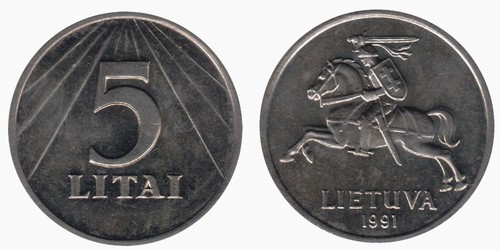
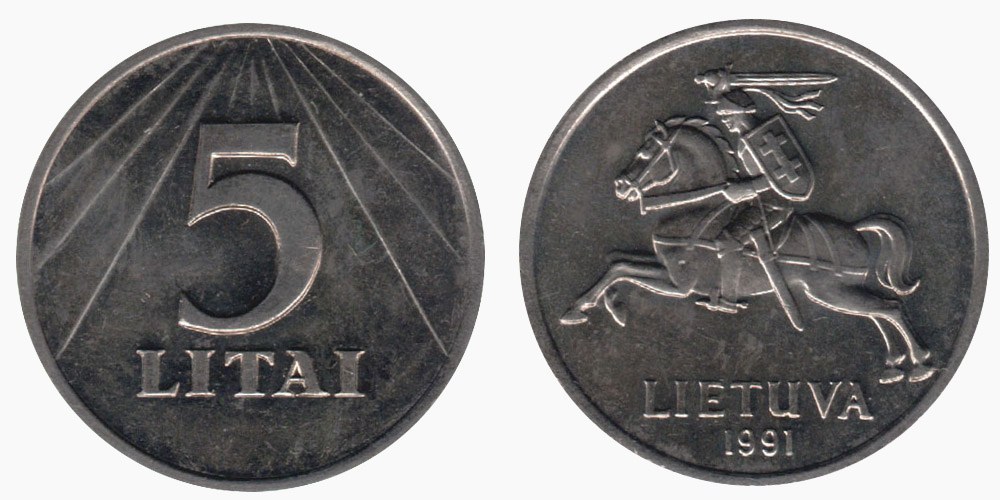
A nickel-alloy 5 litai of newly independent Lithuania dated 1991, showing the value with radiating lines on one side and the armored knight Vytis on horseback on the other.
- Country
- Lithuania
- Denomination
- 5 Litai
- Metal
- Nickel
Got a coin like this?
Identify any coin from a photo, free.
Overview
The 5 Litai dated 1991 is a coin of the newly re-established Republic of Lithuania, struck in the first years after the country restored its independence from the Soviet Union. One face displays the denomination 5 LITAI set against a field of radiating lines, while the other shows Vytis, the armored knight galloping on horseback with sword and shield, Lithuania's historic national emblem.
The coin is a whitish nickel-alloy piece rather than a precious-metal issue. It belongs to the reborn litas coinage that reasserted Lithuanian statehood and revived the interwar currency name, using national imagery in place of Soviet symbolism.
As an early independence-era type, the 1991 5 litai is collected mainly as an affordable and historically meaningful example of Lithuania's return to its own money after decades within the USSR.
History & Background
Lithuania had used the litas as its national currency during the interwar Republic of the 1920s and 1930s, before Soviet annexation in 1940 replaced it with the ruble. When Lithuania declared the restoration of its independence in 1990 and broke free of the Soviet Union, reviving the litas became a symbol of renewed sovereignty.
The 1991-dated litai coins, including this 5 litai, were prepared as part of that revival, carrying the reinstated Vytis knight emblem that Lithuania had used historically and that pointedly rejected Soviet iconography. The full transition took time: temporary coupons circulated first, and the litas itself was formally reintroduced as circulating currency in 1993.
Because of this staggered rollout, the 1991 issues are firmly tied to the dramatic early-independence period. They stand as tangible mementos of Lithuania reclaiming its statehood, currency, and national symbols in the closing days of the Soviet era.
How to Identify
The obverse in hand shows the denomination spelled out as 5 LITAI over a background of radiating straight lines fanning across the field. This bold numeral-and-text value design, with no monarch or Soviet emblem, marks it as a modern Lithuanian republican issue.
The reverse carries Vytis: an armored knight on a rearing or galloping horse facing left, raising a sword and bearing a shield. This mounted knight is Lithuania's national coat of arms and is the single most decisive identifier, distinguishing the coin from Soviet ruble and kopeck pieces that use the hammer-and-sickle and state emblem instead.
The piece is a light, pale nickel-alloy coin, not silver or gold, so it lacks precious-metal heft. Look for the 1991 date and the country name Lietuva. Together the 5 LITAI value, the Vytis knight, the nickel fabric, and the 1991 date confirm the type as an early independence-era Lithuanian 5 litai.
Value & Collectibility
The 1991 5 litai is a base-metal (nickel-alloy) coin with no precious-metal content, so its value rests on collector demand and condition rather than bullion. In circulated grades it is an inexpensive world coin, typically trading for a modest sum.
Because it comes from the symbolically important first years of restored Lithuanian independence, well-preserved and uncirculated examples can carry a small premium over worn pieces, especially among collectors of Baltic or post-Soviet coinage. Even so, prices remain in the affordable range rather than the territory of scarce rarities.
Treat any figures as general context, since low-value modern world coins trade inconsistently across dealers and marketplaces. The coin's appeal is chiefly historical, as an early emblem of Lithuania's return to its own currency, rather than financial.
Frequently asked questions
Who is the knight on the reverse?
It is Vytis, the armored knight on horseback with sword and shield that serves as Lithuania's national coat of arms. Its presence marks the coin as an independence-era Lithuanian issue rather than a Soviet one.
Is the 1991 5 litai made of silver?
No. It is a light nickel-alloy circulation-type coin with no precious-metal content. Its worth comes from collector interest and condition, not bullion value.
Why is it dated 1991 if the litas returned in 1993?
The litai coins were prepared during the early independence period dated 1991, but the litas was only formally reintroduced as circulating money in 1993 after a transitional coupon phase. The date reflects when the coinage was struck rather than a long circulation life.
Is this coin rare or valuable?
It is an affordable modern world coin. Worn pieces are inexpensive, while high-grade uncirculated examples bring a modest premium among Baltic and post-Soviet collectors.
What does LITAI mean?
Litai is the plural form of litas, Lithuania's national currency unit, first used in the interwar republic and revived after independence. The 5 LITAI legend simply states the coin's value of five litas.
5 Litai guides
In-depth guides for identifying, valuing, and collecting 5 Litai.