25 Gulden
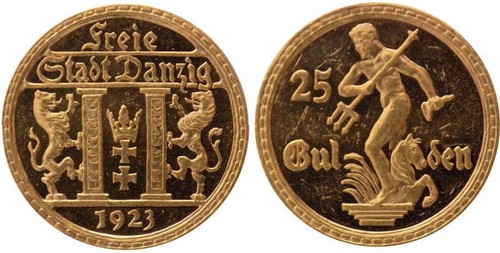
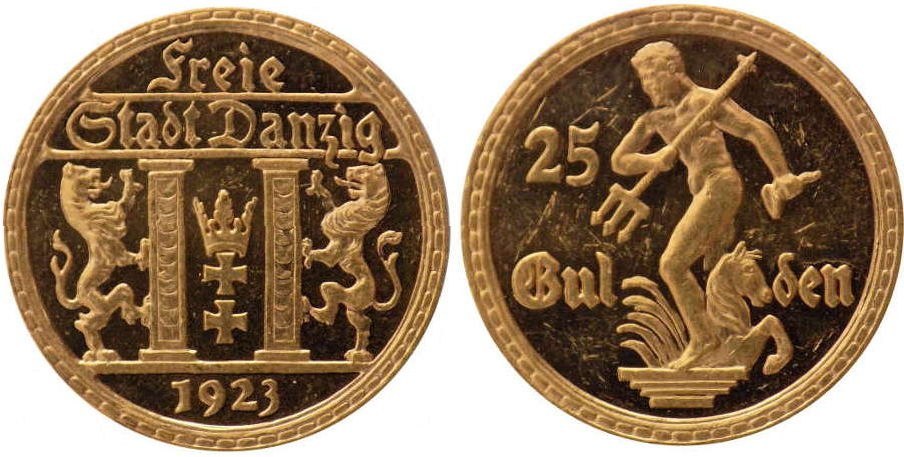
The gold 25 Gulden of the Free City of Danzig, dated 1923, pairing the lion-supported Danzig arms with an armed female figure holding a trident.
- Country
- Free City of Danzig
- Denomination
- 25 Gulden
- Metal
- Gold
Got a coin like this?
Identify any coin from a photo, free.
Overview
The 25 Gulden is a gold coin of the Free City of Danzig, the self-governing city-state that existed between the World Wars. Dated 1923, it belongs to the short-lived Gulden coinage created when Danzig introduced its own currency separate from the German mark. The obverse carries the city's coat of arms, and the reverse shows an armed female figure holding a trident above the value 25 GULDEN.
This was the top gold denomination of Danzig's own money and a deliberate statement of the city's distinct status. Struck in gold and issued only briefly, it is a scarce and desirable piece, sought by collectors of German-area coinage, gold types, and the unusual free-city and inter-war states.
Because it is a small, high-value gold coin produced in limited numbers, the 25 Gulden is far more of a collector and store-of-value issue than an everyday circulating coin, and genuine examples are prized within the Danzig series.
History & Background
After the First World War, the Treaty of Versailles separated the port city of Danzig from Germany and established it in 1920 as the Free City of Danzig, a semi-autonomous city-state under League of Nations protection with its own government, flag, and coinage. Amid the severe inflation of the early 1920s, Danzig moved to its own currency, the Gulden, divided into 100 Pfennig, replacing the collapsing German paper mark.
The 1923 Gulden coinage introduced circulating pieces along with prestige gold denominations, of which the 25 Gulden was the largest gold value. These gold coins expressed the city's separate identity and backed the new currency, though the small gold pieces were never a mass-circulation medium.
The Free City lasted until 1939, when Danzig was annexed at the outbreak of the Second World War and its separate coinage ended. The 1923 gold 25 Gulden survives as a tangible relic of this brief, distinctive experiment in an independent Baltic city-state, and it is collected today as a rare emblem of that period.
How to Identify
The obverse shows the coat of arms of the Free City of Danzig: a shield bearing two crosses beneath a crown, supported by two rampant lions, encircled by the legend FREIE STADT DANZIG. The lion supporters and the crowned double-cross shield are the defining feature and immediately identify the issuing state.
The reverse depicts an armed female figure holding a trident, a maritime allegory fitting for the Baltic port, with the denomination written plainly as 25 GULDEN and the date 1923. Reading the value and date on this side is the surest confirmation of the exact type.
The coin is struck in gold and is physically small, in the range of roughly two centimeters across and only a few grams in weight, so it is compact but dense and has the warm color and heft of a gold piece. Key identifiers together are the FREIE STADT DANZIG legend, the lion-supported arms, the trident-bearing female figure, the 25 GULDEN value, and the 1923 date.
Value & Collectibility
As a scarce inter-war gold coin, the Danzig 25 Gulden carries significant value well above its gold content. It was produced in limited numbers for a small city-state and issued only briefly, so surviving examples are genuinely rare and typically trade at strong prices among specialist collectors and at auction.
Condition, originality, and authentication drive the range. Even worn genuine pieces command a substantial premium as a rare type, while sharp, high-grade examples with original surfaces can bring considerably more. Because the coin is both scarce and gold, prices are set largely by the collector market rather than by spot metal, and they can vary widely with grade and demand.
Treat all figures as broad context rather than fixed quotes: actual results depend on grade, eye appeal, provenance, and the state of the market. Cleaned, damaged, or counterfeit pieces sell for far less than problem-free certified coins, and this is a type where third-party authentication strongly affects realized value.
Frequently asked questions
What country issued the 25 Gulden?
It was issued by the Free City of Danzig (Freie Stadt Danzig), the semi-autonomous Baltic city-state that existed between the World Wars under League of Nations protection, with its own Gulden currency.
Is the 1923 25 Gulden made of gold?
Yes. It is a small gold coin and the largest gold denomination of Danzig's own coinage, which is a major reason it is scarce and valued by collectors.
Who is the figure on the reverse?
The reverse shows an armed female figure holding a trident, a maritime allegory suited to Danzig as a Baltic port, shown above the value 25 GULDEN and the date 1923.
What is on the obverse?
The obverse carries the arms of Danzig, a crowned shield with two crosses supported by two rampant lions, surrounded by the legend FREIE STADT DANZIG.
Is it rare?
Yes. It was struck in limited numbers for a small city-state and issued only briefly, so genuine examples are scarce and generally command strong collector prices.
25 Gulden guides
In-depth guides for identifying, valuing, and collecting 25 Gulden.