20 Reales (Isabel II)
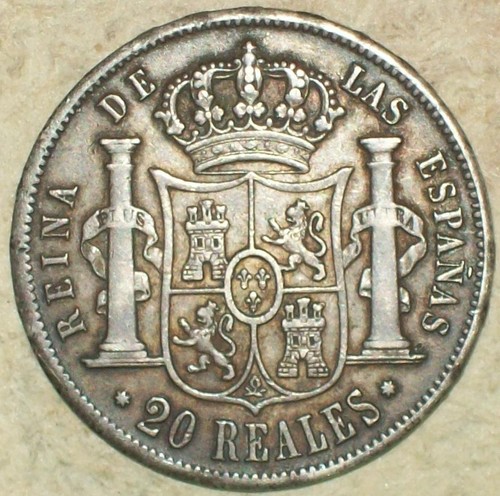
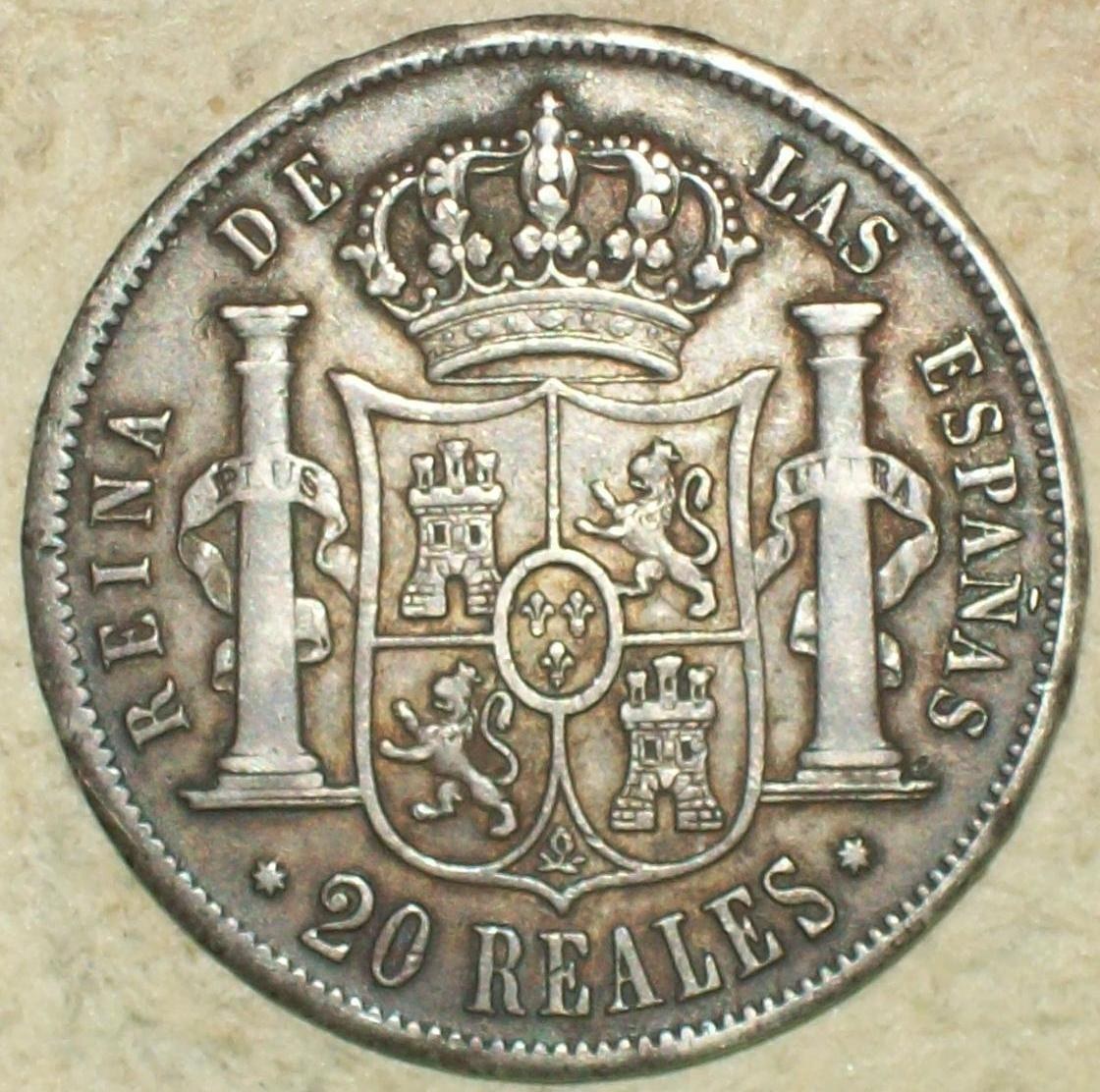
Crown-sized Spanish silver 20 Reales of Queen Isabel II, with her crowned right-facing profile and a crowned pillared shield, dated 1854.
- Country
- Spain
- Denomination
- 20 Reales
- Metal
- Silver
Got a coin like this?
Identify any coin from a photo, free.
Overview
This is a large Spanish silver 20 Reales struck under Queen Isabel II, dated 1854. The obverse shows the queen's crowned bust facing right with the legend REINA DE LAS ESPANAS (Queen of the Spains), while the reverse carries the crowned Spanish coat of arms flanked by the Pillars of Hercules and the denomination.
The 20 Reales was a crown-sized trade coin, the top silver denomination of Spain's real-based system in the mid-19th century, roughly comparable in size and role to a duro or a French five-franc piece. It is a popular and widely collected type among those who follow 19th-century Spanish and world crown silver.
History & Background
Isabel II reigned over Spain from 1833 until she was deposed in 1868. Her long reign saw repeated changes to the coinage as Spain modernized its monetary system, and several distinct portrait styles of the queen appear across the years, from a youthful girl to a mature woman.
The 20 Reales silver pieces of the early-to-mid 1850s, including the 1854 issue, belong to the reformed coinage that used the real de vellon as the accounting unit, with 20 Reales as the large silver crown. These coins were struck at Spanish mints such as Madrid and Seville. In 1864 the system shifted to escudos, and after Isabel's fall Spain adopted the peseta in 1868, so the 20 Reales duro belongs to the last generation of Spain's old real-based crown coinage.
How to Identify
Confirm the obverse legend REINA DE LAS ESPANAS around a crowned right-facing female bust; the surrounding legend and date read 1854. The reverse shows a crowned oval or Spanish shield flanked by the two crowned Pillars of Hercules, with the denomination 20 Rs and mint identifiers in the legend.
Silver 20 Reales of this type are large coins, on the order of about 37 mm in diameter and roughly 26 grams in a high-grade silver alloy near .900 fine. Look near the shield and in the surrounding legend for tiny mint marks and assayer initials that tell Madrid, Seville and other mints apart; these small letters and symbols are important for attributing the exact issue.
Because the design changed across Isabel II's reign, match the specific portrait style and the pillared reverse to references for the 1850s crown type rather than the later escudo or peseta coinage.
Value & Collectibility
As a large .900-fine silver crown, the 20 Reales carries a silver-bullion floor plus a numismatic premium that depends on the year, the mint, and the state of preservation. Common dates in worn, circulated grades typically trade as modest world-silver crowns, while scarcer mint-and-date combinations and high-grade examples command stronger premiums.
Condition matters a great deal on a large silver coin: sharp detail in the queen's hair and crown, in the shield, and in the pillars, along with original surfaces, separates an ordinary piece from a desirable one. Scarcer mint marks and assayer combinations for a given year can be worth substantially more than the type's common examples.
Because popular 19th-century crowns are sometimes counterfeited, verify weight, diameter, and metal, and for higher-value or high-grade examples seek third-party authentication before paying a premium.
Frequently asked questions
What country and ruler is this coin from?
It is a Spanish coin struck under Queen Isabel II (Isabella II), who reigned from 1833 to 1868. The obverse legend REINA DE LAS ESPANAS means Queen of the Spains.
What is the coin made of?
The 20 Reales of this type is a large silver crown, struck in a high-grade silver alloy near .900 fine, weighing roughly 26 grams and measuring about 37 mm across. Always confirm metal by testing.
What is shown on the reverse?
The reverse displays the crowned Spanish coat of arms flanked by the two crowned Pillars of Hercules, together with the 20 Reales denomination and small mint and assayer marks.
How much is an 1854 20 Reales worth?
Value depends on mint, date and condition. Common circulated examples trade as modest silver crowns near bullion plus a premium, while scarce mints and high grades bring more. Authenticate high-value pieces.
Why does the coin say 'Reales' and not 'Pesetas'?
Spain used the real-based system before adopting the peseta in 1868. The 20 Reales duro belongs to the older coinage; the escudo replaced it in 1864 and the peseta followed after Isabel II's fall.
20 Reales (Isabel II) guides
In-depth guides for identifying, valuing, and collecting 20 Reales (Isabel II).