2 Lire
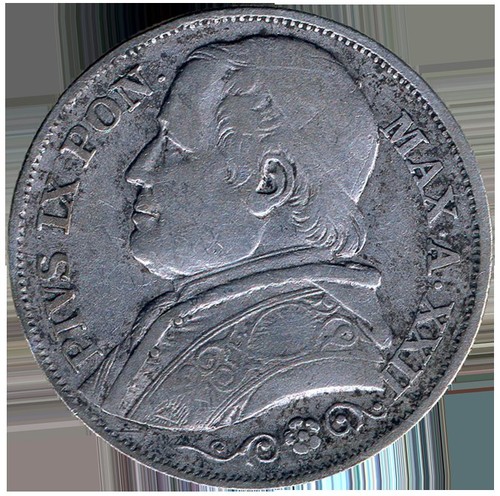
Silver 2 Lire of the Papal States struck under Pope Pius IX, part of the Italian lira system adopted by Rome in the 1860s.
- Country
- Papal States
- Denomination
- 2 Lire
- Metal
- Silver
Got a coin like this?
Identify any coin from a photo, free.
Overview
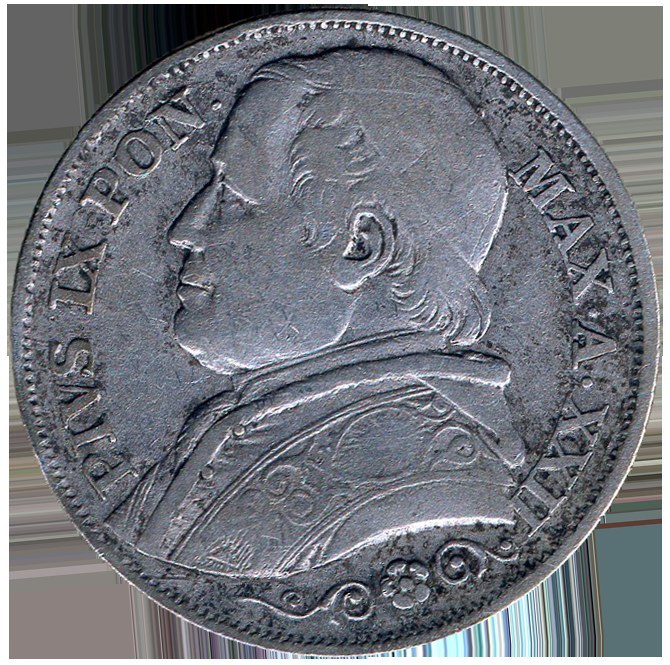
The 2 Lire is a silver denomination issued by the Papal States (Stato Pontificio) during the reign of Pope Pius IX (Pio IX). The photographed example is dated 1867 and shows the Pope's bare-headed profile facing right on the obverse.
This coin belongs to the decimal lira coinage the Papal government adopted in the 1860s, aligning Rome's money with the wider Italian and Latin Monetary Union standard rather than the older scudo system. As a mid-size silver piece it sat between the 1 Lira and the larger 5 Lire in the series.
It is a circulating silver coin, not a commemorative issue, and today is collected as a tangible artifact of the final years of papal temporal rule over Rome.
History & Background
Pius IX (reigned 1846-1878) presided over the Papal States during a period of profound upheaval, including the unification of Italy that steadily reduced the territory under direct papal control. In 1866 the papal administration reformed its coinage onto the decimal lira, mirroring the standard used by the new Kingdom of Italy and the Latin Monetary Union, so that a papal lira matched the weight and fineness of its Italian counterpart.
The 2 Lire was struck in silver at the Rome mint in the mid-to-late 1860s, with 1867 among the dates encountered. Coinage in this system continued only a few more years: in 1870 Italian forces captured Rome, ending the Papal States as a sovereign entity and closing this chapter of papal secular coinage.
Because the series was short-lived and tied to a vanished state, surviving pieces are prized as historical documents of the Risorgimento era.
How to Identify
Look first at the obverse: a bare, right-facing bust of Pius IX with an encircling Latin legend naming the Pope (typically forms of PIVS IX with pontifical titulature) and the date. The photographed coin clearly shows this right-facing papal profile and the year 1867.
The reverse (not shown in the source image) of this series characteristically carries the denomination and value together with heraldic or wreath elements associated with the Holy See, and the mint identifier for Roma. The stated value 'L. 2' anchors the identification of the denomination.
As a lira-standard silver 2 Lire, expect a diameter and weight consistent with the Latin Monetary Union 2-franc/2-lire module (roughly 27 mm and about 10 g of .835 fine silver). Confirm the country as Papal States rather than the Kingdom of Italy by the papal portrait and Latin ecclesiastical legends, since Italian 2 Lire of the same era share the same size and metal.
Value & Collectibility
Value depends heavily on date, grade, and eye appeal. As a genuine silver coin the 2 Lire carries a modest floor from its precious-metal content, but collector demand for well-preserved papal silver usually pushes prices well above melt.
Circulated examples in worn but identifiable condition tend to trade in the low-to-moderate range typical of common 19th-century European silver minors, while higher grades with sharp portrait detail and original surfaces command meaningful premiums. Scarcer dates within the short series can be worth substantially more.
Because condition drives price, have valuable-looking pieces assessed against recent auction records or by a reputable dealer rather than relying on face-value or bullion estimates alone.
Frequently asked questions
Who is on the 2 Lire coin?
The obverse portrait is Pope Pius IX (Pio IX), shown as a bare-headed bust facing right, with a Latin legend naming him and the date of striking.
What is the 2 Lire made of?
It is a silver coin struck to the Latin Monetary Union lira standard, typically around .835 fine silver in a roughly 10-gram, 27 mm module.
Is a Papal States 2 Lire the same as an Italian 2 Lire?
No. They share the same size and metal standard, but the Papal issue carries a papal portrait and Latin ecclesiastical legends and was struck by the Papal States, a separate authority from the Kingdom of Italy.
Why did the Papal States use lire instead of scudi?
In 1866 the papal government reformed its coinage onto the decimal lira to align with the Italian and wider Latin Monetary Union standard, replacing the older scudo system in its final years of coinage.
How much is an 1867 2 Lire worth?
It depends on grade and date. Circulated pieces sit near common 19th-century silver minor levels, while sharp higher-grade examples and scarcer dates bring notable premiums; check recent auction results for a specific coin.
2 Lire guides
In-depth guides for identifying, valuing, and collecting 2 Lire.