2.5 Escudos
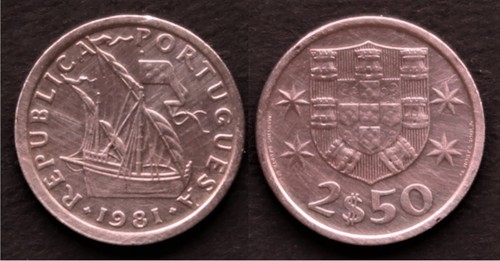
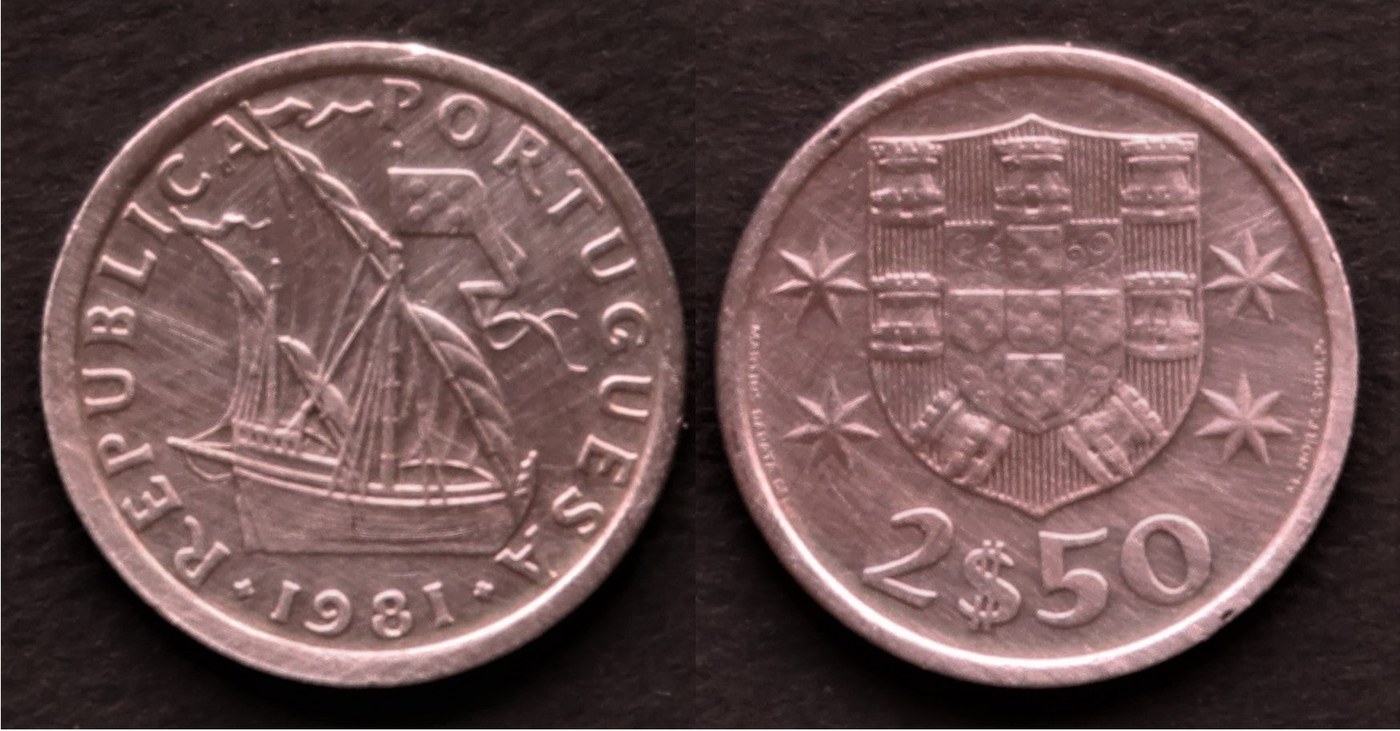
A copper-nickel 2.5 Escudos of the Portuguese Republic, showing a sailing caravel on the obverse and the national shield with the value 2$50.
- Country
- Portugal
- Denomination
- 2.5 Escudos
- Metal
- Copper-Nickel
Got a coin like this?
Identify any coin from a photo, free.
Overview
The 2.5 Escudos is a mid-value circulating coin of the Portuguese Republic, struck in copper-nickel. The example shown here is dated 1981 and carries the legend REPUBLICA PORTUGUESA around a caravel, the small ocean-going sailing ship that Portugal used to symbolize its seafaring past. The reverse shows the Portuguese coat of arms with the denomination written in escudo notation as 2$50.
The value 2$50 reads as two escudos and fifty centavos, that is two and a half escudos. The dollar-like sign, called the cifrão, separates the whole escudos from the centavos, so 2$50 is the same as writing 2.50. This notation is standard on Portuguese escudo coinage and is one of the coin's most distinctive features.
As a copper-nickel piece it has a plain silvery-grey appearance rather than the yellow of a brass coin or the warm tone of bronze. It belongs to the long-running caravel series of Portuguese coins that circulated through the second half of the twentieth century, before the escudo was eventually replaced by the euro.
History & Background
Portugal adopted the escudo in 1911, after the fall of the monarchy and the founding of the Republic, replacing the older real. The escudo was divided into 100 centavos, and coins were inscribed REPUBLICA PORTUGUESA to mark the new republican state rather than a reigning monarch.
The caravel design carried by this coin belongs to a family of Portuguese coinage introduced in the 1960s that used the sailing ship as a national emblem, evoking the country's Age of Discovery voyages. The copper-nickel 2.5 Escudos of this type was struck across a range of years in the 1960s, 1970s, and into the 1980s, with the coin illustrated here bearing the date 1981.
The escudo remained Portugal's currency until the country joined the euro. Escudo coins and notes were withdrawn from everyday use after the euro was introduced for cash in 2002, which makes 1980s pieces like this one part of the final decades of the national currency.
How to Identify
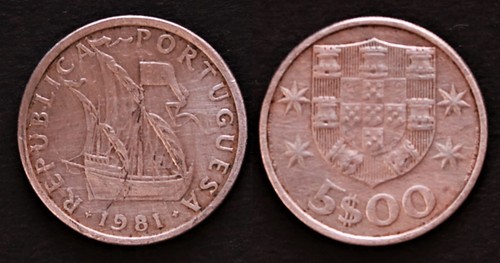
The surest identifiers are the two inscriptions. The obverse reads REPUBLICA PORTUGUESA around a caravel with billowing sails, and the reverse shows the value as 2$50 beside the Portuguese shield. If a coin has a caravel, that Portuguese legend, and the 2$50 mark, it is this denomination. The year, here 1981, appears with the design.
The metal is copper-nickel, so the coin is silvery-grey and non-magnetic, with a smooth or reeded edge depending on the issue. It is a modest mid-sized coin, larger than the small centavo pieces but smaller than the higher escudo values, and it feels light for its size compared with a solid silver coin.
Do not confuse the 2.5 Escudos with other caravel-series coins that share the same ship motif and republic legend. The neighboring 1 Escudo, 5 Escudos, and 10 Escudos of the era look broadly similar, so the printed value, 2$50, is the detail that fixes the denomination. The Portuguese shield with its castles and the small quinas (the five shield-shaped charges) confirms the country.
Value & Collectibility
The caravel 2.5 Escudos was a workaday circulating coin produced in large numbers over many years, so most examples are common and carry modest value. Well-worn pieces are typically worth little more than a token or bulk-lot amount, and they are widely available to collectors at low cost.
Value rises with condition. Coins that are bright, sharply struck, and free of heavy wear are worth more than circulated examples, and truly uncirculated or proof pieces command the strongest premiums. Certain dates in the series are scarcer than others, so the year on the coin can matter to a specialist even when the design is unchanged.
Because it is copper-nickel rather than a precious metal, the 2.5 Escudos has no meaningful bullion value; its worth is entirely collector- and condition-driven. For a common date like 1981 in circulated grade, expect a small figure, with the real interest lying in complete date runs and high-grade examples.
Frequently asked questions
What does 2$50 mean on the coin?
It is the value written in Portuguese escudo notation. The cifrão sign ($) separates escudos from centavos, so 2$50 means two escudos and fifty centavos, in other words two and a half escudos.
What is the ship on the front of the coin?
It is a caravel, the small sailing ship associated with Portugal's Age of Discovery voyages. The Portuguese Republic used it as a national emblem on a whole series of escudo coins.
What is the 2.5 Escudos made of?
This caravel type is struck in copper-nickel, giving it a silvery-grey color. It is not silver and is non-magnetic, so its value comes from collector interest rather than metal content.
Is a 1981 example valuable?
Usually only modestly. The coin was made in quantity over many years and 1981 is a common date, so circulated pieces are worth little; bright, uncirculated examples are worth more.
Is the escudo still used in Portugal?
No. Portugal replaced the escudo with the euro, and escudo cash was withdrawn from everyday use in the early 2000s. Coins like this now survive as collectibles and keepsakes.
2.5 Escudos guides
In-depth guides for identifying, valuing, and collecting 2.5 Escudos.