
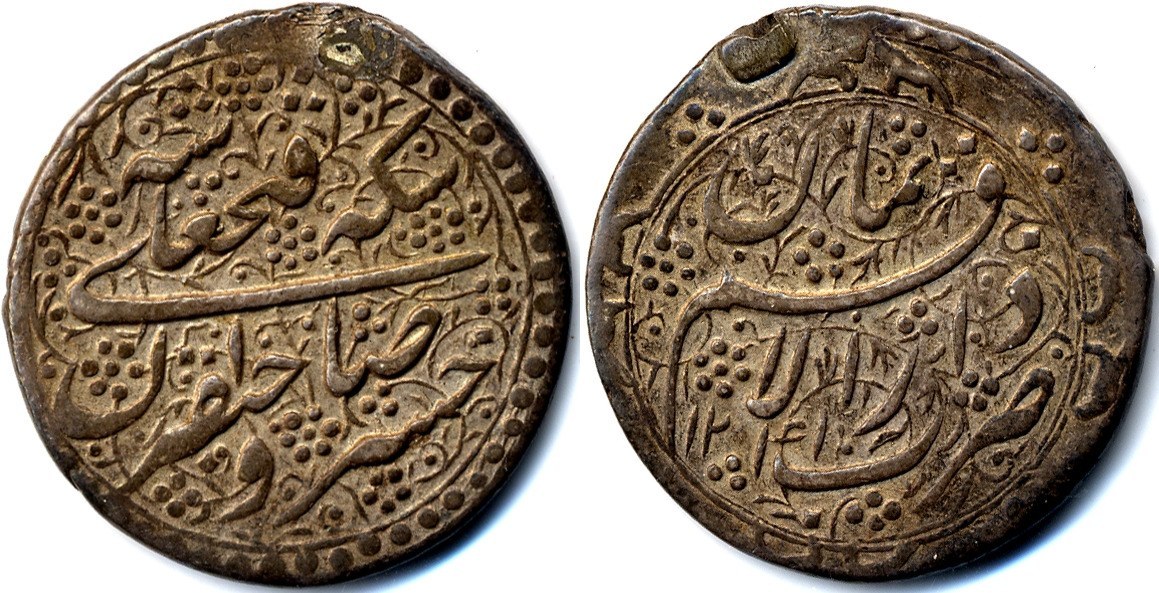
Qiran of Fath-Ali Shah Qajar
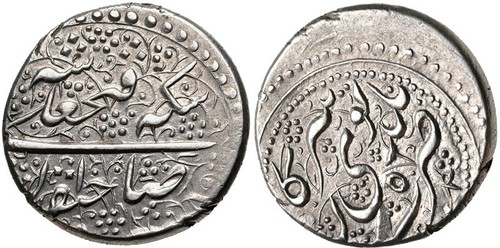
A hand-struck silver qiran of the Qajar shah Fath-Ali, carrying Persian calligraphy, a decorative border and crown motif, dated AH 1240–1241 (AD 1825–1826).
- Country
- Persia (Iran)
- Denomination
- Qiran
- Metal
- Silver
Got a coin like this?
Identify any coin from a photo, free.
Overview
The qiran of Fath-Ali Shah is a silver coin of Qajar Persia, struck under the second Qajar monarch, who reigned from 1797 to 1834. The example shown carries flowing Persian and Arabic inscriptions framed by an ornamental border on the obverse, and further inscriptions on the reverse set beneath a crown motif and flanked by wreath-like devices. It is dated to AH 1240–1241, corresponding to about AD 1825–1826.
Like most Islamic-world coinage of the period, the qiran is fundamentally a calligraphic coin: its message is carried in Arabic-script legends naming the ruler and recording the mint and date, rather than in figural imagery. The decorative crown and border elements accompany, rather than replace, the inscriptions.
The qiran was one of the principal silver denominations of nineteenth-century Iran and remained in use, under later shahs, long after Fath-Ali's reign, which makes his early qirans a recognizable starting point for the series.
History & Background
Fath-Ali Shah Qajar (reigned 1797–1834) was the second ruler of the Qajar dynasty and presided over a period of costly wars with Russia and expanding European contact. His long reign produced a large and varied body of Persian coinage struck at mints across the empire.
The qiran (also spelled kran) belongs to a reform of the Iranian silver coinage associated with this era, in which the qiran — valued at 1,000 dinars — became a standard unit alongside fractional and multiple pieces. Coins dated in the AH 1240s, such as this AH 1240–1241 issue, fall in the later part of the reign, when this denomination was firmly established.
Qajar silver of Fath-Ali Shah continued the long Persian tradition of aniconic, inscription-based money. His successors maintained the qiran as a core denomination through the nineteenth century, and it was only gradually superseded as Iran moved toward machine-struck and, later, decimal coinage.
How to Identify
A qiran of Fath-Ali Shah is a small, roughly circular silver coin, typically in the order of about 20–23 mm across and a few grams in weight, consistent with a hand-struck nineteenth-century Persian silver denomination. Because the dies were often larger than the flan, the legend may be partly off the edge and the strike can look slightly off-center.
The obverse carries Persian and Arabic calligraphy naming the shah within a decorative border; the reverse gives further legend — including the mint city and the Hijri date — accompanied by a crown motif above and wreath-like ornament to the sides. The AH date, here 1240–1241 (AD 1825–1826), is part of the reverse legend and is the key to placing the coin within the reign.
There is no Latin lettering and no realistic human portrait; identification rests on reading the Arabic-script inscriptions. The presence of the ruler's name confirms the attribution to Fath-Ali Shah, while the named mint distinguishes one issue from another within the series.
Value & Collectibility
Qajar silver qirans of Fath-Ali Shah are collected pieces of nineteenth-century Persian coinage, and as a group they are more available than much earlier Islamic silver. Ordinary circulated examples typically trade at modest collector prices, driven more by the coin's history and legibility than by bullion value alone.
Within the series, value is influenced by the mint, the specific date, the sharpness and completeness of the legend, and overall condition. Coins from scarcer mints, well-centered strikes showing the full inscription and crown motif, and clearly attributable pieces generally command more than worn, partially struck examples.
Because pricing for hand-struck silver depends heavily on grade, eye appeal and specialist demand, the figures here are context rather than fixed values. An accurate reading of the mint and AH date is the single most useful step in judging where a given qiran sits in the market.
Frequently asked questions
Who was Fath-Ali Shah?
Fath-Ali Shah Qajar was the second ruler of Iran's Qajar dynasty, reigning from 1797 to 1834. Silver qirans in his name, including this AH 1240–1241 example, were struck during his reign.
What is a qiran?
The qiran (also spelled kran) was a silver denomination of nineteenth-century Persia, valued at 1,000 dinars. It served as one of the standard silver units of the Qajar monetary system.
Is the coin made of real silver?
Yes. The qiran was a silver denomination, and coins of this type are struck in silver rather than base metal, in keeping with Qajar silver standards of the period.
What does AH 1240–1241 mean?
AH refers to the Islamic Hijri calendar. AH 1240–1241 corresponds to roughly AD 1825–1826, placing this coin in the later part of Fath-Ali Shah's reign.
Why is there no portrait of the shah?
Persian coinage of this era was largely aniconic, relying on Arabic-script calligraphy rather than realistic portraits. The coin's decorative border and crown motif accompany the inscriptions instead of a facial likeness.
Qiran of Fath-Ali Shah Qajar guides
In-depth guides for identifying, valuing, and collecting Qiran of Fath-Ali Shah Qajar.
Other coins you may enjoy
Pahlavi Reign Gold Medal
1971
Qajar 5 Tomans Commemorative
Late Qajar period; dated 1299 (Solar Hijri, c. 1920 CE), reign of Ahmad Shah Qajar (1909–1925)
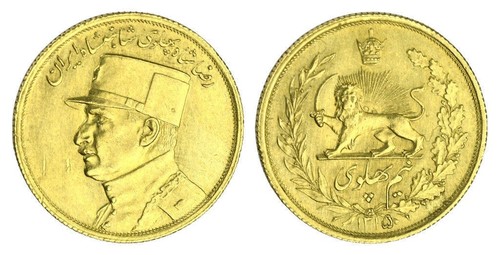
Half Pahlavi Gold Coin
1920s–1930s (Reza Shah era)
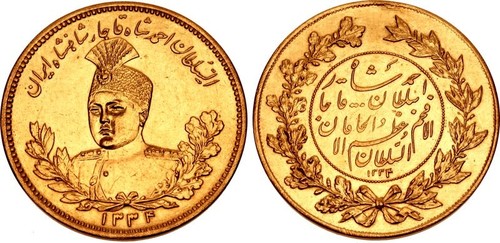
Gold Toman of Ahmad Shah Qajar
Qajar dynasty; Ahmad Shah's reign AH 1327–1344 (1909–1925 CE)
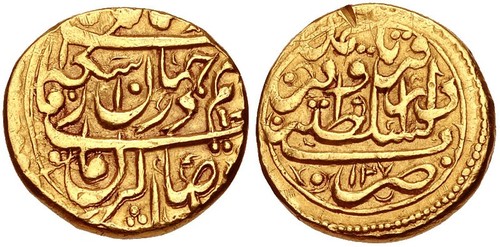
Gold Toman of Agha Mohammad Khan Qajar
1792–1793 CE (AH 1206–1207)
Gold Toman of Fath-Ali Shah Qajar
1811–1812 CE (AH 1226–1227)
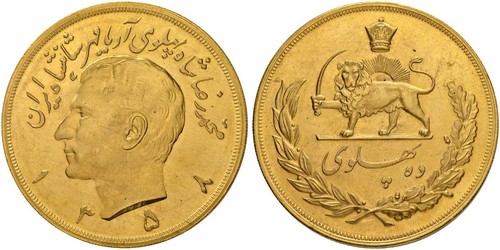
10 Pahlavi Gold Coin
Struck under Mohammad Reza Shah Pahlavi; the example shown is dated 1979 (Imperial year 2537–2538 SH)
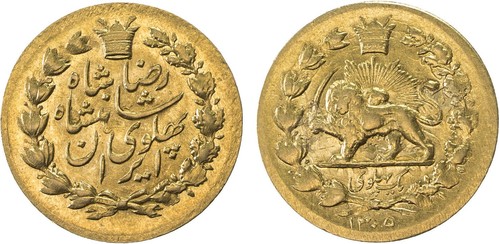
1 Pahlavi Gold Coin
Pahlavi dynasty, mid-20th century (issues commonly dated to the 1950s–1970s)
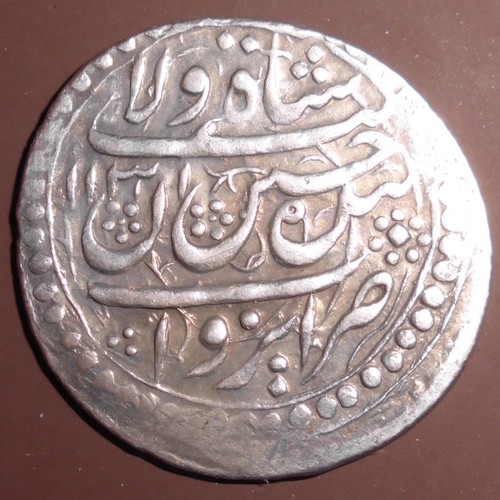
Abbasi of Shah Sultan Husayn
Reign of Shah Sultan Husayn, AH 1105–1135 (1694–1722 CE)