
How to Identify the Qiran of Fath-Ali Shah Qajar
A collector's guide to attributing a Qajar silver qiran to Fath-Ali Shah: reading the legend, mint and AH date, size, metal and common look-alikes.
Read the full Qiran of Fath-Ali Shah Qajar encyclopedia entry →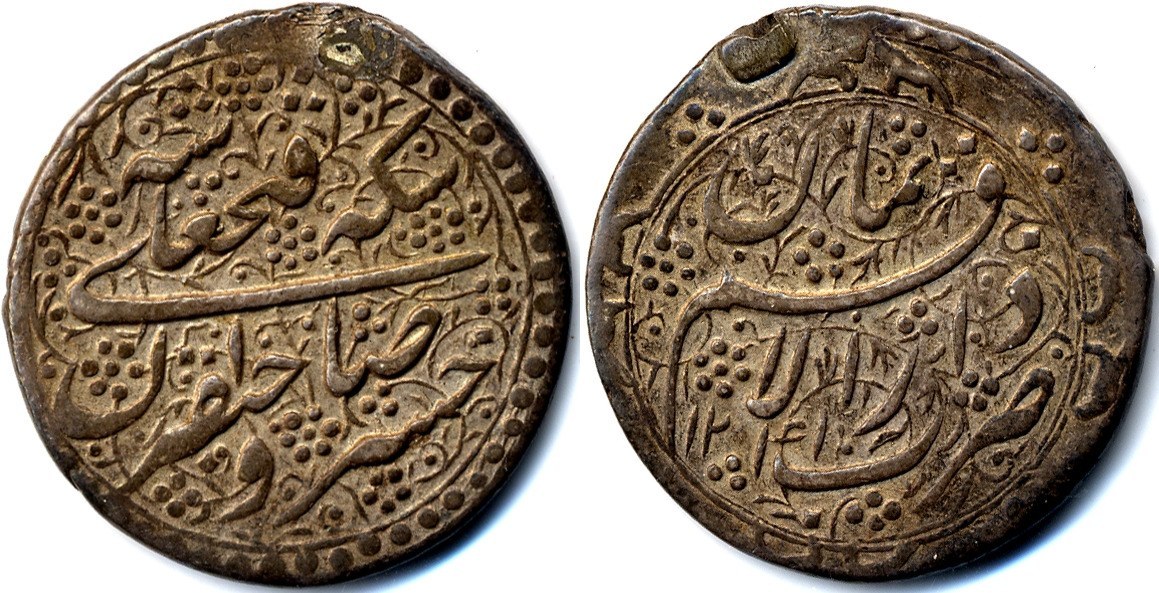
Begin with the physical coin. A qiran of Fath-Ali Shah should be silver, roughly circular, small — on the order of about 20–23 mm across — and light, only a few grams. A piece that is markedly heavier or larger may be a multiple denomination, while one that is magnetic or clearly base metal is likely a modern replica rather than a genuine silver qiran. Expect a hand-struck look: slightly uneven flans and legends that run off the edge are normal and not defects.
Attribution rests on the inscriptions. Both faces are covered in Persian and Arabic calligraphy; the obverse names the shah, and identifying his name in that legend is what confirms the coin as a Fath-Ali Shah issue rather than one of a later Qajar ruler such as Muhammad Shah or Nasir al-Din Shah. There is no Latin lettering and no realistic portrait, so reading the Arabic script — or comparing it against a reference — is essential.
The reverse tells you the mint and date. Look for the named mint city — Qajar coins commonly cite mints such as Tehran, Isfahan, Tabriz, Shiraz, Kashan or Yazd — together with the Hijri (AH) date, here AH 1240–1241 (AD 1825–1826), set beneath the crown motif and wreath-like ornament. Correctly reading the mint and year is the most important step for a serious attribution, because rarity and value within the series depend far more on those details than on the ruler alone.
Watch for look-alikes. Later Qajar qirans share the same general format and can appear very similar at a glance, and some carry a lion-and-sun device that Fath-Ali Shah's calligraphic qirans do not emphasize; do not assume any Qajar silver coin is his without reading the name and date. Fractional and multiple silver denominations of the same reign also resemble the qiran but differ in size and weight.
Be cautious about authenticity. Genuine qirans are struck, not cast, so casting seams, air bubbles, a soft or grainy surface, a mold line around the rim, or an incorrect weight are warning signs. When in doubt, weigh and measure the coin, photograph both faces clearly, and have the legend read by someone familiar with Qajar epigraphy or checked against standard catalog references.
Frequently asked questions
How do I tell a Fath-Ali Shah qiran from a later Qajar qiran?
Read the obverse legend for the ruler's name and check the AH date on the reverse. Fath-Ali Shah reigned 1797–1834 (into the AH 1240s–1250s), so a name and date matching his reign confirm the attribution over later shahs.
Where is the date on the coin?
The Hijri (AH) date is part of the reverse legend, near the mint name and beneath the crown motif. On this coin the date is AH 1240–1241, about AD 1825–1826.
Why is my coin off-center with part of the writing missing?
That is typical of hand-struck Qajar silver. The dies were often larger than the blank, so many coins show only part of the full legend and are rarely perfectly centered.
How can I spot a fake?
Genuine qirans are struck, not cast. Watch for casting seams, bubbles, a soft or grainy surface, a rim mold line, incorrect weight, or magnetic metal, and verify the legend against reference material when unsure.