
Qajar 5 Tomans Commemorative
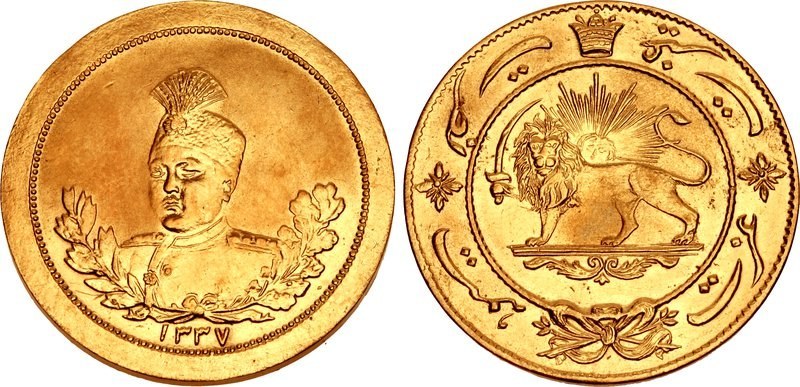
A late Qajar gold 5 Tomans of Persia showing Ahmad Shah Qajar in a laurel wreath and the national Lion emblem, dated 1299.
- Country
- Persia (Iran)
- Denomination
- 5 Tomans
- Metal
- Gold
Got a coin like this?
Identify any coin from a photo, free.
Overview
The Qajar 5 Tomans is a large gold coin of Persia (modern Iran), representing one of the highest denominations of the late Qajar monetary system. The example shown carries a laurel-wreathed portrait bust of Ahmad Shah Qajar on the obverse with the date 1299, and the national heraldic Lion within a circular design and decorative border on the reverse.
The toman was the principal gold unit of Qajar Persia, with one toman equal to ten silver krans. A 5 Tomans piece therefore sat near the top of the denominational range and was struck in gold, making it a substantial and prestigious coin rather than an everyday circulating piece.
As a European-style portrait coin bearing the ruler's laurelled bust, this issue reflects the Westernizing die-engraving conventions adopted by the late Qajar mint. It is often described in the trade as a commemorative or presentation-style gold piece because of its large size, high denomination, and formal royal portraiture.
History & Background
The Qajar dynasty ruled Persia from 1789 to 1925. Ahmad Shah Qajar, whose portrait appears on this coin, was the seventh and last Qajar monarch; he came to the throne as a boy in 1909, was formally crowned in 1914, and was deposed in 1925 when Reza Khan founded the Pahlavi dynasty. Coinage of his reign frequently shows a laurel-wreathed royal bust in the European manner.
The date 1299 on the obverse is read on late Qajar gold using the Solar Hijri (Shamsi) calendar, which places the coin at roughly 1920 CE, within Ahmad Shah's reign. Late Qajar Persia was a period of financial strain and foreign influence, and large gold denominations such as the 5 Tomans functioned partly as stores of value and instruments of state prestige.
The reverse Lion is part of the Lion and Sun (Shir o Khorshid), the historic national emblem of Persia. Rendered here as a crowned heraldic lion within a circular frame and ornamental border, it signals the coin's official state character and its place within the long tradition of Persian royal iconography.
How to Identify
This is a gold coin of high denomination, so expect a warm yellow-gold color, notable heft for its size, and a broad, well-produced flan consistent with a machine-struck late-Qajar issue rather than a small hand-hammered coin.
The obverse shows a portrait bust of Ahmad Shah Qajar encircled by a laurel wreath, accompanied by the numerical date 1299. The reverse displays the heraldic Lion of Persia, shown crowned, set within a circular design and a decorative border. The pairing of a laurelled royal portrait with the national Lion emblem is the core diagnostic combination for this type.
Legends and inscriptions are in Persian (Arabic script), typically naming the ruler and the denomination in tomans. Because 5 Tomans is a large denomination, the coin is bigger and heavier than the more common 1 Toman and 2 Tomans gold pieces; confirming the stated denomination in the legend, alongside the size and weight, helps separate it from the smaller Qajar gold coins.
Value & Collectibility
As a large gold coin, the Qajar 5 Tomans carries significant intrinsic bullion value from its gold content, which sets a substantial floor beneath its price regardless of collector demand. Beyond metal, its numismatic value depends on the specific ruler, date, die variety, and state of preservation.
High-denomination Qajar gold is scarcer than the smaller circulating denominations, and attractive, well-struck examples with clear portraiture and sharp Lion detail command a premium over worn or damaged pieces. Because gold coins of this type were also produced in presentation or commemorative contexts, quality and eye appeal weigh heavily in the market.
Given that pricing turns on gold content, grade, date, and demand among specialists in Persian coinage, values should be treated as ranges and context rather than fixed figures. Authentication and accurate attribution of the ruler and date are the most important factors in establishing what a given 5 Tomans is worth.
Frequently asked questions
What is a toman?
The toman was the principal gold-based unit of Qajar Persia, with one toman equal to ten silver krans. A 5 Tomans piece was one of the higher denominations and was struck in gold.
Who is on this coin?
The obverse shows Ahmad Shah Qajar, the last monarch of the Qajar dynasty, who reigned from 1909 until he was deposed in 1925. He is depicted as a laurel-wreathed portrait bust.
What does the date 1299 mean?
On late Qajar gold the date is read using the Solar Hijri (Shamsi) calendar, so 1299 corresponds to roughly 1920 CE, which falls within Ahmad Shah's reign.
What is the lion on the reverse?
The lion is part of the Lion and Sun (Shir o Khorshid), the historic national emblem of Persia. Here it appears as a crowned heraldic lion within a circular design and decorative border.
Is a Qajar 5 Tomans valuable?
Yes, meaningfully so. Being a large gold coin it has substantial bullion value, and as a scarce high denomination it can carry a numismatic premium depending on ruler, date, grade, and demand.
Qajar 5 Tomans Commemorative guides
In-depth guides for identifying, valuing, and collecting Qajar 5 Tomans Commemorative.
Qajar 5 Tomans Commemorative identified by the community
Real coins identified with Coin Identifier.
Other coins you may enjoy
Pahlavi Reign Gold Medal
1971
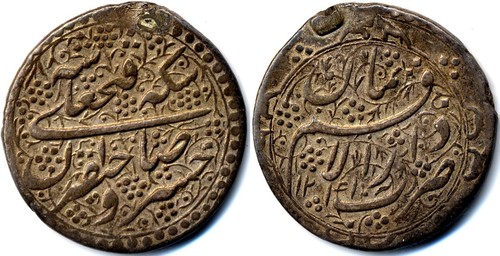
Qiran of Fath-Ali Shah Qajar
AH 1240–1241 (AD 1825–1826)
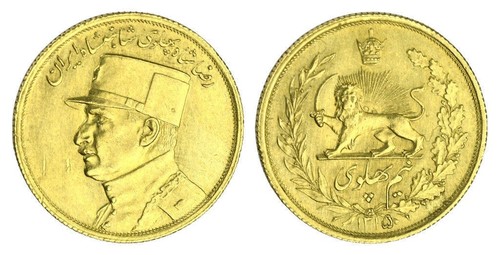
Half Pahlavi Gold Coin
1920s–1930s (Reza Shah era)
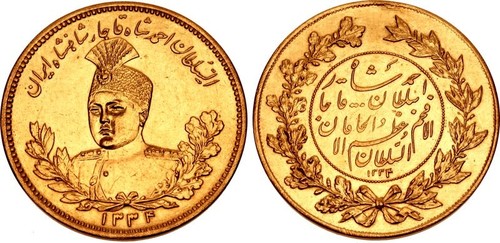
Gold Toman of Ahmad Shah Qajar
Qajar dynasty; Ahmad Shah's reign AH 1327–1344 (1909–1925 CE)
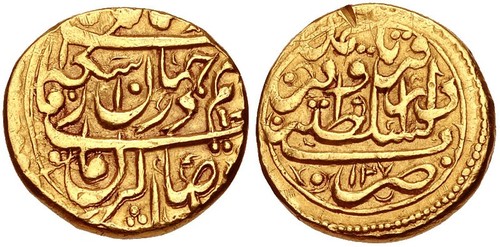
Gold Toman of Agha Mohammad Khan Qajar
1792–1793 CE (AH 1206–1207)
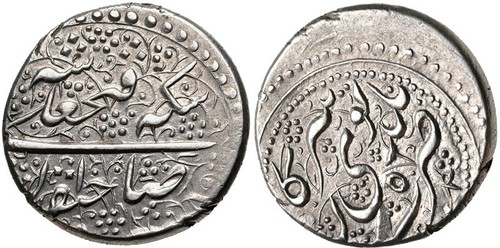
Gold Toman of Fath-Ali Shah Qajar
1811–1812 CE (AH 1226–1227)
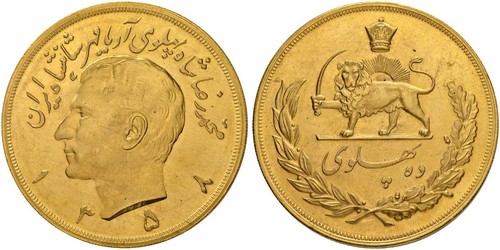
10 Pahlavi Gold Coin
Struck under Mohammad Reza Shah Pahlavi; the example shown is dated 1979 (Imperial year 2537–2538 SH)
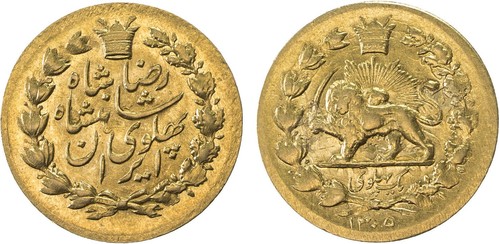
1 Pahlavi Gold Coin
Pahlavi dynasty, mid-20th century (issues commonly dated to the 1950s–1970s)
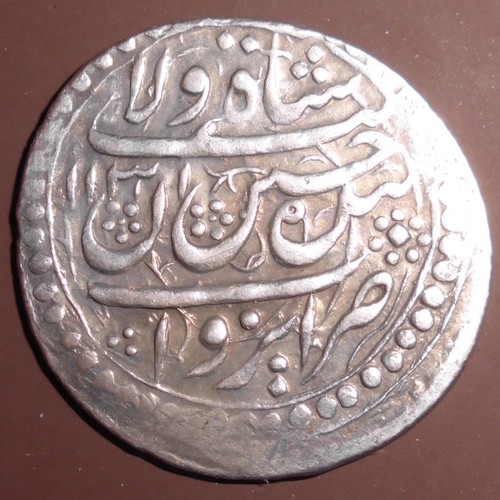
Abbasi of Shah Sultan Husayn
Reign of Shah Sultan Husayn, AH 1105–1135 (1694–1722 CE)