How to Identify the Qajar 5 Tomans Commemorative
A collector's guide to attributing a Qajar gold 5 Tomans: the laurelled Ahmad Shah portrait, the crowned Lion reverse, date reading, size and metal, and fakes.
Read the full Qajar 5 Tomans Commemorative encyclopedia entry →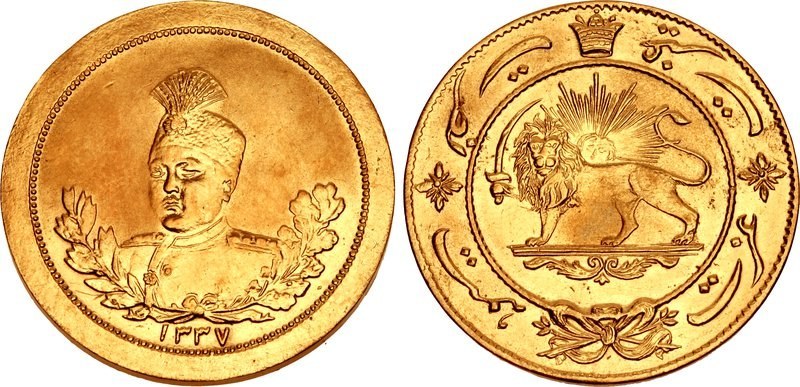
Begin with the two defining devices. A Qajar 5 Tomans of this type pairs a laurel-wreathed portrait bust of Ahmad Shah Qajar on the obverse with the crowned heraldic Lion of Persia on the reverse, the latter set inside a circular design and an ornamental border. If both faces show this portrait-and-Lion combination, you are on the right track; a coin with only inscriptions and no portrait, or with a full Lion and Sun scene, points to a different Persian type.
Read the date and denomination. The obverse carries the numerical date 1299, which on late Qajar gold is read in the Solar Hijri calendar and places the coin around 1920 CE, within Ahmad Shah's reign. The Persian legends should also state the denomination in tomans; confirming that it reads five tomans is essential, because the same portrait-and-Lion design was used across the smaller 1 Toman and 2 Tomans gold denominations.
Check the physical coin carefully. This is a gold piece, so it should show a warm yellow color, feel dense and heavy for its diameter, and lack any magnetic response. The 5 Tomans is physically larger and heavier than the lower gold denominations, so size and weight are among the quickest ways to separate it from a 1 or 2 Tomans bearing similar imagery. A known reference weight and diameter for the denomination is a valuable cross-check.
Be alert to look-alikes and to counterfeits. Because these are high-value gold coins, they are targets for forgery, including cast copies, modern restrikes, and gold-plated base-metal fakes. Warning signs include incorrect weight or diameter, soft or blurry portrait and Lion detail, casting seams or bubbles, a dull or coppery tone under the plating, and lettering that does not match genuine dies. Any deviation in size, weight, or fineness from the published standard for the denomination is a serious red flag.
For a coin of this value, verify before you trust. Compare the portrait style, Lion design, legends, and date against a specialist catalog of Qajar gold, and for any significant purchase seek authentication and, ideally, third-party grading. Correctly confirming the ruler, the denomination in tomans, and the date is what turns a general 'Qajar gold coin' into a specific, defensible attribution.
Frequently asked questions
How do I tell a 5 Tomans from a 1 or 2 Tomans?
They can share the same portrait-and-Lion design, so rely on the denomination stated in the Persian legend plus the physical size and weight. The 5 Tomans is notably larger and heavier than the lower gold denominations.
How do I read the date?
The obverse shows the numeral 1299. On late Qajar gold this is read in the Solar Hijri (Shamsi) calendar, giving roughly 1920 CE, consistent with Ahmad Shah Qajar's reign.
How can I check that it is really gold?
Genuine pieces show a warm yellow-gold color, are dense and heavy for their size, and are non-magnetic. Confirm the coin's weight and diameter against the published standard; a mismatch suggests a plated or cast fake.
Why are fakes a concern with this coin?
Because it is a high-value gold denomination, it attracts counterfeits including cast copies, restrikes, and plated forgeries. Soft detail, casting seams, wrong weight or size, and off-color surfaces are all warning signs; authenticate significant pieces before buying.
Qajar 5 Tomans Commemorative identified by the community
Recent Qajar 5 Tomans Commemorative coins identified with Coin Identifier.