
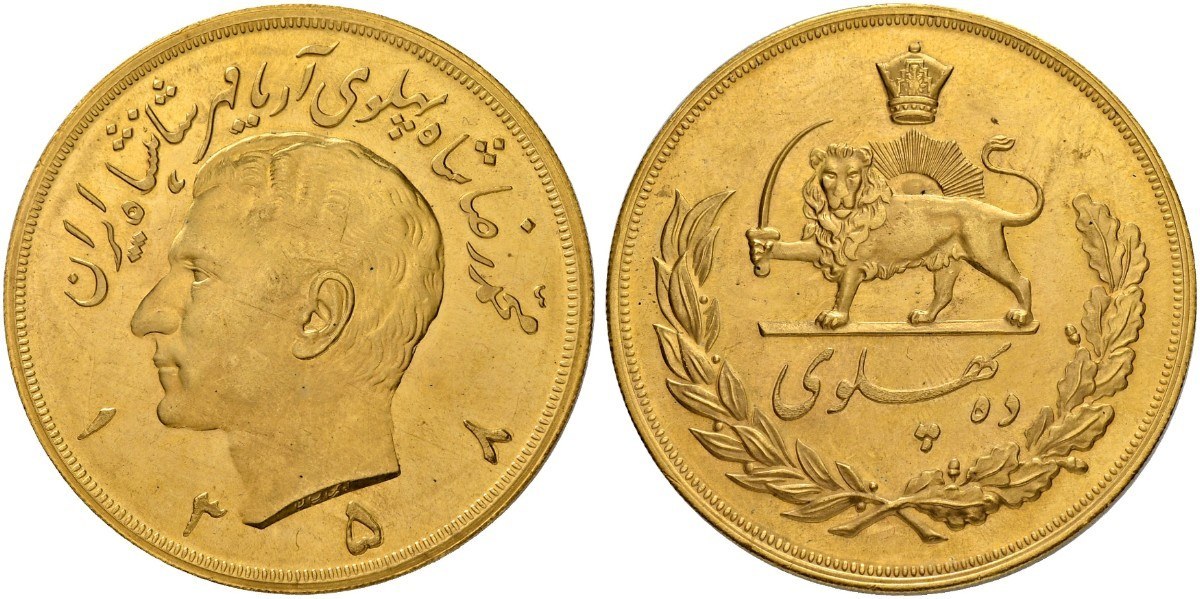
10 Pahlavi Gold Coin
A large gold coin of Imperial Iran valued at ten Pahlavi, showing Mohammad Reza Shah on the obverse and the crowned Lion and Sun on the reverse.
- Country
- Iran
- Denomination
- 10 Pahlavi
- Metal
- Gold
Got a coin like this?
Identify any coin from a photo, free.
Overview
The 10 Pahlavi is the largest of the modern Iranian Pahlavi gold coins, a heavy bullion-style piece struck under Mohammad Reza Shah Pahlavi. The example shown carries his uniformed left-facing portrait on the obverse and the crowned Lion and Sun of Iran flanked by laurel wreaths on the reverse, with Persian inscriptions and the date.
The Pahlavi was Iran's gold coin denomination during the twentieth-century monarchy, issued in fractions and multiples that included the quarter, half, one, two-and-a-half, five, and ten Pahlavi. As the top multiple, the 10 Pahlavi is a substantial gold coin held mainly for its metal value and as a store of wealth rather than for everyday circulation.
The date on this piece is expressed in Iran's Imperial (Shahanshahi) calendar, which the government briefly adopted in the mid-1970s in place of the usual solar Hijri years. A reading such as 2537 or 2538 corresponds to the late 1970s CE, near the very end of Pahlavi rule.
History & Background
The Pahlavi dynasty ruled Iran from 1925 to 1979, and gold Pahlavi coins were introduced under Reza Shah before continuing under his son, Mohammad Reza Shah Pahlavi, who reigned from 1941 until the Islamic Revolution of 1979. Over that period the coins carried the reigning shah's portrait together with the national Lion and Sun emblem, a symbol of Iranian statehood used on flags, seals, and coinage.
The multi-denomination gold Pahlavi series functioned partly as circulating money and increasingly as an official bullion and savings instrument, giving Iranians a trusted, government-guaranteed way to hold gold. The 10 Pahlavi, as the largest denomination, was the flagship of this series.
In 1976 the Iranian government replaced the solar Hijri calendar with an Imperial calendar counted from the founding of the Achaemenid Persian empire, so coins of the following few years bear dates in the 2530s rather than in the 1350s. The 2537–2538 dating of this coin places it in roughly 1978–1979, the closing years of the monarchy; after the 1979 revolution the shah's portrait and the royal Lion and Sun were removed from Iranian coinage.
How to Identify
The 10 Pahlavi is a large, thick gold coin with the warm yellow color of high-purity gold. Pahlavi gold was struck in a fixed fineness, so on this top denomination the flan is noticeably heavy and broad compared with the smaller Pahlavi fractions; size and weight are among the quickest ways to tell the 10 Pahlavi from a 5, 2.5, or 1 Pahlavi of the same design.
The obverse shows the bare-headed, left-facing bust of Mohammad Reza Shah Pahlavi in a military-style uniform, encircled by a Persian legend naming him and his titles. The reverse displays the crowned Lion holding a sword with the rising Sun behind it, set between laurel or olive branches, with the denomination and the date in Persian numerals below.
Attribution rests on reading the Persian legends and, above all, the date. Because these coins can be dated in either the solar Hijri or the Imperial calendar, a date in the 2530s (such as 2537 or 2538) signals an Imperial-calendar issue of the late 1970s. Matching the portrait, the denomination wording, and the date against a reference for Mohammad Reza Shah's gold coinage confirms both the type and the year.
Value & Collectibility
The 10 Pahlavi is fundamentally a gold bullion coin, so its value is anchored to its substantial gold content and moves with the international gold price. Because it is the largest Pahlavi denomination, it contains far more gold than the common one Pahlavi, and its price is correspondingly higher.
Beyond metal value, factors such as the specific date, overall preservation, and originality of surfaces affect what a given coin brings. Some dates and finishes are scarcer than others, and pieces that have been cleaned, mounted as jewelry, or damaged trade at a discount to clean, original examples. Certified problem-free coins generally command the strongest prices.
Because pricing is driven mainly by the gold market and by date and condition among collectors, figures should be treated as general context rather than fixed quotes. For a coin like this, confirming that it is genuine, unmounted gold of full weight is the single biggest factor in its value.
Frequently asked questions
How much gold is in a 10 Pahlavi coin?
The 10 Pahlavi is the largest Pahlavi gold denomination and contains roughly ten times the gold of a one Pahlavi coin, making it a substantial bullion piece. Its worth is anchored mainly to its gold content and the current gold price.
Who is on the coin?
The obverse portrait is Mohammad Reza Shah Pahlavi, who reigned as Shah of Iran from 1941 until the 1979 revolution. He is shown bare-headed and facing left in a military-style uniform.
What is the lion and sun on the reverse?
It is the Lion and Sun, the historic national emblem of Iran. On this coin the lion holds a sword with a rising sun behind it and wears a crown, flanked by laurel branches, representing the Iranian monarchy and state.
Why is the date in the 2500s?
In 1976 Iran adopted an Imperial calendar counted from the founding of the Achaemenid empire, so late-1970s coins are dated in the 2530s. A date of 2537 or 2538 corresponds to about 1978–1979 CE.
Is a 10 Pahlavi gold coin valuable?
Yes. As a large gold coin its value tracks the gold price and is well above that of the smaller Pahlavi fractions. Date, condition, and whether the coin is original and unmounted then determine the premium over melt.
10 Pahlavi Gold Coin guides
In-depth guides for identifying, valuing, and collecting 10 Pahlavi Gold Coin.
Other coins you may enjoy
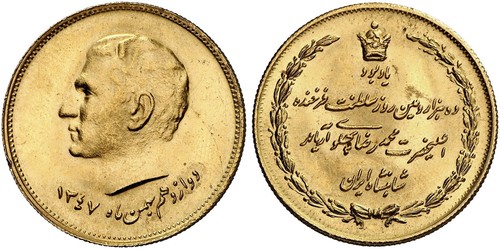
Pahlavi Reign Gold Medal
1971
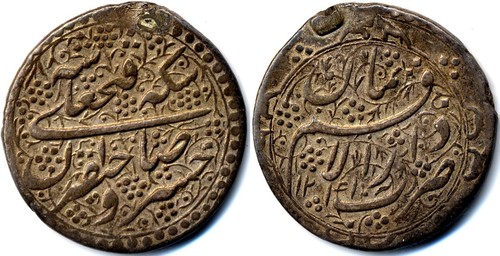
Qiran of Fath-Ali Shah Qajar
AH 1240–1241 (AD 1825–1826)
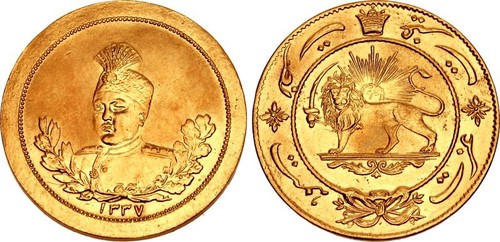
Qajar 5 Tomans Commemorative
Late Qajar period; dated 1299 (Solar Hijri, c. 1920 CE), reign of Ahmad Shah Qajar (1909–1925)
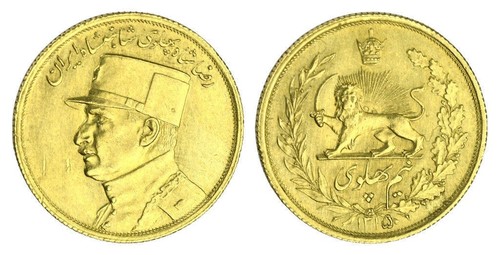
Half Pahlavi Gold Coin
1920s–1930s (Reza Shah era)
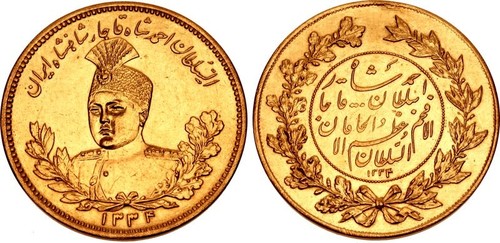
Gold Toman of Ahmad Shah Qajar
Qajar dynasty; Ahmad Shah's reign AH 1327–1344 (1909–1925 CE)
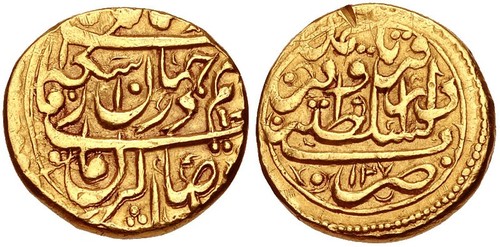
Gold Toman of Agha Mohammad Khan Qajar
1792–1793 CE (AH 1206–1207)
Gold Toman of Fath-Ali Shah Qajar
1811–1812 CE (AH 1226–1227)
1 Pahlavi Gold Coin
Pahlavi dynasty, mid-20th century (issues commonly dated to the 1950s–1970s)
Abbasi of Shah Sultan Husayn
Reign of Shah Sultan Husayn, AH 1105–1135 (1694–1722 CE)