
How to Identify the 10 Pahlavi Gold Coin
A collector's guide to recognizing the 10 Pahlavi: the shah's portrait, the crowned Lion and Sun, its large gold flan, the Imperial-calendar date, and look-alikes.
Read the full 10 Pahlavi Gold Coin encyclopedia entry →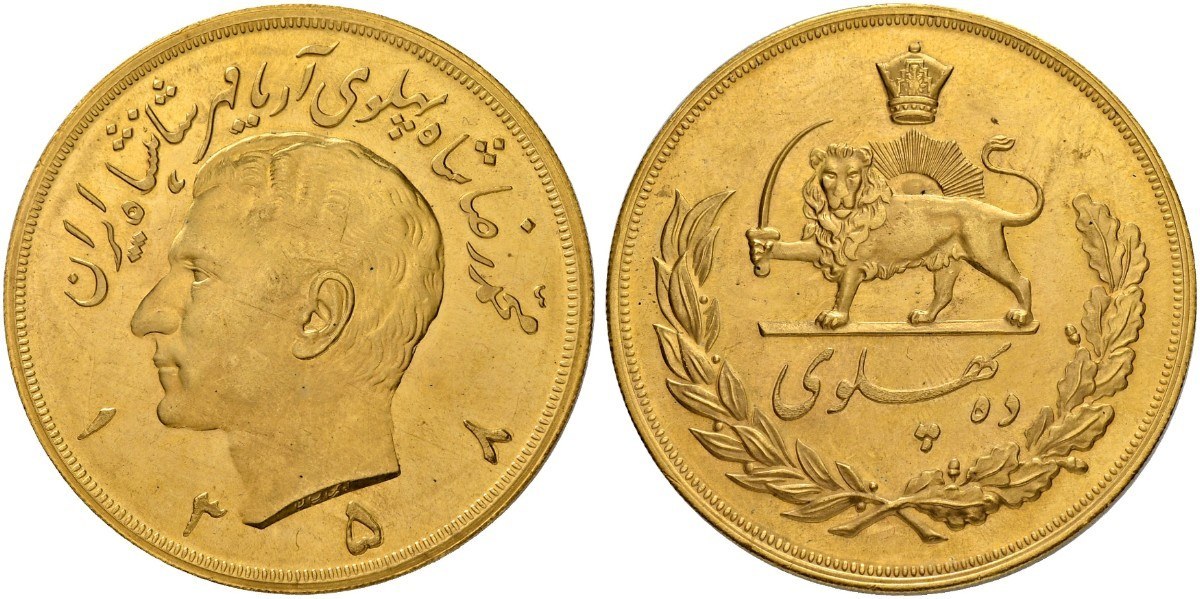
Start with size, color, and weight. The 10 Pahlavi is the largest coin in the Pahlavi gold series, so it is a broad, heavy piece with the rich yellow color of high-fineness gold. Its heft is the fastest way to separate it from the visually identical but much smaller 1, 2.5, and 5 Pahlavi coins, which share the same portrait-and-emblem design at reduced diameters and weights. If a coin looks like a Pahlavi but is light or thin, it is a lower denomination, not a 10 Pahlavi.
Confirm the two designs. The obverse must show the bare-headed, left-facing bust of Mohammad Reza Shah Pahlavi in a military-style uniform, ringed by a Persian legend. The reverse must show the crowned Lion holding a sword with the rising Sun behind it, set between laurel branches, with the denomination and date in Persian numerals. Both faces are inscribed only in Persian; there is no Western lettering and no mint mark in the European sense, so attribution comes from the legends themselves.
Read the date carefully, because Pahlavi gold uses two calendars. Most issues are dated in the solar Hijri era (years in the 1300s), but coins of the mid-to-late 1970s can instead carry Imperial (Shahanshahi) dates in the 2530s. A date such as 2537 or 2538, as on this example, is an Imperial-calendar year corresponding to roughly 1978–1979 CE. Knowing which calendar you are reading prevents mis-dating the coin by centuries.
Watch for look-alikes and altered pieces. The same portrait and Lion-and-Sun appear across the whole Pahlavi fractional series, so denomination is set by size and by the numeral of the denomination in the legend, not by the design alone. Coins that have been mounted in jewelry, polished, or re-engraved are common for gold of this kind; look for solder traces, filed edges, brightened or hairlined fields, and softened detail that indicate handling or repair.
Apply basic authentication. Genuine Pahlavi gold is struck to a consistent standard, so a piece that is off in diameter, thickness, or weight for the 10 Pahlavi, or that has a wrong color suggesting low gold content, should be treated with caution as counterfeits of popular gold coins exist. Because the value is tied to gold content, verifying weight and dimensions against published specifications, and using a specialist or assay when in doubt, is the safest path before buying or selling.
Frequently asked questions
How do I tell a 10 Pahlavi from a 5 or 1 Pahlavi?
They share the same portrait and Lion-and-Sun design, so the difference is size and the denomination wording. The 10 Pahlavi is the largest and heaviest of the series; the smaller values have proportionally reduced diameter and weight.
What date should I expect to see?
Pahlavi gold is dated in either the solar Hijri calendar (1300s) or the Imperial calendar (2500s). This example reads in the 2530s (2537–2538), an Imperial-calendar dating that corresponds to about 1978–1979 CE.
Is there a mint mark to look for?
Not in the Western sense. These coins were struck at the Imperial Mint and identified through their Persian legends and design rather than by a letter mint mark, so attribution comes from reading the inscriptions and date.
How can I check that it is genuine gold?
Compare the coin's weight and dimensions against published specifications for the 10 Pahlavi, watch for a wrong color or light weight, and check for signs of mounting or repair. For valuable gold, confirm authenticity with a specialist or an assay when in doubt.