
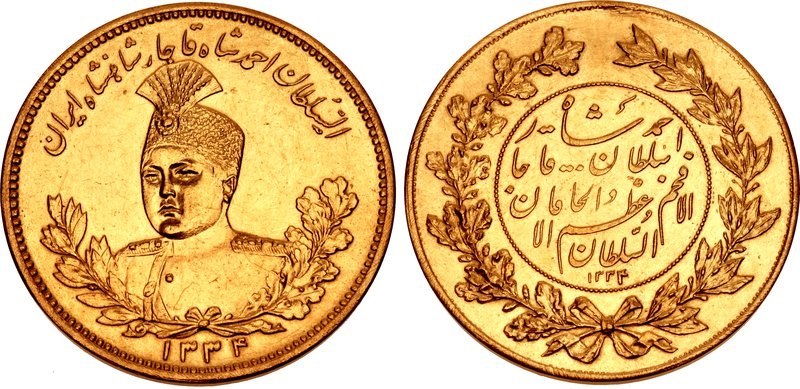
Gold Toman of Ahmad Shah Qajar
A Qajar-era gold toman bearing the portrait bust and tall headdress of Ahmad Shah, with Persian legends, date and mint, and a wreathed calligraphic reverse.
- Country
- Persia (Iran)
- Denomination
- Toman
- Metal
- Gold
Got a coin like this?
Identify any coin from a photo, free.
Overview
The gold toman of Ahmad Shah Qajar is a Persian gold coin struck under the last shah of the Qajar dynasty, which ruled Iran until 1925. The example shown carries a portrait bust of the ruler wearing a tall headdress on the obverse, together with a date and mint designation, while the reverse presents inscribed Persian calligraphy set within a cartouche and framed by decorative wreaths.
The toman was the principal gold denomination of Qajar Iran, standing at the top of the monetary system above the silver kran. Gold tomans functioned as high-value coinage for large transactions, savings, and prestige, and they were struck in relatively limited numbers compared with the everyday silver and copper coins.
This piece belongs to the machine-struck phase of Qajar coinage, when Iranian mints adopted European-style presses to produce neat, round coins with a raised portrait and finely engraved legends. The combination of a royal portrait, Persian inscriptions, and a wreathed reverse is characteristic of the later Qajar gold series.
History & Background
The Qajar dynasty ruled Persia from 1789 to 1925, a period during which the country modernized its coinage and moved from hand-struck to machine-struck production. Ahmad Shah Qajar was the dynasty's final ruler, reigning from 1909 to 1925 before the Qajars were replaced by the Pahlavi dynasty under Reza Shah.
Under the later Qajars, gold tomans typically carried a portrait of the reigning shah, a departure from the earlier aniconic Islamic tradition and a reflection of European influence on Persian coin design. The ruler is generally shown in a bust wearing the distinctive tall Persian headdress or crown, surrounded by his titles, with the mint and the Hijri date worked into the legend.
Coins of this era document a monarchy under growing internal and foreign pressure. Persian gold circulated alongside foreign trade coins, and the toman remained a symbol of state authority and wealth. With the fall of the Qajars, later Iranian gold was struck under the Pahlavi shahs, making Qajar tomans a distinct and closing chapter of Persia's dynastic coinage.
How to Identify
This is a round, machine-struck gold coin. The obverse is dominated by a portrait bust of the shah facing to one side, wearing a tall headdress, with Persian inscriptions giving his name and titles and, as part of the surrounding legend, a mint designation and a date. The neat, evenly centered strike and raised relief distinguish it from earlier hand-struck Persian coinage.
The reverse carries Persian calligraphy contained within a cartouche or central panel, encircled by decorative wreaths or sprays. Dates are expressed in the Islamic (Hijri) calendar using Persian-Arabic numerals rather than Western figures, and the mint name is spelled out in the legend rather than shown as a symbol.
Gold gives the coin a warm yellow tone and a substantial feel for its size; genuine tomans are noticeably dense. Attribution rests on reading the ruler's name and titles in the obverse legend, together with the mint and Hijri date, which place the coin within Ahmad Shah's reign and the wider Qajar gold series. The presence of a royal portrait rather than purely aniconic text marks it as a later Qajar issue.
Value & Collectibility
As a gold coin, the toman of Ahmad Shah Qajar carries an intrinsic precious-metal value that sets a floor beneath its price, so even a worn example is worth well more than base-metal coins of the period. Its collector value then depends on how far it rises above that bullion baseline.
Price within the series turns on the specific date and mint, the denomination or weight of the toman, the sharpness of the portrait and legends, and overall preservation. Well-struck coins with a clear portrait, full readable inscriptions, and attractive surfaces command more than worn, scratched, mounted, or ex-jewelry pieces. Because gold coins were sometimes used in jewelry, watch for solder marks or edge damage that reduce value.
Given that pricing depends on gold content, grade, and demand among specialists in Persian and Islamic coinage, figures should be treated as general context rather than fixed quotes. A confident reading of the mint and Hijri date, plus a genuine, undamaged gold surface, are the biggest factors in determining a particular coin's interest and value.
Frequently asked questions
What is a toman?
The toman was the principal gold denomination of Qajar Iran, ranking at the top of the monetary system above the silver kran. It was used for high-value transactions, savings, and as a symbol of wealth and state authority.
Who was Ahmad Shah Qajar?
Ahmad Shah was the last ruler of the Qajar dynasty, reigning from 1909 to 1925. His gold coinage typically bears his portrait bust, and after his fall Iran's coinage passed to the Pahlavi dynasty.
Why does this coin have a portrait when many Islamic coins do not?
Later Qajar coinage broke with the older aniconic Islamic tradition and, under European influence, placed a portrait of the reigning shah on the coin, shown in a bust wearing the tall Persian headdress.
Is a Qajar gold toman valuable?
Yes, at minimum for its gold content, which gives even a worn example a substantial baseline value. Collector premiums depend on the date, mint, weight, condition, and whether the coin has been mounted or damaged.
How is the date shown on the coin?
The date is given in the Islamic (Hijri) calendar using Persian-Arabic numerals within the obverse legend, alongside the mint name spelled out in the inscription rather than shown as a symbol.
Gold Toman of Ahmad Shah Qajar guides
In-depth guides for identifying, valuing, and collecting Gold Toman of Ahmad Shah Qajar.
Other coins you may enjoy
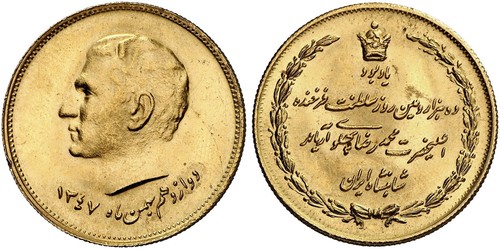
Pahlavi Reign Gold Medal
1971
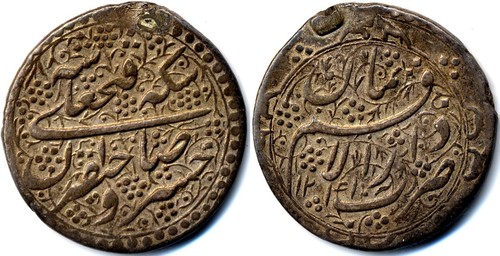
Qiran of Fath-Ali Shah Qajar
AH 1240–1241 (AD 1825–1826)
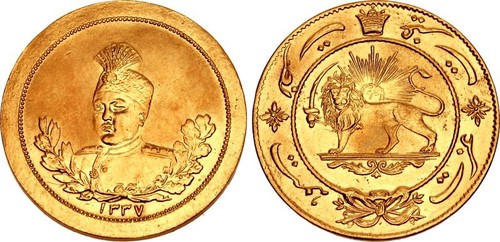
Qajar 5 Tomans Commemorative
Late Qajar period; dated 1299 (Solar Hijri, c. 1920 CE), reign of Ahmad Shah Qajar (1909–1925)
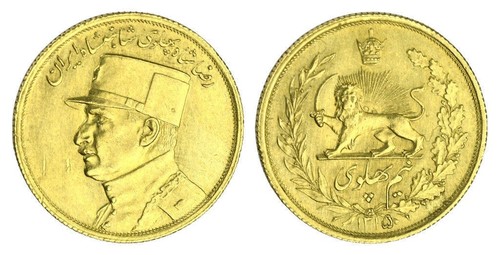
Half Pahlavi Gold Coin
1920s–1930s (Reza Shah era)
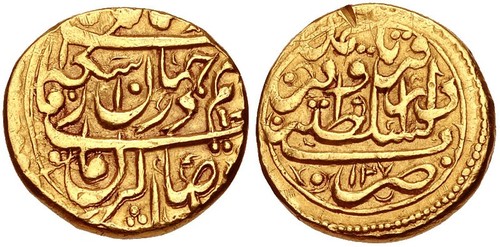
Gold Toman of Agha Mohammad Khan Qajar
1792–1793 CE (AH 1206–1207)
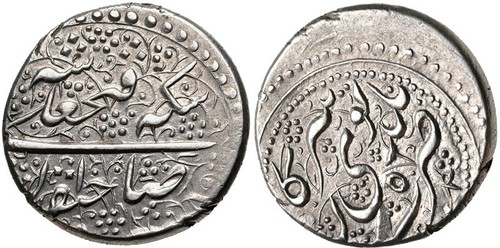
Gold Toman of Fath-Ali Shah Qajar
1811–1812 CE (AH 1226–1227)
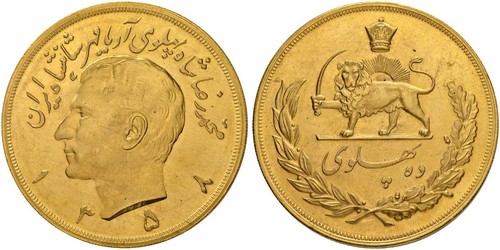
10 Pahlavi Gold Coin
Struck under Mohammad Reza Shah Pahlavi; the example shown is dated 1979 (Imperial year 2537–2538 SH)
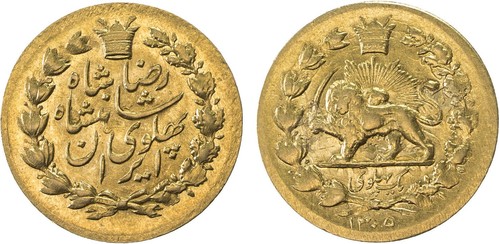
1 Pahlavi Gold Coin
Pahlavi dynasty, mid-20th century (issues commonly dated to the 1950s–1970s)
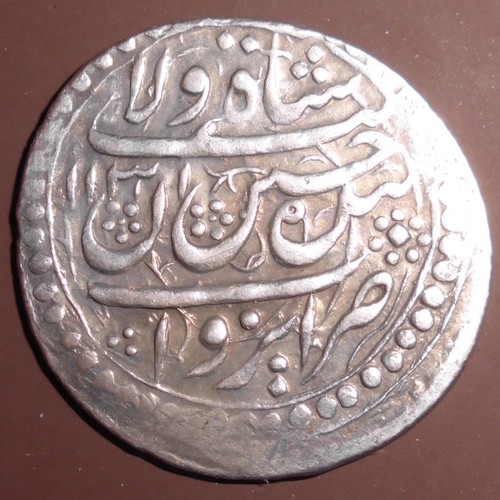
Abbasi of Shah Sultan Husayn
Reign of Shah Sultan Husayn, AH 1105–1135 (1694–1722 CE)