
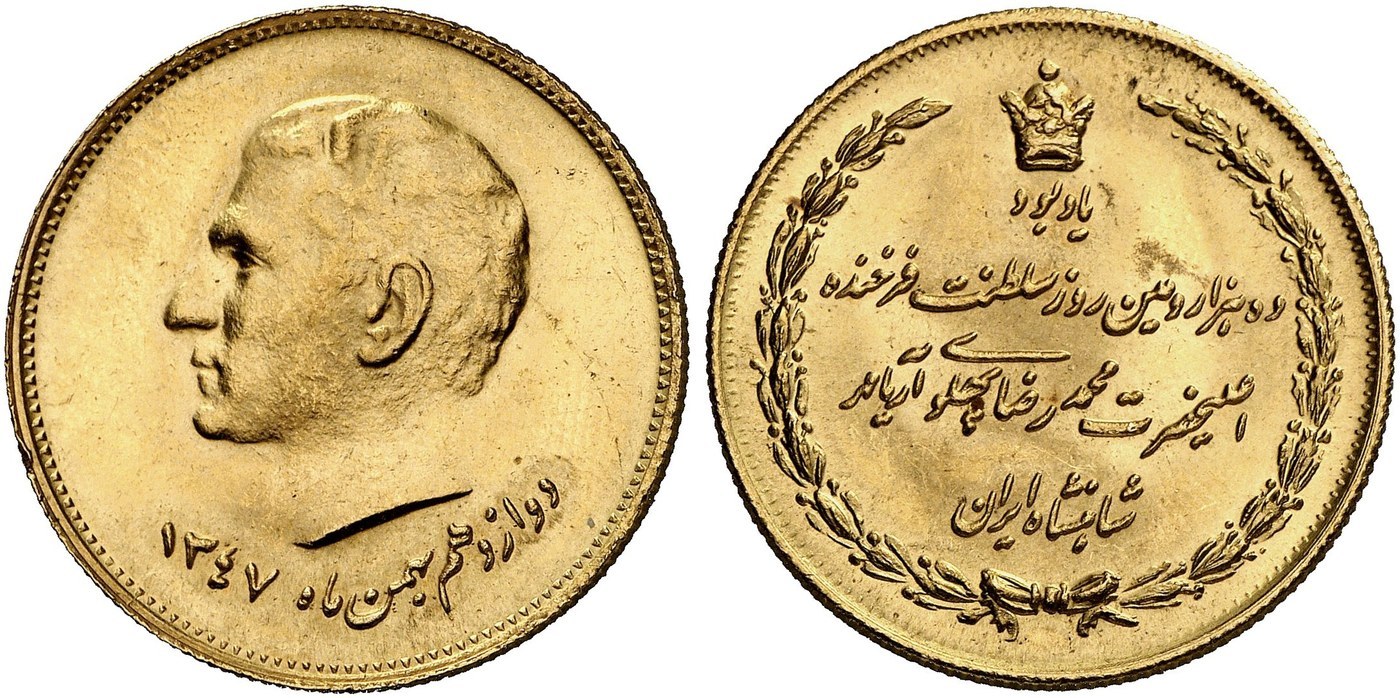
Pahlavi Reign Gold Medal
A gold medal of Pahlavi-era Iran, its obverse a left-facing royal portrait and its reverse the Lion and Sun beneath a crown, dated 1971.
- Country
- Iran
- Denomination
- Gold Medal
- Metal
- Gold
Got a coin like this?
Identify any coin from a photo, free.
Overview
The Pahlavi Reign Gold Medal is a gold medallic piece from Iran under the Pahlavi dynasty. The example shown carries a male portrait in profile facing left on the obverse — the visual language of a modern Iranian sovereign — and, on the reverse, the Lion and Sun (Shir-o-Khorshid) emblem crowned above, flanked by Persian text and laurel wreaths. It is dated 1971.
Because it presents a royal portrait paired with the national Lion and Sun rather than a stated cash denomination, this piece is catalogued as a gold medal rather than as a circulating coin. Its 1971 date places it squarely in the reign of Mohammad Reza Shah Pahlavi, the year Iran staged its celebrations for the 2,500th anniversary of the founding of the Persian Empire.
Medals of this kind were struck as commemorative, presentation and keepsake objects rather than as everyday money. Treat the description here as a record of what the piece depicts; confirm the exact issue, weight and fineness against specialist references and testing before relying on any single attribution.
History & Background
The Pahlavi dynasty ruled Iran from 1925 to 1979, spanning Reza Shah Pahlavi and his son Mohammad Reza Shah Pahlavi. The dynasty presented itself as heir to Iran's ancient imperial past while pursuing modernization, and it made heavy use of the Lion and Sun — a national emblem of long standing in Persia — surmounted by a crown to signify the monarchy.
The 1971 date is significant. In October 1971 Mohammad Reza Shah hosted lavish celebrations at Persepolis and Pasargadae marking 2,500 years since the founding of the Persian Empire by Cyrus the Great. The occasion produced a range of official and semi-official commemorative material, including gold and silver medals and coins bearing royal portraiture and imperial symbolism, of which a crowned Lion and Sun with laurel wreaths is entirely characteristic.
Against that backdrop, a portrait-and-emblem gold medal dated 1971 fits the wave of Pahlavi prestige and anniversary issues of the period. The precise program a given piece belongs to — and whether it is an official mint product or a later commemorative — must be settled by reading its Persian legends and comparing it to documented examples rather than by the imagery alone.
How to Identify
Begin with the obverse: a left-facing profile portrait of a man, the standard way Pahlavi-era Iran depicted its ruler. Note the truncation of the bust, any surrounding Persian legend and the style of the portrait, all of which help fix the issue and, potentially, the identity of the figure shown.
Turn to the reverse, whose defining feature is the Lion and Sun (Shir-o-Khorshid) beneath a crown, framed by laurel wreaths with Persian text. This crowned Lion and Sun is the emblem of Imperial Iran and is the single strongest clue that a piece belongs to the Pahlavi period. Record the wording of the legends and the date exactly as they appear.
Because no cash denomination is stated and the design is medallic rather than that of a standard rial or toman coin, do not assume a catalog number or value from appearance alone. Measure the diameter and weight, check for edge lettering, and remember that gold color is not proof of gold content. This entry reflects the piece as photographed; verify the metal and the specific issue with a specialist before treating any attribution as final.
Value & Collectibility
Value for a piece like this hinges on exactly what it is — an official Pahlavi mint medal, a 2,500th-anniversary commemorative, a later restrike, or a private or souvenir piece — and that can only be resolved from the legends, fabric and provenance rather than the imagery alone. Attribution therefore matters far more here than for common circulating coins.
If the piece is genuinely gold, it carries at least a bullion value tied to its weight and fineness, with any collector premium resting on rarity, the appeal of Pahlavi and 2,500th-anniversary material, condition and documented provenance. Well-documented Imperial Iranian gold with clear association to the 1971 celebrations can be desirable to collectors of Persian and world gold.
Because royal-portrait "imperial gold" is an area where commemorative medals, restrikes, gilt tokens and outright fakes circulate, treat any figure as general context only. Obtain independent metal testing and a specialist opinion before assigning a firm value or paying a numismatic premium.
Frequently asked questions
Who issued this medal and when?
It is a gold medal from Pahlavi-dynasty Iran, dated 1971 — the reign of Mohammad Reza Shah Pahlavi and the year of Iran's 2,500th-anniversary celebrations of the Persian Empire. The exact issuing program should be confirmed from its Persian legends.
What is the emblem on the reverse?
It is the Lion and Sun (Shir-o-Khorshid) beneath a crown, framed by laurel wreaths — the national and imperial emblem of Iran under the monarchy, and the clearest sign that the piece belongs to the Pahlavi period.
Is it a coin or a medal?
It is described here as a gold medal because it shows a royal portrait and the imperial emblem rather than a stated cash denomination. Recording its weight, diameter and legends helps confirm whether it is medallic or a denominated coin.
Who is the man on the obverse?
The obverse shows a left-facing male portrait consistent with Pahlavi royal imagery. Given the 1971 date it is most naturally associated with Mohammad Reza Shah Pahlavi, but the exact identification should be verified from the coin's legends.
Is it solid gold?
It is described as gold based on appearance, but color alone does not prove gold content. Only weighing, measuring and professional metal testing can confirm the metal and fineness.
Pahlavi Reign Gold Medal guides
In-depth guides for identifying, valuing, and collecting Pahlavi Reign Gold Medal.
Other coins you may enjoy
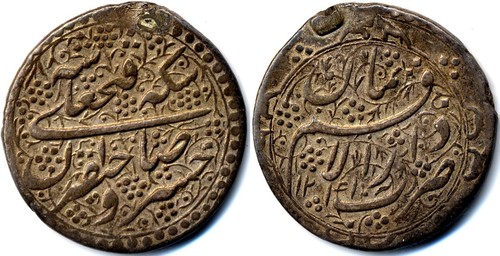
Qiran of Fath-Ali Shah Qajar
AH 1240–1241 (AD 1825–1826)
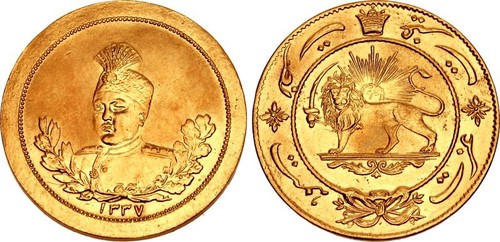
Qajar 5 Tomans Commemorative
Late Qajar period; dated 1299 (Solar Hijri, c. 1920 CE), reign of Ahmad Shah Qajar (1909–1925)
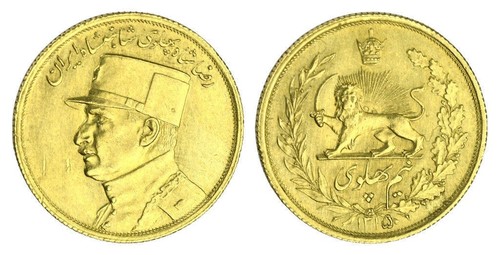
Half Pahlavi Gold Coin
1920s–1930s (Reza Shah era)
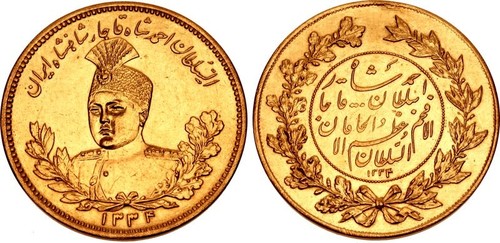
Gold Toman of Ahmad Shah Qajar
Qajar dynasty; Ahmad Shah's reign AH 1327–1344 (1909–1925 CE)
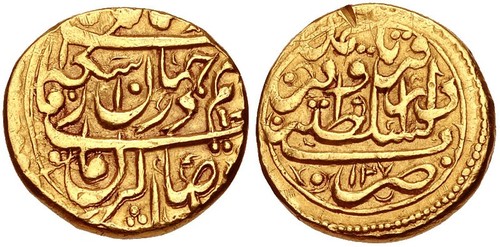
Gold Toman of Agha Mohammad Khan Qajar
1792–1793 CE (AH 1206–1207)
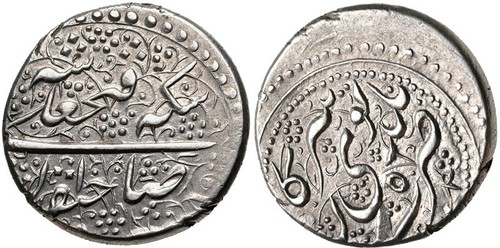
Gold Toman of Fath-Ali Shah Qajar
1811–1812 CE (AH 1226–1227)
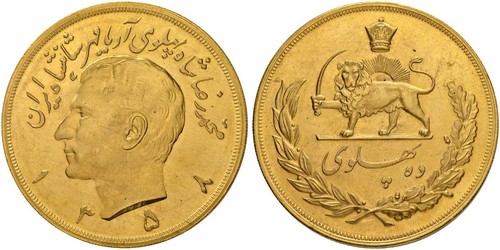
10 Pahlavi Gold Coin
Struck under Mohammad Reza Shah Pahlavi; the example shown is dated 1979 (Imperial year 2537–2538 SH)
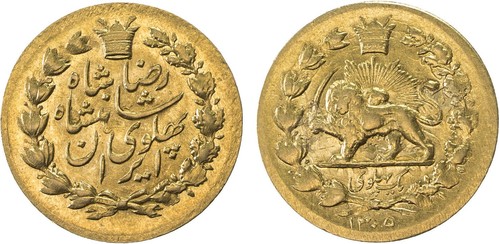
1 Pahlavi Gold Coin
Pahlavi dynasty, mid-20th century (issues commonly dated to the 1950s–1970s)
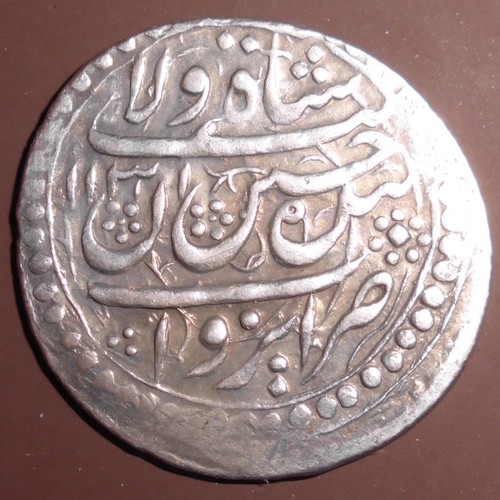
Abbasi of Shah Sultan Husayn
Reign of Shah Sultan Husayn, AH 1105–1135 (1694–1722 CE)