
How to Identify the Gold Toman of Ahmad Shah Qajar
A collector's guide to attributing a Qajar gold toman: reading the portrait, Persian legends, mint and Hijri date, judging the gold, and spotting look-alikes and fakes.
Read the full Gold Toman of Ahmad Shah Qajar encyclopedia entry →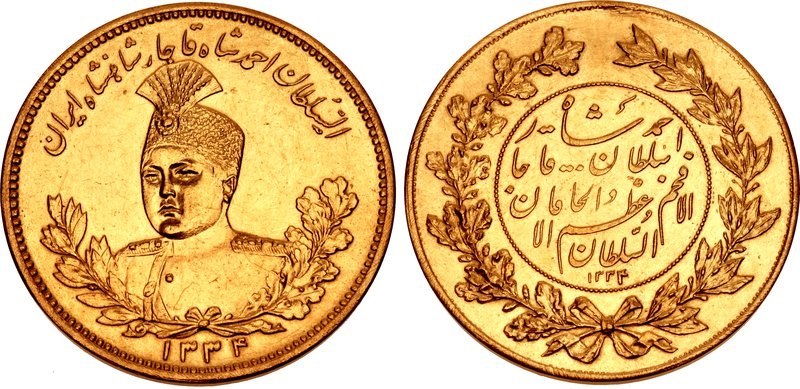
Begin with the overall type. A Qajar gold toman of this style is a round, machine-struck gold coin with a portrait bust of the shah on the obverse, shown wearing a tall Persian headdress and surrounded by Persian inscriptions. The reverse holds Persian calligraphy inside a cartouche framed by decorative wreaths. A neat, even strike, raised relief, and a warm yellow metal are the first signs you are looking at a later Qajar gold issue rather than an earlier hand-struck or base-metal coin.
Read the obverse legend to attribute the piece. The ruler's name and royal titles run around the portrait, and the mint-and-date formula names where the coin was struck and gives the year in the Islamic (Hijri) calendar, written with Persian-Arabic numerals rather than Western figures. Matching the shah's name against a reference confirms an attribution to Ahmad Shah, while the mint and Hijri year pin the coin to a specific issue within his reign.
Check the metal and physical feel. Gold is dense, so a genuine toman feels heavy for its size and shows a soft, warm yellow color without the gray or reddish tones of silver or copper. Note the diameter and weight, since tomans were struck in different denominations or fractions; recording these helps distinguish one gold value from another and flags underweight or plated fakes.
Be alert to look-alikes and mounting damage. Other Qajar shahs and later Pahlavi rulers struck superficially similar portrait gold, so the specific name in the legend, not the general portrait style, is what identifies the coin as Ahmad Shah's. Because gold coins were often worn as jewelry, inspect the edge and fields for solder traces, filing, or a removed loop, all of which affect authenticity and value.
Apply sensible authentication checks. Compare the portrait style, legends, and layout against catalog images of genuine Qajar tomans, and weigh and measure the coin against published standards. Be cautious of cast copies with soft, blurry detail or seams, gold-plated base-metal fakes that feel light, and modern replicas. When the legend cannot be read clearly or the weight is wrong, seek an expert opinion in Persian or Islamic coinage before accepting a firm attribution.
Frequently asked questions
How do I know the coin shows Ahmad Shah rather than another Qajar ruler?
Several Qajar shahs issued similar portrait gold, so the portrait alone is not enough. Read the ruler's name and titles in the obverse legend and match them against a reference; the name, together with the mint and Hijri date, confirms the attribution.
Where are the mint and date on the coin?
Both appear in the obverse legend around the portrait as part of the mint-and-date formula. The mint is spelled out in Persian, and the year is given in the Islamic (Hijri) calendar using Persian-Arabic numerals rather than Western figures.
How can I tell if the gold is genuine?
Genuine gold is dense and feels heavy for its size, with a warm yellow tone and no gray or reddish cast. Weigh and measure the coin against published standards for the toman; a light or oddly colored piece may be plated or a cast fake and warrants expert review.
Does jewelry use affect the coin?
Yes. Qajar gold was often mounted as jewelry, so check the edge and fields for solder marks, filing, or a removed loop. Such damage reduces both authenticity confidence and value even when the coin itself is genuine.