
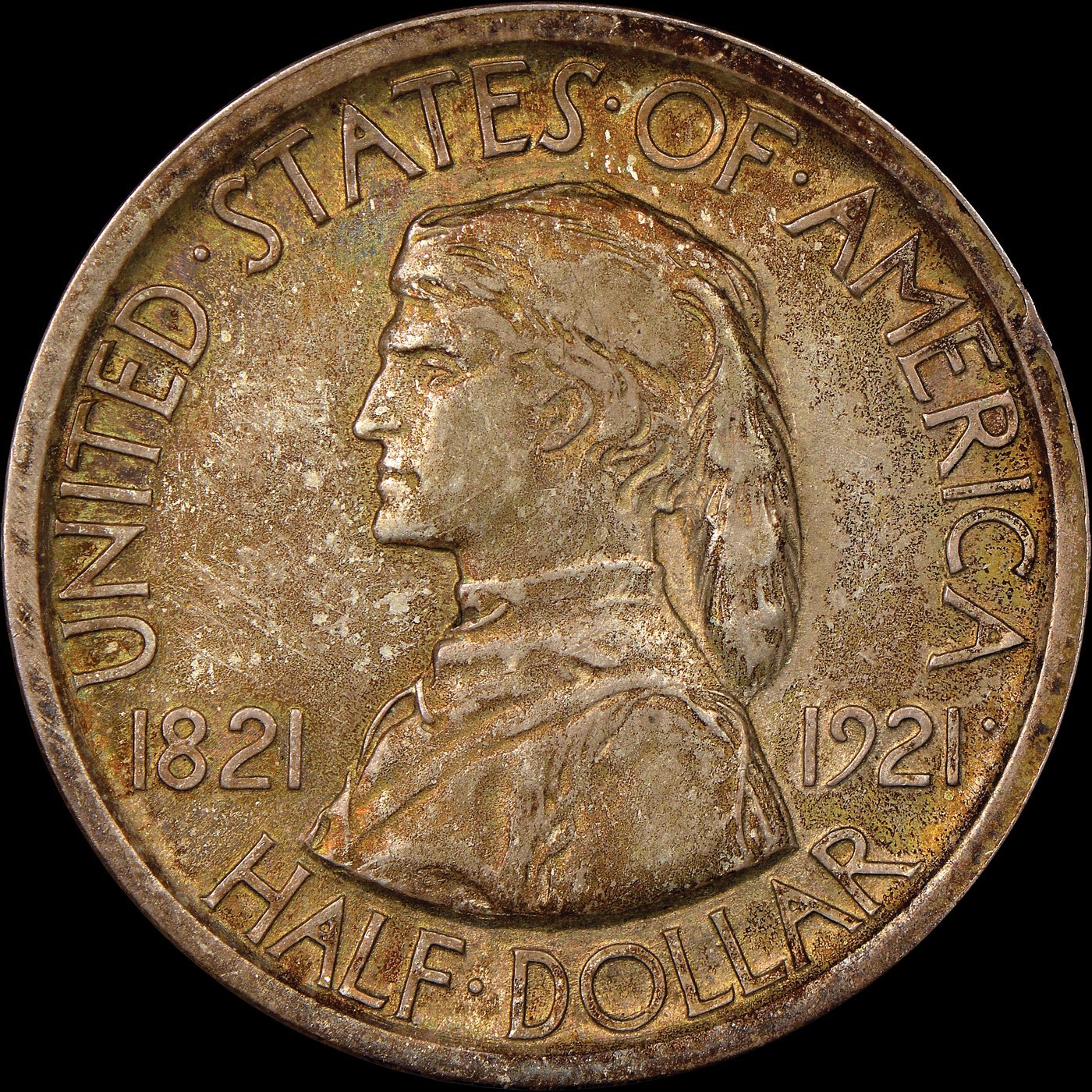
Missouri Centennial Half Dollar
A 1921 U.S. silver commemorative half dollar marking 100 years of Missouri statehood, with a coonskin-capped frontiersman facing left and a frontier-scene reverse.
- Country
- United States
- Denomination
- 50¢
- Metal
- Silver (.900 fine)
Got a coin like this?
Identify any coin from a photo, free.
Overview
The Missouri Centennial Half Dollar is a United States silver fifty-cent commemorative coin struck in 1921 to mark the one-hundredth anniversary of Missouri's admission to the Union in 1821. Designed by sculptor Robert Ingersoll Aitken, it belongs to the classic era of U.S. commemorative coinage, when Congress authorized limited-issue half dollars to honor anniversaries and events.
The obverse presents the bust of a buckskin-clad frontiersman wearing a coonskin cap and facing left, a figure long associated in popular tradition with Missouri's pioneer heritage. The reverse carries a frontier scene of a standing frontiersman and a Native American, encircled by stars. Like other commemoratives of the period, it was sold above face value to raise funds tied to the centennial celebration rather than released into ordinary circulation.
History & Background
Missouri entered the Union on August 10, 1821, as the twenty-fourth state, an event bound up with the Missouri Compromise. To commemorate the centennial, Congress authorized a fifty-cent coin, and up to 250,000 pieces were approved for striking at the Philadelphia Mint. The design work was carried out by Robert Aitken, a well-known medalist of the era.
Two main varieties exist. The first coins struck carry a small "2★4" incuse in the obverse field, referencing Missouri as the twenty-fourth state; a later portion of the run omits this marking and is known as the plain, or "no 2★4," variety. Although a quarter-million coins were authorized, far fewer were actually struck, and a large share went unsold at the centennial exposition and was returned to the Mint for melting. Net distribution ended up only in the tens of thousands, making both varieties genuinely scarce today.
How to Identify
The obverse shows a frontiersman's head and shoulders, clad in buckskin and wearing a coonskin cap, facing left, with the legend UNITED STATES OF AMERICA and the denomination HALF DOLLAR around the rim and the date 1921. On the "2★4" variety a tiny 2★4 appears in the field to the left of the bust; the plain variety lacks it. The reverse depicts a standing frontiersman holding a rifle beside a seated or standing Native American, with a border of twenty-four stars and the wording MISSOURI CENTENNIAL and the anniversary dates.
The coin follows standard U.S. half dollar specifications: struck in .900 fine silver (90% silver, 10% copper), it weighs about 12.5 grams, measures roughly 30.6 mm in diameter, and has a reeded edge. All examples were produced at the Philadelphia Mint and therefore carry no mint mark. The 1921 date and pioneer imagery on the photographed coin match this commemorative type.
Value & Collectibility
As a low-mintage classic commemorative, the Missouri Centennial Half Dollar carries a substantial premium over its silver content in every grade. Well-worn, problem-free circulated examples of the plain variety commonly trade in the low-to-mid hundreds of dollars, while attractive uncirculated pieces generally range from several hundred into the low thousands depending on grade and eye appeal.
The "2★4" variety is scarcer and typically commands a meaningful premium over the plain type in comparable condition. Values rise sharply for high-grade, well-struck, original examples, and gem pieces can bring strong prices at auction. Because commemoratives are widely collected and occasionally cleaned, altered, or counterfeited, condition, originality, and third-party certification all significantly affect what a given coin is worth.
Frequently asked questions
What is the Missouri Centennial Half Dollar?
It is a United States silver fifty-cent commemorative coin struck in 1921 at the Philadelphia Mint to mark the one-hundredth anniversary of Missouri statehood.
What is the difference between the "2★4" and plain varieties?
The first coins struck bear a small incuse 2★4 in the obverse field, noting Missouri as the twenty-fourth state, while a later portion of the run omits it. The 2★4 variety is scarcer and usually more valuable.
What is the coin made of and how big is it?
It is struck in .900 fine silver (90% silver, 10% copper), weighs about 12.5 grams, measures roughly 30.6 mm across, and has a reeded edge, matching standard U.S. half dollar specifications.
Does it have a mint mark?
No. Every Missouri Centennial Half Dollar was struck at the Philadelphia Mint, which used no mint mark on these coins.
Was it meant for circulation?
No. Like other classic commemoratives, it was sold above face value in connection with the centennial rather than released for everyday use, so surviving coins were not intended to circulate.
Missouri Centennial Half Dollar guides
In-depth guides for identifying, valuing, and collecting Missouri Centennial Half Dollar.
Other coins you may enjoy
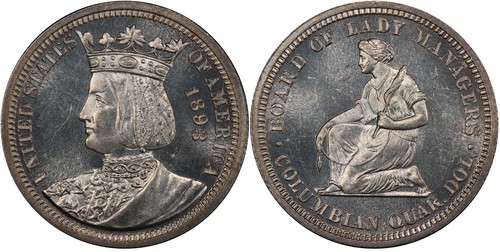
Isabella Quarter
1893
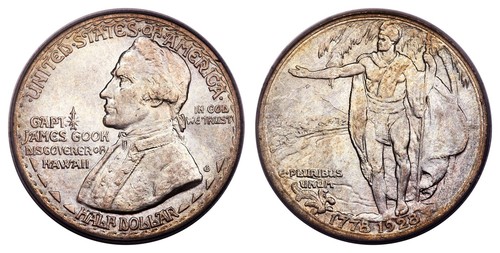
Hawaiian Sesquicentennial Half Dollar
1928
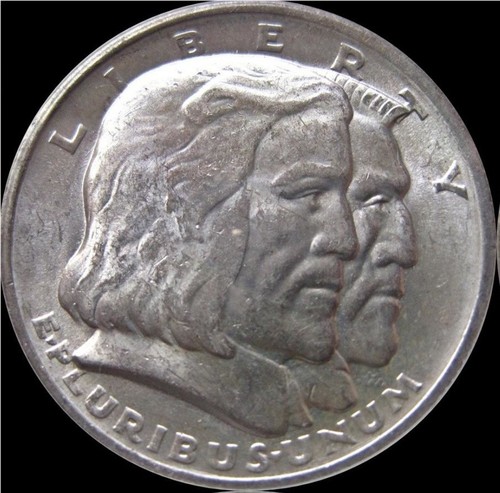
Long Island Tercentenary Half Dollar
1936
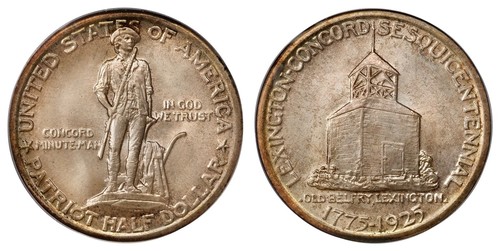
Lexington-Concord Sesquicentennial Half Dollar
1925
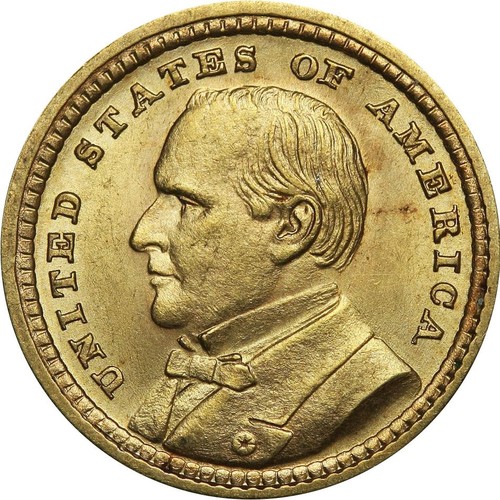
Louisiana Purchase Exposition Dollar (Jefferson)
1903
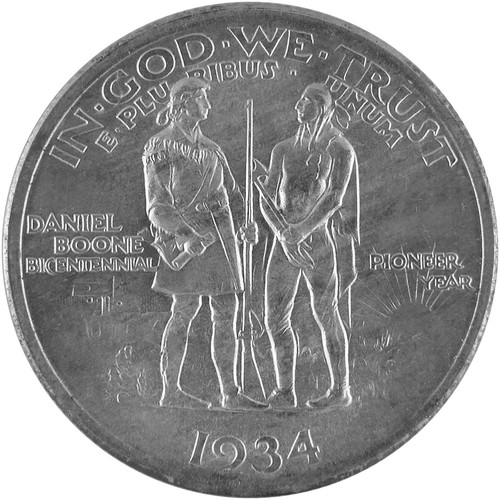
Daniel Boone Bicentennial Half Dollar
1934–1938
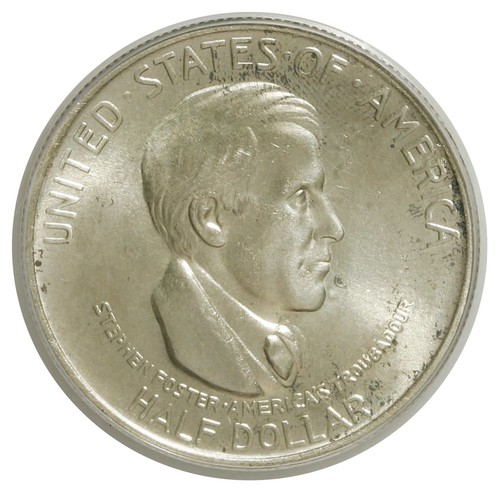
Cincinnati Music Center Half Dollar
1936
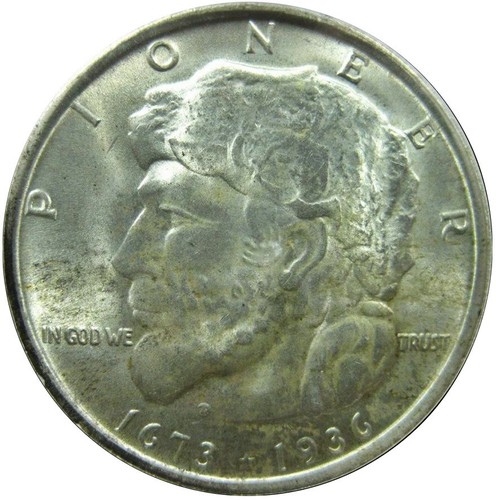
Elgin Illinois Centennial Half Dollar
1936
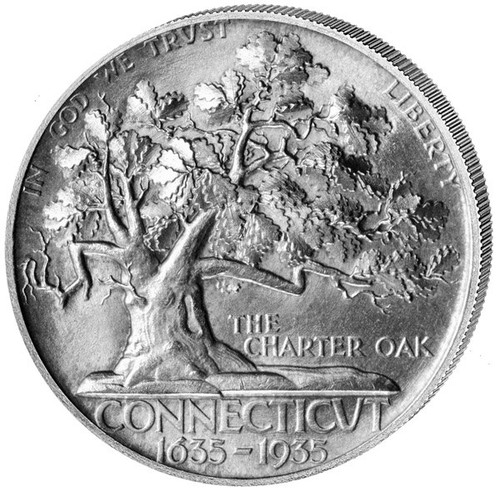
Connecticut Tercentennial Half Dollar
1935
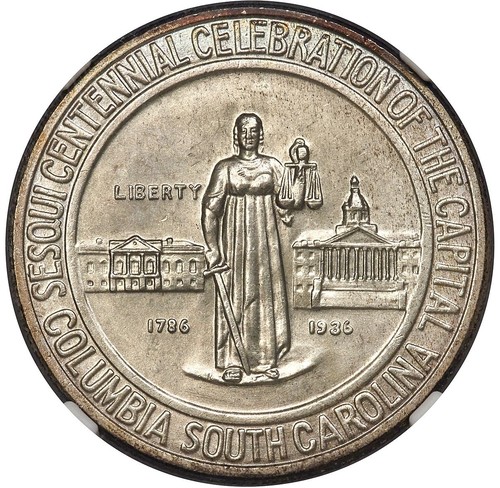
Columbia South Carolina Sesquicentennial Half Dollar
1936
Sesquicentennial of American Independence Quarter Eagle
1926
Pilgrim Tercentenary Half Dollar
1920-1921