
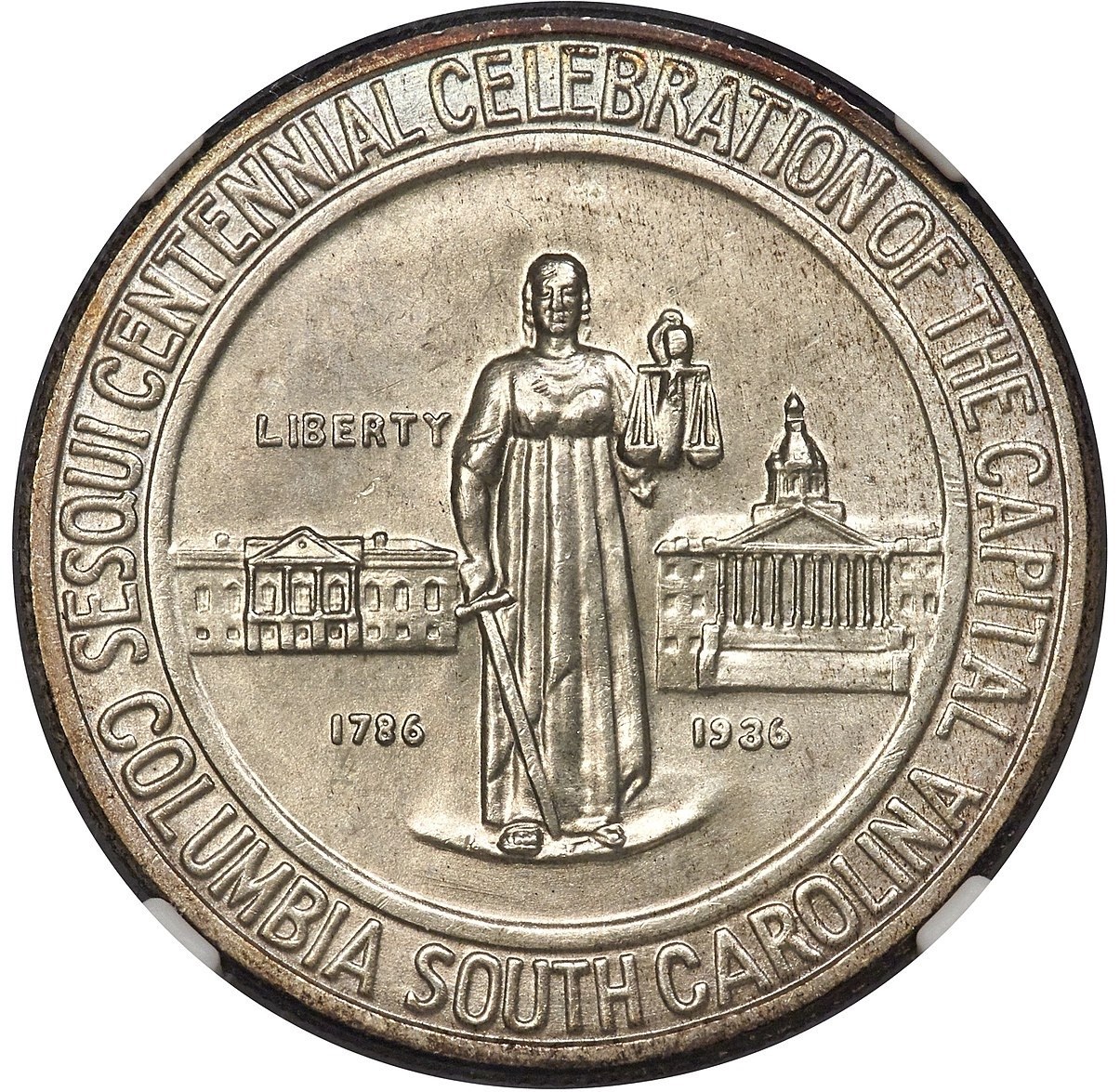
Columbia South Carolina Sesquicentennial Half Dollar
A 1936 U.S. silver half dollar marking 150 years of Columbia as South Carolina's capital; Justice with scales between two statehouses, palmetto reverse.
- Country
- United States
- Denomination
- 50¢
- Metal
- Silver
Got a coin like this?
Identify any coin from a photo, free.
Overview
The Columbia South Carolina Sesquicentennial Half Dollar is a United States silver commemorative fifty-cent piece struck in 1936 to mark the 150th anniversary of Columbia's founding as the capital of South Carolina in 1786. It is part of the long "classic" commemorative series (1892–1954), in which Congress authorized special half dollars to honor an event and allowed them to be sold at a premium to raise funds.
The obverse presents a standing figure of Justice holding a set of scales, flanked by the anniversary dates "1786" and "1936" and the word "LIBERTY," with representations of the old and new South Carolina statehouse buildings. The reverse features a palmetto tree — South Carolina's state symbol — accompanied by the national mottoes, including E PLURIBUS UNUM.
Struck in the standard 90% silver alloy of a regular half dollar, the coin was never meant for circulation. It was issued at three mints and distributed largely as three-coin sets, and today it is collected as part of the classic commemorative half dollar series.
History & Background
Congress authorized a commemorative half dollar for the sesquicentennial of Columbia, South Carolina, which had been established as the state capital in 1786. The coins were struck in 1936, a year in which a large number of commemorative issues appeared, and were sold at a premium above face value to benefit the anniversary celebration, following the fundraising model used throughout the classic commemorative program.
The design depicts a figure of Justice on the obverse, standing with scales and flanked by images meant to represent Columbia's old and new statehouses along with the dates 1786 and 1936. The reverse centers on a palmetto tree, long a symbol of South Carolina, surrounded by stars and other devices tied to the state's history.
The coins were produced at three mints — Philadelphia, Denver, and San Francisco — in relatively small numbers, on the order of several thousand from each facility, for a combined distribution in the low tens of thousands. They were marketed chiefly as matched three-coin sets containing one example from each mint, which is why complete original sets are a common way collectors pursue the issue today.
How to Identify
Identify the type by its inscriptions and imagery. The obverse shows a standing allegorical figure of Justice holding a balance scale, with the word "LIBERTY" and the paired dates "1786" and "1936" flanking the design, plus depictions of statehouse buildings. That 1786/1936 date pairing is the single most useful diagnostic, since it names the sesquicentennial span directly.
The reverse displays a palmetto tree, the emblem of South Carolina, together with lettering that includes the national motto E PLURIBUS UNUM. The palmetto — not a national eagle or a circulating design — is the key reverse identifier for this issue. The coin is a standard-size half dollar: about 30.6 mm in diameter, roughly 12.5 grams, struck in 90% silver with a reeded edge.
Mint marks matter on this type. Philadelphia coins carry no mint mark, while Denver coins show a "D" and San Francisco coins an "S." Because the coin was distributed as three-mint sets, all three exist in comparable numbers; the palmetto reverse and 1786/1936 obverse together confirm the type regardless of which mint struck a given piece.
Value & Collectibility
As a classic silver commemorative with a low overall mintage, the Columbia South Carolina Sesquicentennial Half Dollar trades well above its face value and its silver content. Because relatively few were made and many were saved by collectors in high grade, most surviving examples are uncirculated.
Individual coins in collector grades commonly sell in the range of roughly one hundred to a few hundred dollars, with premium, high-grade, and exceptionally well-preserved pieces bringing more. Complete original three-coin sets (Philadelphia, Denver, and San Francisco) are especially popular and are valued as a group. Condition, eye appeal, original surfaces, and third-party grade all strongly affect price.
Because values move with the collector market and depend on grade and whether a coin is sold singly or as part of a set, any specific example should be checked against recent auction results and current price guides rather than a single fixed figure.
Frequently asked questions
What does the Columbia South Carolina Sesquicentennial Half Dollar commemorate?
It marks the 150th anniversary of Columbia becoming the capital of South Carolina. The city was established as the state capital in 1786, and the coin was struck in 1936 for the sesquicentennial, with both dates shown on the obverse.
What is shown on the coin?
The obverse depicts a standing figure of Justice holding scales, flanked by the dates 1786 and 1936 and representations of the state's old and new capitol buildings. The reverse shows a palmetto tree, South Carolina's state symbol, with the motto E PLURIBUS UNUM.
Why are there three versions with different mint marks?
The coin was struck at three mints — Philadelphia (no mint mark), Denver (D), and San Francisco (S) — and sold largely as matched three-coin sets, one from each mint. Collectors often pursue the complete set.
Is it made of silver?
Yes. Like a regular U.S. half dollar of the era, it is struck in 90% silver with 10% copper, about 12.5 grams and 30.6 mm across, with a reeded edge.
Is it a rare coin?
It has a low mintage compared with circulating coins, on the order of several thousand from each mint. Many survive in high grade because they were saved by collectors, so it is scarce but obtainable, and it carries a solid premium as a classic commemorative.
Columbia South Carolina Sesquicentennial Half Dollar guides
In-depth guides for identifying, valuing, and collecting Columbia South Carolina Sesquicentennial Half Dollar.
Other coins you may enjoy
Isabella Quarter
1893
Hawaiian Sesquicentennial Half Dollar
1928
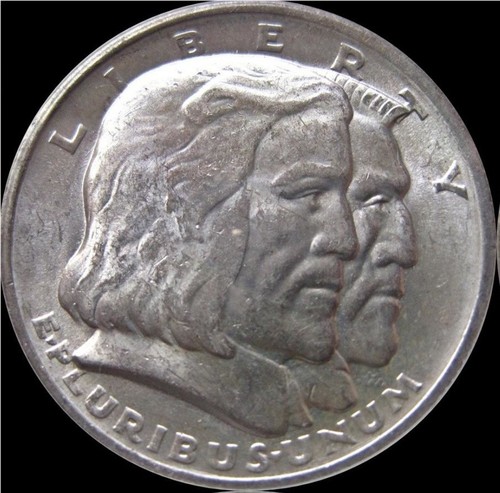
Long Island Tercentenary Half Dollar
1936
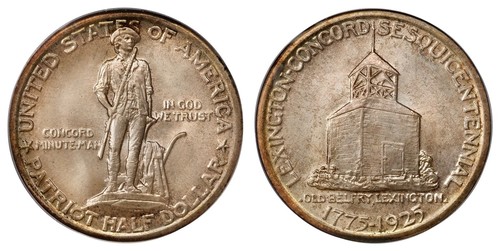
Lexington-Concord Sesquicentennial Half Dollar
1925
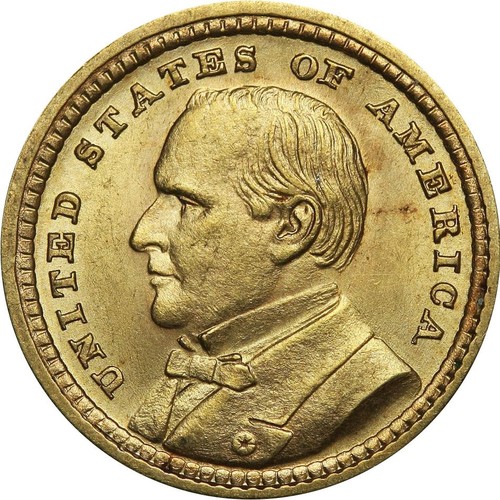
Louisiana Purchase Exposition Dollar (Jefferson)
1903
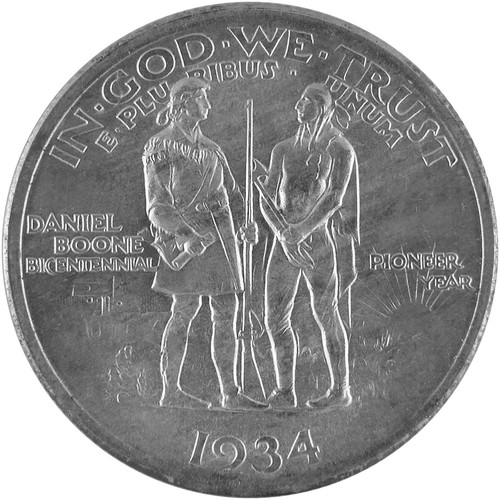
Daniel Boone Bicentennial Half Dollar
1934–1938
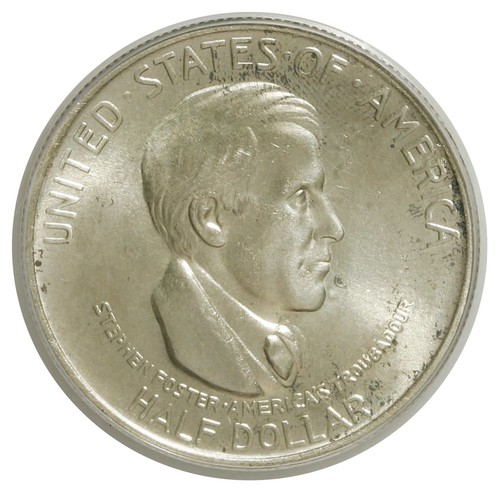
Cincinnati Music Center Half Dollar
1936
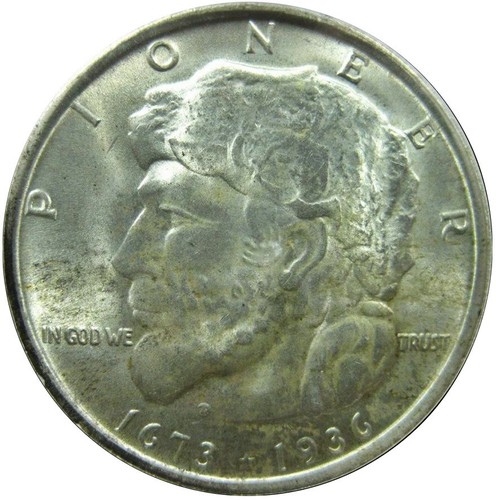
Elgin Illinois Centennial Half Dollar
1936
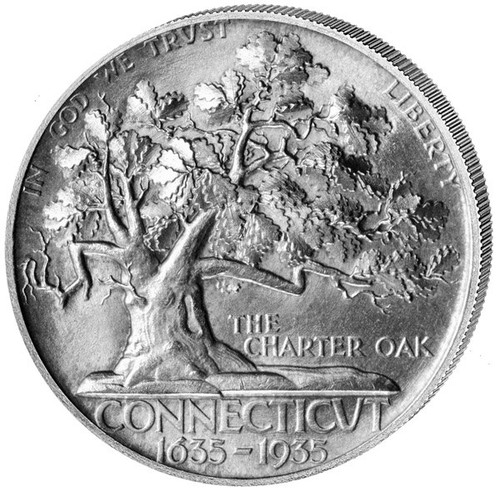
Connecticut Tercentennial Half Dollar
1935
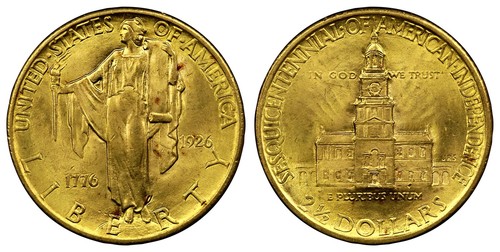
Sesquicentennial of American Independence Quarter Eagle
1926
Pilgrim Tercentenary Half Dollar
1920-1921
Alabama Centennial Half Dollar
1921