
How to Identify the Columbia South Carolina Sesquicentennial Half Dollar
A collector's checklist for confirming a 1936 Columbia SC Sesquicentennial half dollar — Justice obverse, palmetto reverse, dates, mint marks, and specs.
Read the full Columbia South Carolina Sesquicentennial Half Dollar encyclopedia entry →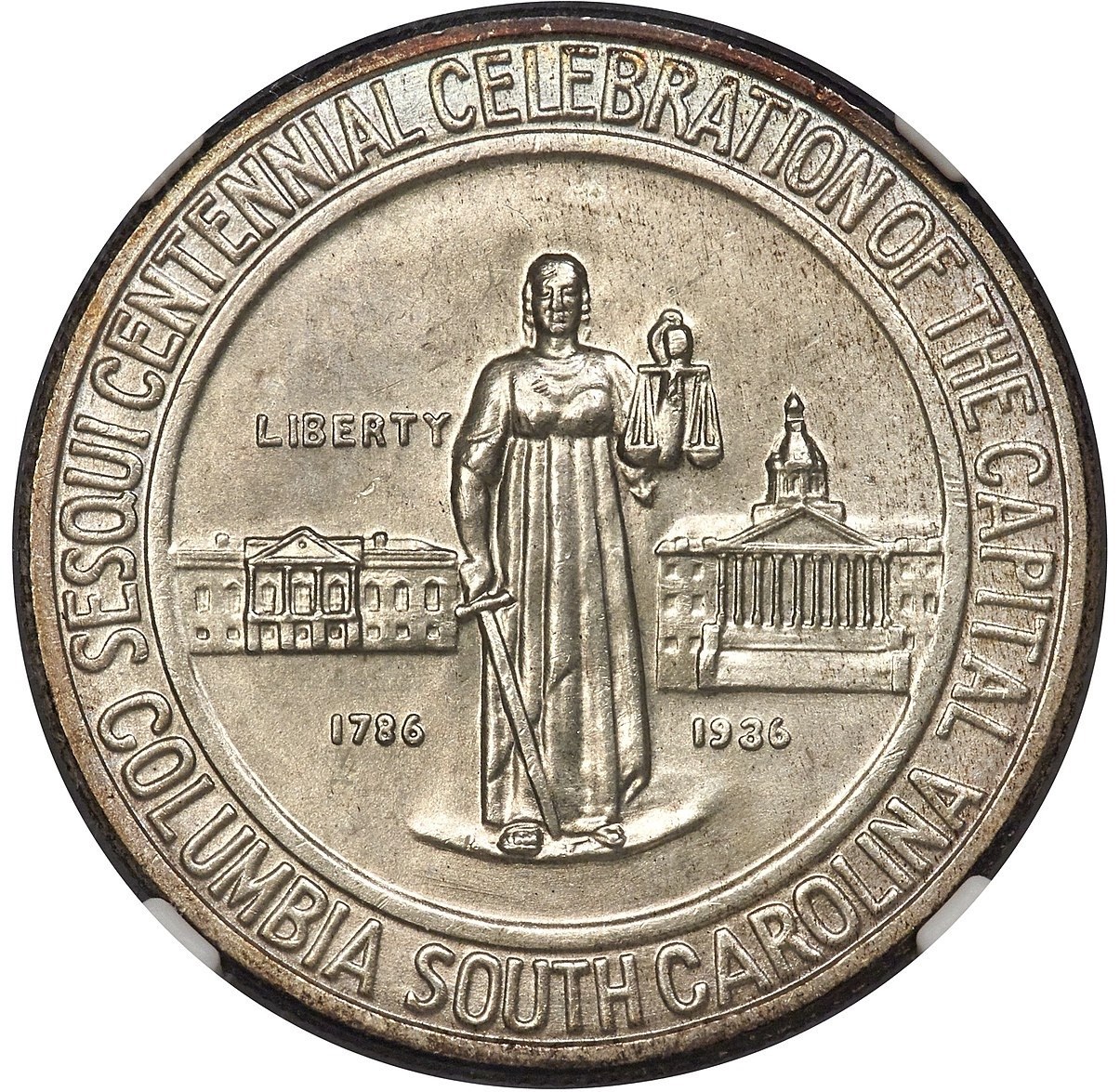
Start with the obverse figure and dates. A genuine Columbia South Carolina Sesquicentennial Half Dollar shows a standing allegorical figure of Justice holding a balance scale, with the word "LIBERTY" and the two dates "1786" and "1936" placed on either side, along with statehouse imagery. That 1786/1936 pairing, naming the 150-year span, is the fastest way to confirm the type and to separate it from the Walking Liberty half dollars circulating in the same period, which show a full striding Liberty and a single date.
Check the reverse for the palmetto tree. South Carolina's palmetto — not a national eagle — is the central device, surrounded by lettering that includes E PLURIBUS UNUM. If the reverse shows a standard national design instead of the palmetto, the coin is not this commemorative type. Note that palmetto fronds can be mistaken at a glance for spread wings in poor photos, so inspect the trunk and fronds directly.
Verify the physical specifications. The coin is a standard half dollar: roughly 30.6 mm in diameter, about 12.5 grams, struck in 90% silver with a reeded edge. A calibrated scale and calipers are the best tools; a piece that is off in weight, diameter, or edge reeding for a silver half dollar is a warning sign.
Read the mint mark to place the coin. Philadelphia examples have no mint mark, Denver coins carry a "D," and San Francisco coins an "S." All three were issued in similar quantities and were commonly sold together as a set, so any of the three mint marks is normal for this type; a date other than 1936 is not.
Be cautious with authentication, since classic commemoratives are targets for counterfeits and for altered mint marks used to fake a scarcer variety. Watch for tooling around the mint mark, mushy or doubled lettering, incorrect weight, or a color that does not match 90% silver. For any higher-value purchase — especially high-grade coins or complete original sets — rely on reputable dealers and third-party grading (PCGS, NGC) rather than eye appeal alone.
Frequently asked questions
How do I distinguish it from an ordinary 1936 half dollar?
The commemorative shows a standing figure of Justice with scales and the dates 1786 and 1936 on the obverse, plus a palmetto tree on the reverse — not the Walking Liberty design. Its Columbia-specific imagery is unlike any circulating half dollar of the era.
What is on the reverse of this coin?
A palmetto tree, the state symbol of South Carolina, along with the national motto E PLURIBUS UNUM and other lettering. There is no eagle; the palmetto is the key reverse identifier.
What should a genuine example weigh and measure?
About 12.5 grams and roughly 30.6 mm in diameter, in 90% silver with a reeded edge. Figures that don't match those of a standard silver half dollar are a counterfeit warning sign.
What do the mint marks mean?
Philadelphia coins have no mint mark, Denver coins show a D, and San Francisco coins show an S. The coin was sold mainly as a three-mint set, so all three mint marks are legitimate for this 1936 issue.