
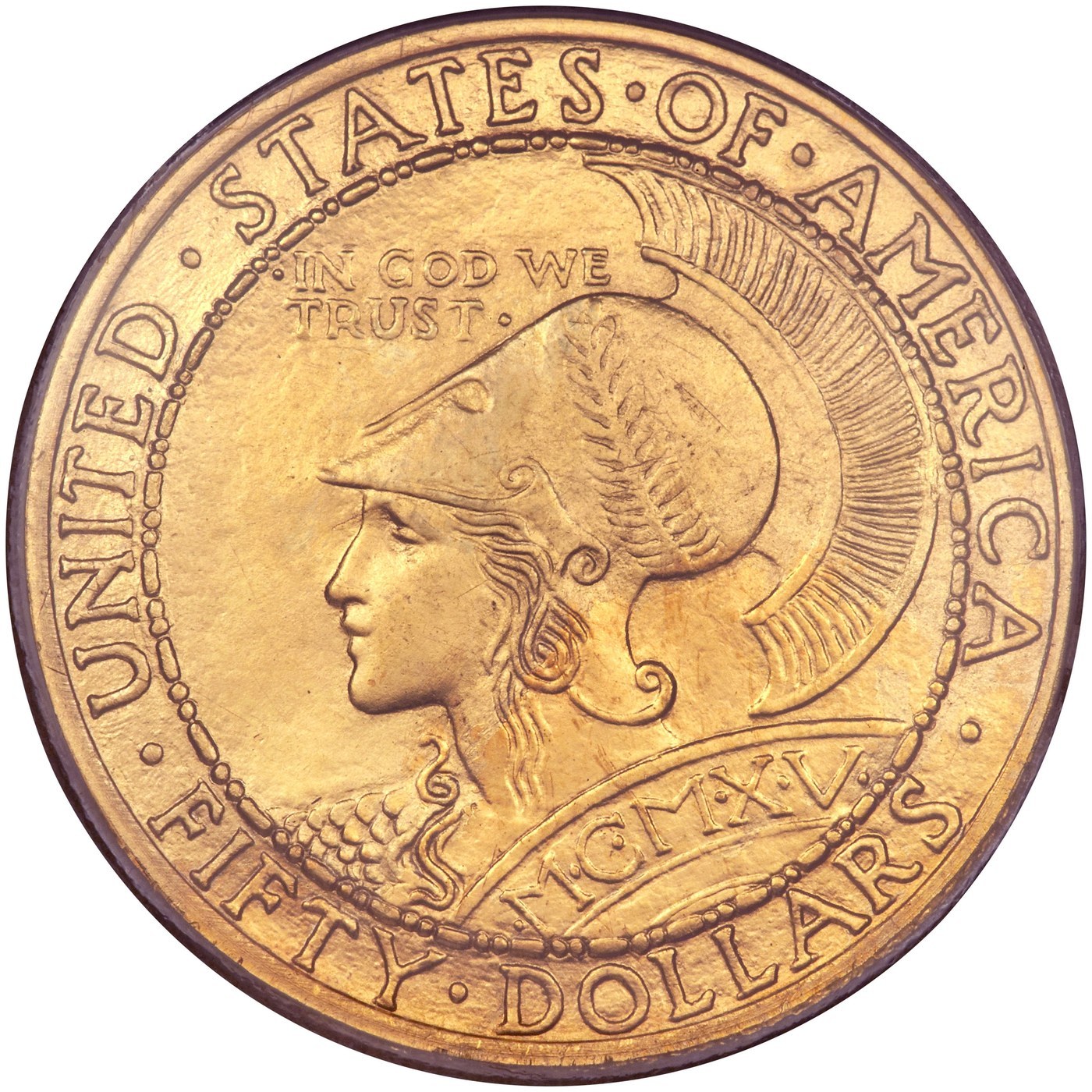
Panama-Pacific Exposition $50 (Octagonal)
An eight-sided $50 gold commemorative struck for San Francisco's 1915 world's fair, showing Minerva and her owl — the largest U.S. coin of its era.
- Country
- United States
- Denomination
- $50
- Metal
- Gold
Got a coin like this?
Identify any coin from a photo, free.
Overview
The Panama-Pacific Exposition $50 (Octagonal) is a monumental gold commemorative issued in 1915 to mark the Panama-Pacific International Exposition, the world's fair held in San Francisco to celebrate the opening of the Panama Canal and the city's recovery from the 1906 earthquake. The photographed coin, dated 1915, shows the helmeted head of Minerva in left-facing profile on the obverse and a perched owl with wings spread on the reverse.
What sets this piece apart is its distinctive eight-sided shape. The Mint produced both a round and an octagonal version of the $50; this is the octagonal one, whose form deliberately echoes the privately made octagonal $50 gold "slugs" of California's Gold Rush era. At a full ounce-plus of gold, it was the largest and highest-denomination U.S. coin of its time.
Because of its size, purity, and tiny production, the octagonal $50 is one of the most coveted classic U.S. commemoratives. It is a trophy coin — heavy, dramatic, and rarely encountered outside major auctions and advanced collections.
History & Background
Congress authorized a commemorative coinage program for the Panama-Pacific International Exposition in 1915, which included a gold dollar, a gold quarter eagle, a silver half dollar, and two versions of a $50 gold piece — one round and one octagonal. All were struck at the San Francisco Mint, some famously at a special coining press set up on the fairgrounds. The sculptor Robert Aitken designed both $50 pieces.
Aitken drew on classical imagery: Minerva, the Roman goddess of wisdom and war, on the obverse, and her attribute the owl on the reverse. The octagonal format was a conscious tribute to the octagonal $50 slugs made by private assayers in California during the 1850s, tying the fair to the region's Gold Rush heritage.
The coins sold poorly at their high original price, and large numbers went unsold and were later melted. Only a few hundred of each $50 type survived, making both rarities today. The octagonal version was made in slightly smaller numbers than the round, and surviving examples of either type number in the mere hundreds.
How to Identify
The most immediate diagnostic is the shape: this coin has eight straight sides rather than a round rim, with the design pressed into a recessed central field bordered by ornament. The obverse shows Minerva wearing a crested helmet, facing left, with the date 1915 and inscriptions around her. The reverse shows an owl perched on a branch (pine boughs and cones) with its wings spread.
On the octagonal version specifically, small dolphins are worked into the angles between the border and the eight corners — a detail absent from the round $50. Look for the "S" mint mark for San Francisco on the reverse. The denomination FIFTY DOLLARS and UNITED STATES OF AMERICA appear as part of the surrounding legends.
The coin is struck in .900 fine gold, weighs about 83.5 grams (roughly 2.5 troy ounces of gold content), and measures around 44 mm across the flats — far larger and heavier than a standard double eagle. Its sheer heft and eight-sided outline make it unmistakable in hand.
Value & Collectibility
The octagonal $50 is a high-value rarity in every grade. Even well-worn or impaired examples trade in the tens of thousands of dollars, and choice uncirculated pieces routinely bring six figures at auction. Values reflect both the coin's substantial gold content and its extreme scarcity and demand.
Because so few survive, condition and eye appeal drive large price swings, and certified examples from PCGS or NGC dominate the market. The octagonal version is generally scarcer than the round $50, though both are premier trophies. Pedigree — a documented history through famous collections — can add further premium.
Given the sums involved and the existence of counterfeits and altered pieces, any example should be evaluated by a professional grading service and current auction records rather than a fixed price. This is a coin bought and sold at the top end of the U.S. commemorative market.
Frequently asked questions
Why is this coin eight-sided?
The octagonal shape pays tribute to the private octagonal $50 gold 'slugs' made in California during the 1850s Gold Rush. The Mint issued both a round and an octagonal $50 for the 1915 exposition; this is the octagonal one.
Who is the figure on the front?
It is Minerva, the Roman goddess of wisdom and war, shown in profile wearing a crested helmet. Her companion the owl, a classical symbol of wisdom, appears on the reverse.
How can I tell the octagonal $50 from the round one?
Beyond the shape, the octagonal version has small dolphins worked into the angles at its eight corners. The round $50 lacks these dolphins. Both share the Minerva-and-owl design.
How rare is it?
Very rare. Most were unsold and melted, leaving only a few hundred of the octagonal type. It is one of the key rarities among classic U.S. commemorative coins.
How much is it worth?
A great deal. Even worn examples sell in the tens of thousands of dollars, and high-grade pieces bring six figures at auction. Its value comes from both its gold content and its scarcity, so any coin should be professionally appraised.
Panama-Pacific Exposition $50 (Octagonal) guides
In-depth guides for identifying, valuing, and collecting Panama-Pacific Exposition $50 (Octagonal).
Other coins you may enjoy
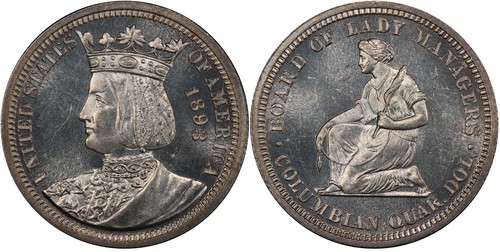
Isabella Quarter
1893
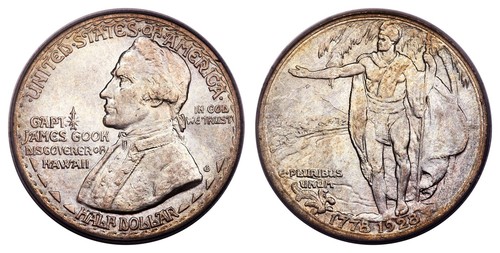
Hawaiian Sesquicentennial Half Dollar
1928
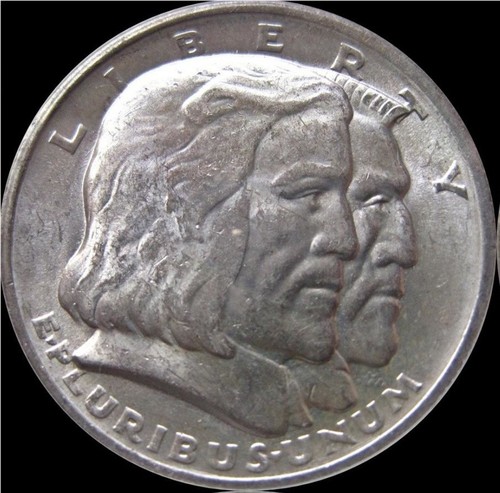
Long Island Tercentenary Half Dollar
1936
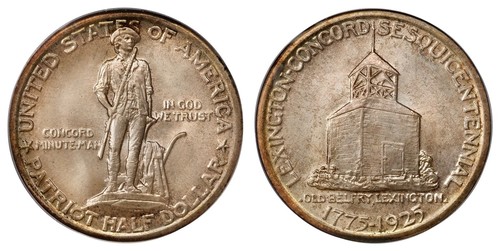
Lexington-Concord Sesquicentennial Half Dollar
1925
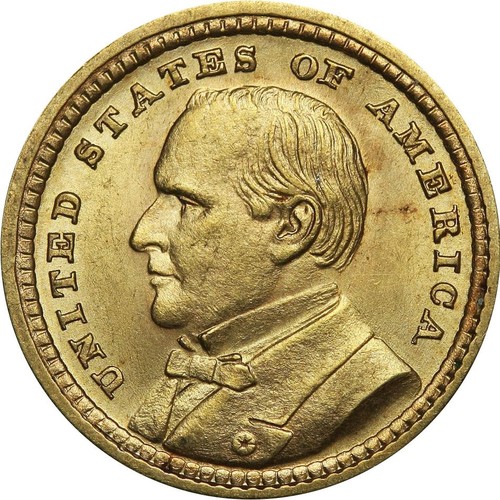
Louisiana Purchase Exposition Dollar (Jefferson)
1903
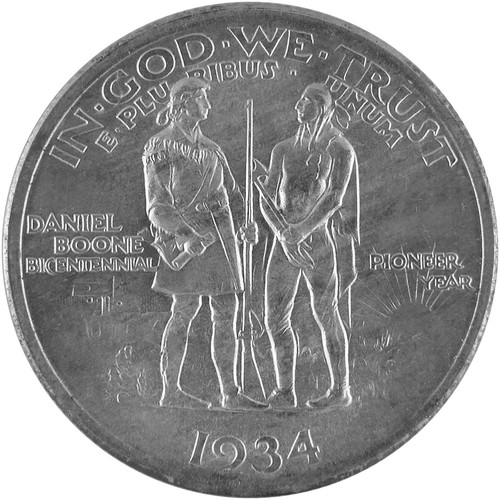
Daniel Boone Bicentennial Half Dollar
1934–1938
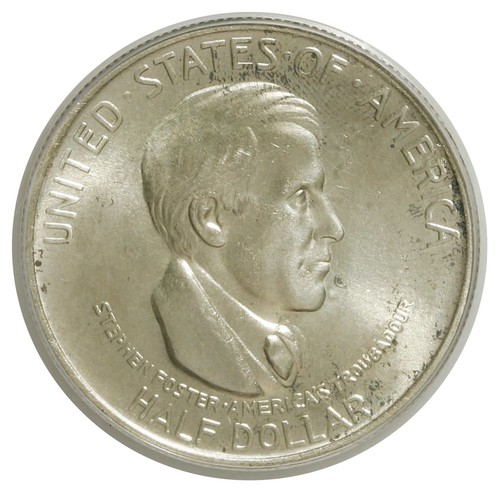
Cincinnati Music Center Half Dollar
1936
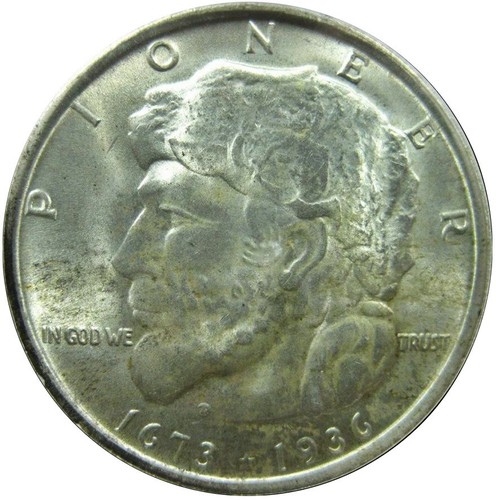
Elgin Illinois Centennial Half Dollar
1936
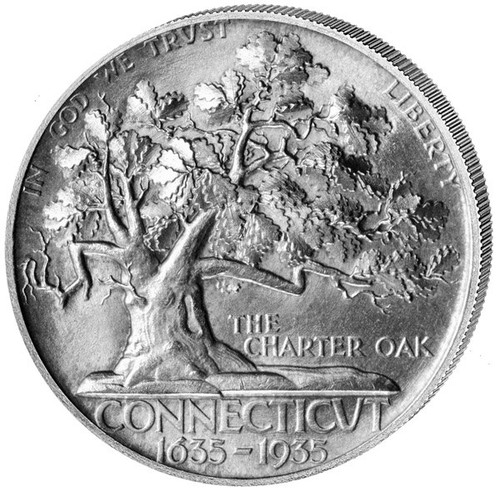
Connecticut Tercentennial Half Dollar
1935
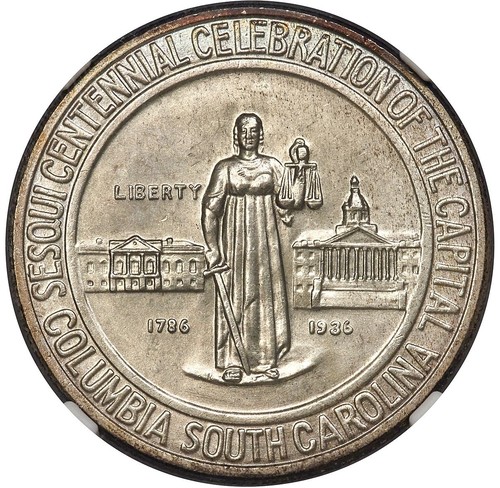
Columbia South Carolina Sesquicentennial Half Dollar
1936
Sesquicentennial of American Independence Quarter Eagle
1926
Pilgrim Tercentenary Half Dollar
1920-1921