
How to Identify the Panama-Pacific Exposition $50 (Octagonal)
A collector's checklist for the eight-sided 1915 Pan-Pac $50 gold — shape, Minerva-and-owl designs, dolphins, weight, and authentication cautions.
Read the full Panama-Pacific Exposition $50 (Octagonal) encyclopedia entry →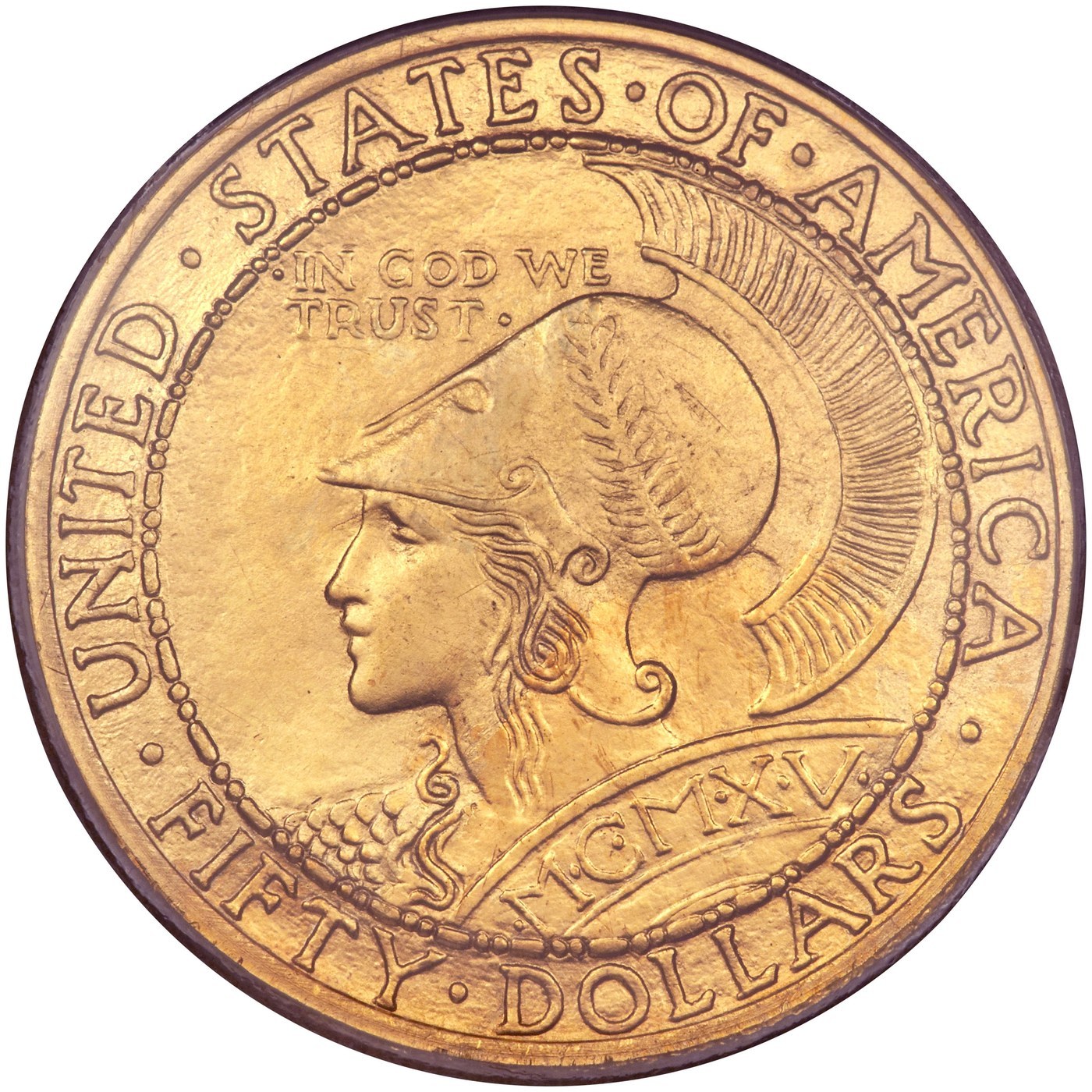
Begin with the outline, because it settles the identification instantly. This coin has eight distinct straight sides, not a round rim. The design sits in a recessed central field framed by a decorative border. If the coin is round, you may have the round Panama-Pacific $50 or another issue entirely — but this octagonal type is unmistakable by shape alone.
Confirm the two designs. The obverse shows Minerva, the Roman goddess of wisdom, in left-facing profile wearing a crested (plumed) helmet, with the date 1915 present. The reverse shows an owl perched on pine boughs with cones, wings spread. Then check the feature unique to the octagonal version: small dolphins are worked into the angular spaces at each of the eight corners, between the central border and the rim. The round $50 does not have these dolphins, so they are the fastest way to separate the two $50 types.
Check the physical specifications, which are dramatic. The coin is struck in .900 fine gold, weighs roughly 83.5 grams — about 2.5 troy ounces of gold — and spans about 44 mm across the flats. This is far heavier and larger than a $20 double eagle. Look for the small "S" mint mark (San Francisco) on the reverse, and read the legends for UNITED STATES OF AMERICA and FIFTY DOLLARS. The combination of great weight, rich .900 gold color, and eight sides is genuinely distinctive in hand.
Be aware of look-alikes and cautions. Modern replicas, gold-plated copies, and privately made "tribute" pieces exist, and some copy the octagonal format; these will typically be underweight, off in diameter, or made of base metal or non-standard gold. The privately issued California Gold Rush $50 slugs that inspired this coin are a separate, earlier product and should not be confused with the 1915 commemorative.
Given the coin's very high value, authentication is not optional. Weigh and measure any candidate precisely, and treat any piece that is light, magnetic, or dimensionally wrong as suspect. Because sophisticated counterfeits and altered coins are known at this price level, a genuine example should be certified by a major grading service such as PCGS or NGC before any purchase is made.
Frequently asked questions
What is the single fastest way to identify this coin?
Its eight-sided shape. Very few U.S. coins are octagonal, and combined with the Minerva head and owl and the 1915 date, the shape identifies the Panama-Pacific $50 octagonal at a glance.
How do I distinguish the octagonal $50 from the round $50?
The octagonal version has small dolphins in the angles at its eight corners; the round version does not. Both use the same Minerva obverse and owl reverse, so the dolphins and the shape are the key differences.
What should the coin weigh?
About 83.5 grams in .900 fine gold, roughly 2.5 troy ounces of gold content, at around 44 mm across the flats. A coin that is significantly lighter or smaller is likely a replica or counterfeit.
Where is the mint mark?
On the reverse. These $50 pieces were struck at the San Francisco Mint and carry an 'S' mint mark. Their surviving numbers are small, so authenticated, certified examples are strongly preferred.