
How to Identify the Missouri Centennial Half Dollar
A collector's guide to recognizing the 1921 Missouri commemorative half dollar by its frontiersman portrait, frontier-scene reverse, silver specs, and 2★4 variety.
Read the full Missouri Centennial Half Dollar encyclopedia entry →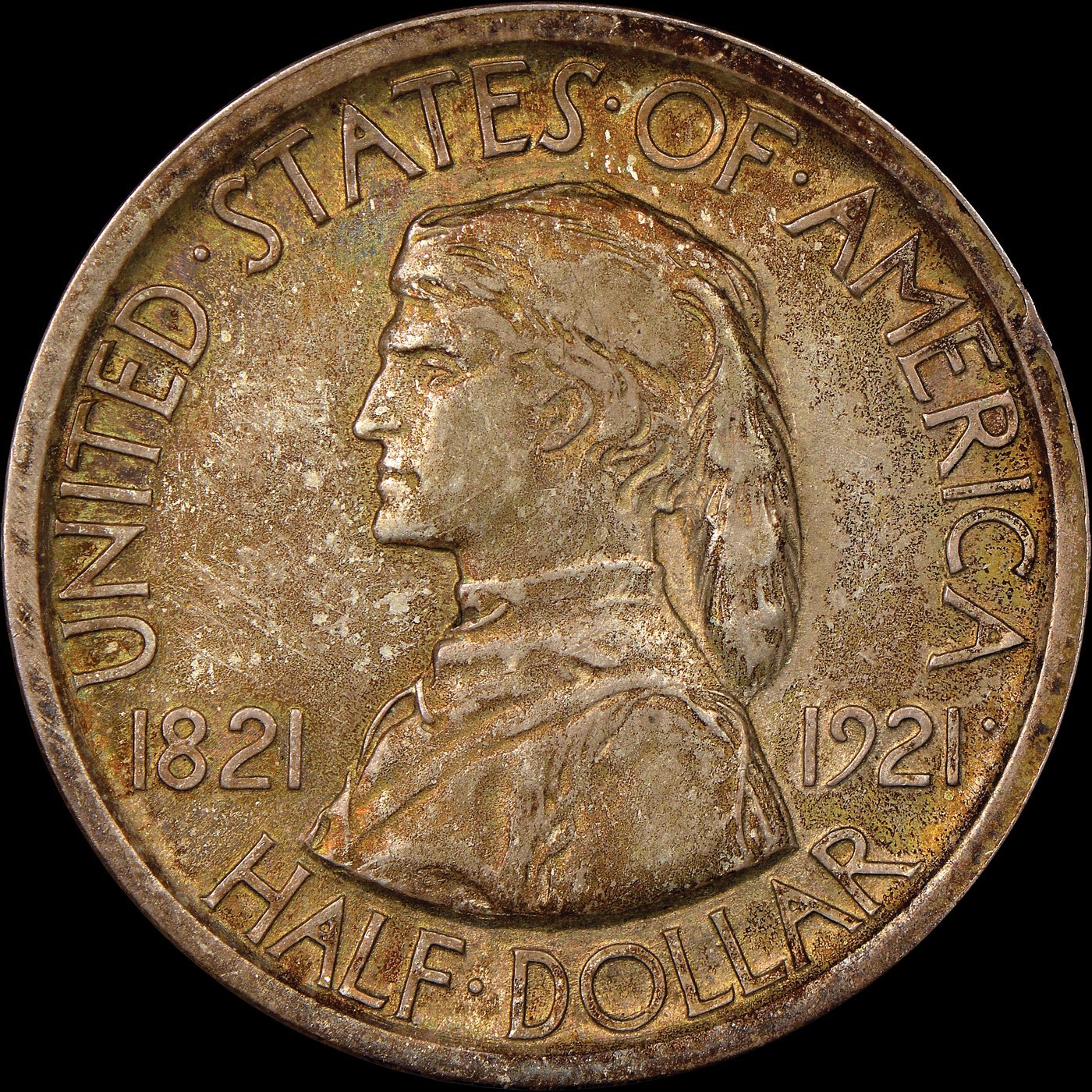
Start with the obverse portrait. A genuine Missouri Centennial Half Dollar shows a buckskin-clad frontiersman in a coonskin cap facing left, surrounded by UNITED STATES OF AMERICA and HALF DOLLAR with the date 1921. This rugged pioneer bust, rather than a seated Liberty or a walking figure, is the quickest way to separate this commemorative from circulating half dollars of the same era such as the Walking Liberty.
Check for the variety marker. Look closely in the obverse field to the left of the bust: the earliest strikes carry a small incuse "2★4" (two, star, four), referencing Missouri as the twenty-fourth state, while later coins omit it and are called the plain variety. Confirming which variety you have matters, because the 2★4 is scarcer and typically worth more. Use magnification, since the marking is small and can be softly struck or hidden by wear.
Read the reverse and confirm the specifications. The reverse should show a standing frontiersman with a rifle beside a Native American, ringed by twenty-four stars with MISSOURI CENTENNIAL and the anniversary dating. The coin should be .900 fine silver, weigh about 12.5 grams, measure roughly 30.6 mm in diameter, and have a reeded edge. There is no mint mark, because all pieces were struck at Philadelphia; a supposed Missouri Centennial half with a D or S mint mark is a red flag.
Be alert to authentication cautions. Because this is a valuable low-mintage commemorative, cleaned surfaces, added or altered detail, and outright counterfeits all exist, and a fake "2★4" can be tooled into a plain coin's field to boost its value. Original surfaces, correct weight and diameter, and honest wear are reassuring signs, while incorrect weight, casting seams, mushy detail, or the word COPY indicate a replica.
Finally, compare against look-alikes. Other 1920s classic commemorative half dollars share the same size and silver composition but carry entirely different designs and legends, so always read the wording and imagery rather than judging by size alone. Given the premiums involved and the existence of two varieties and altered pieces, certification by a major third-party grading service is strongly recommended before buying or selling.
Frequently asked questions
How do I tell the Missouri Centennial Half Dollar from a regular 1921 half dollar?
The commemorative shows a coonskin-capped frontiersman on the obverse and a frontier scene with twenty-four stars on the reverse, whereas circulating 1921 halves carry the Walking Liberty design. Read the imagery and legends to be sure.
Where do I look for the "2★4" marking?
It sits as a tiny incuse 2★4 in the obverse field beside the frontiersman's bust. Use magnification; if it is absent, you have the plain variety, which is more common.
Does the coin have a mint mark?
No. All examples were struck at the Philadelphia Mint and carry no mint mark, so any Missouri Centennial half showing a mint mark should be treated with suspicion.
Should I have one authenticated?
Yes. Because it is a scarce, valuable commemorative with a premium 2★4 variety that can be faked, certification by a reputable third-party grading service is strongly advised before any transaction.