
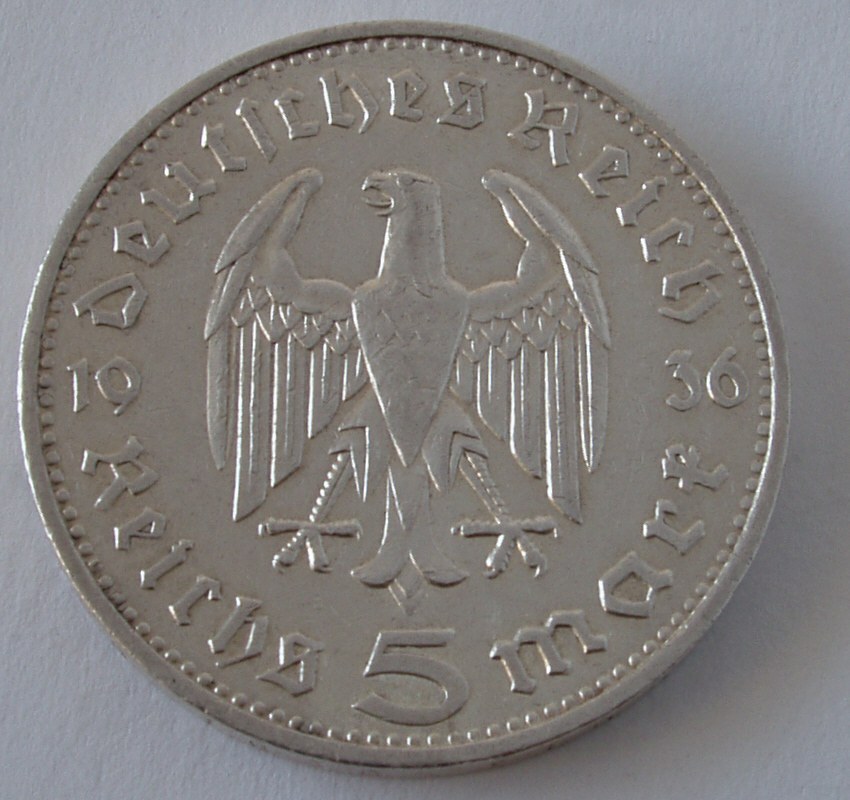
German 5 Reichsmark (Hindenburg)
German silver 5 Reichsmark of the Third Reich, pairing a portrait of Paul von Hindenburg with an eagle-and-swastika reverse; dated 1936.
- Country
- Germany
- Denomination
- 5 Reichsmark
- Metal
- Silver
Got a coin like this?
Identify any coin from a photo, free.
Overview
The German 5 Reichsmark (Hindenburg) is a large silver circulation coin struck under the Third Reich. The side shown here carries the German Reichsadler (Imperial Eagle) with wings spread, clutching a wreath that encloses a swastika, framed by the inscription DEUTSCHES REICH ("German Reich"). The opposite side, not visible in this photograph, bears a portrait of Reich President Paul von Hindenburg.
This was the standard-size silver crown of Nazi-era Germany, valued at 5 Reichsmark within the Reichsmark currency that circulated from 1924 until the post-war currency reform. As a .900 fine silver coin roughly 29 mm across, it is a substantial piece that saw wide circulation and was struck in large numbers across several German mints.
The example here is dated 1936, one of the years the swastika-bearing Hindenburg type was produced. It is a historically charged coin: a mass-produced circulation issue that is also a physical artifact of Nazi Germany's official coinage.
History & Background
Paul von Hindenburg, the German field marshal and later Reich President, died in office in 1934. This 5 Reichsmark type was introduced in his memory and pairs his portrait with the national eagle. The very first Hindenburg 5 Mark of 1935 was issued with an eagle that did not carry a swastika; the design was quickly revised so that the eagle clutched a wreath enclosing a swastika, the state emblem of the Nazi regime.
The swastika-eagle version — the type shown here — was struck in 1935 and 1936. It replaced earlier Weimar-era 5 Reichsmark designs and served as the main silver crown of the period. Coins were produced at Germany's traditional network of mints, each identified by a letter mint mark, and the type circulated widely as everyday high-value money.
The Reichsmark and its coinage were withdrawn after World War II, when currency reforms in occupied Germany replaced the Reich's money. Surviving Hindenburg 5 Reichsmark coins are today collected as silver bullion-adjacent pieces and as artifacts of a specific and troubled chapter of German history.
How to Identify
Eagle side (shown): the spread-winged German eagle grips a wreath enclosing a swastika, surrounded by the legend DEUTSCHES REICH together with the denomination FÜNF REICHSMARK ("five Reichsmark") and the date. A small letter mint mark (such as A, D, E, F, G or J) identifies the striking mint.
Portrait side (not shown here): a bust of Paul von Hindenburg in profile, accompanied by his name and life dates (1847–1934). On the coin as a whole you should find the year of issue — 1936 on this example.
Size and metal: a large silver crown of roughly 29 mm diameter, struck in .900 fine silver and weighing about 13.9 grams, with a reeded (grooved) edge. Its heft, pale silver colour and crown size, combined with the eagle-and-swastika legend DEUTSCHES REICH, are the quickest confirmation of the type.
Value & Collectibility
The Hindenburg 5 Reichsmark is a fairly common coin that was struck in large quantities, so ordinary circulated examples trade close to their silver content plus a modest collector premium. The coin contains roughly a third of an ounce of fine silver, which sets a practical floor under its value.
Condition drives most of the price difference. Well-worn pieces are inexpensive, while sharp, lightly circulated or uncirculated examples with strong detail command higher premiums. Date and mint mark also matter — some mint-and-year combinations were struck in smaller numbers and are scarcer than others.
Because silver prices move and collector demand for this specific historical type varies, treat any single figure as a rough guide only. Compare recent sales of the same date, mint mark and grade, and be aware that this series is sometimes counterfeited, so provenance and authentication add confidence for higher-grade or higher-value pieces.
Frequently asked questions
What is shown on the German 5 Reichsmark (Hindenburg)?
One side shows the German eagle clutching a wreath with a swastika and the inscription DEUTSCHES REICH with the denomination; the other side bears a portrait of Paul von Hindenburg with his life dates 1847–1934.
What metal is it made of?
It is struck in .900 fine silver. The coin is about 29 mm across and weighs roughly 13.9 grams, making it a substantial silver crown-size piece.
Is the Hindenburg 5 Reichsmark valuable?
It is a common coin, so most circulated examples are valued near their silver content plus a modest premium. Higher grades, and scarcer date-and-mint combinations, are worth more.
Why does this coin have a swastika?
It was issued under Nazi Germany, and from 1935 onward the type's eagle clutches a wreath enclosing a swastika, the state emblem of the regime. It is an authentic period artifact, not a reproduction marking.
Were there versions without the swastika?
Yes. The first 1935 Hindenburg 5 Mark used an eagle without a swastika, which was soon revised to the swastika-bearing eagle seen on this 1936 coin.
German 5 Reichsmark (Hindenburg) guides
In-depth guides for identifying, valuing, and collecting German 5 Reichsmark (Hindenburg).
Other coins you may enjoy
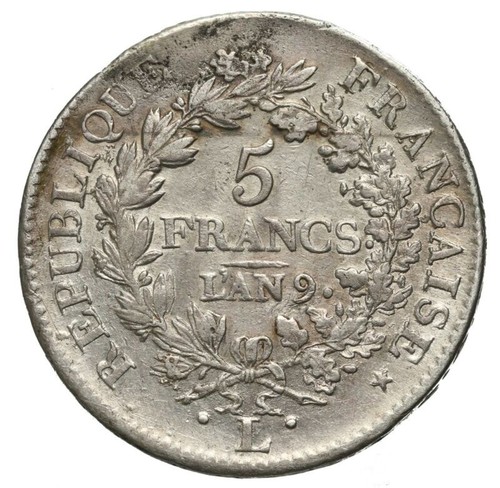
5 Francs (First Republic)
L'an 9 (1800–1801)
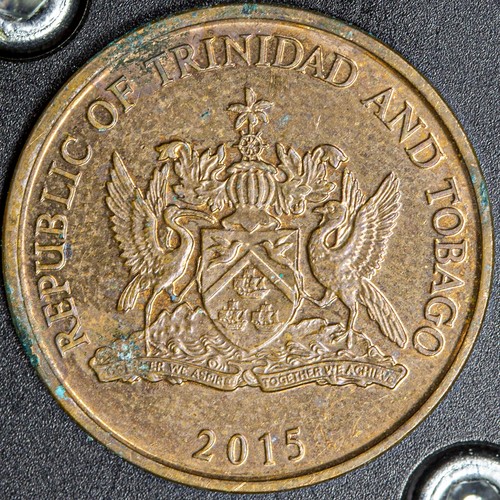
Trinidad and Tobago Dollar
2015
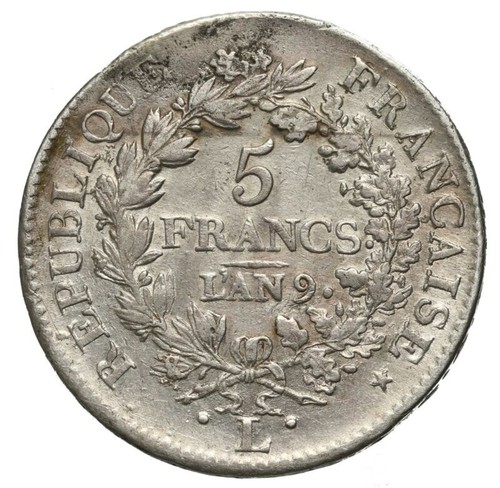
5 Francs Semeuse
1960–1969
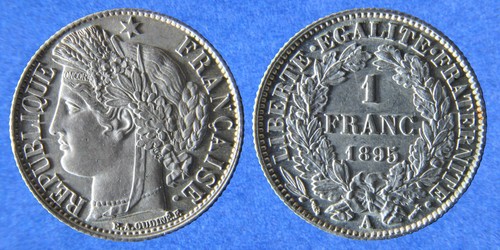
French Cérès 1 Franc
1849–1895
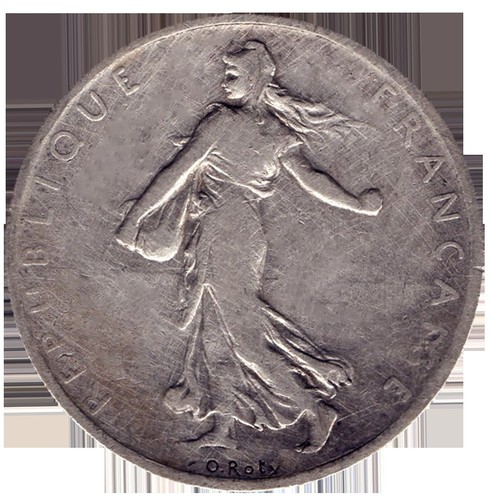
French Semeuse 2 Francs
1898–1920 (silver issues; pictured example dated 1899)
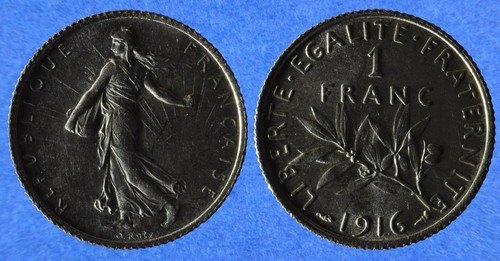
French Semeuse 1 Franc
1898–1920 (silver Semeuse 1 franc type)
France 50 Cent Euro
1999–present
Swiss 1 Franc
1861
France 20 Centimes
1962–2001 (Fifth Republic, Marianne / Lagriffoul type)
Swiss 2 Francs
1860
Austria-Hungary 15 Kreuzer
1807
Austria-Hungary 10 Kreuzer
1872 (issue shown)