
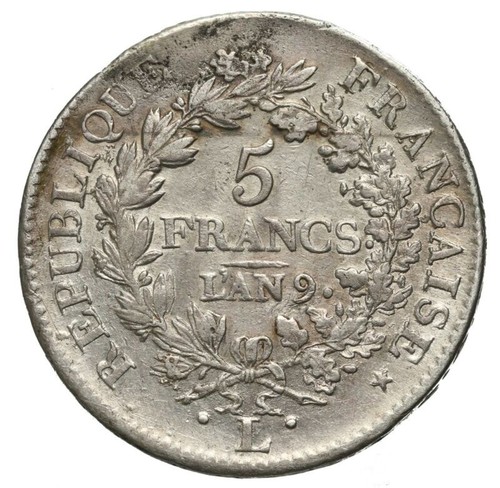
5 Francs (First Republic)
A large silver 5-franc crown of the French First Republic, dated by the revolutionary calendar as L'an 9 (1800–1801), with a right-facing Liberty head.
- Country
- France
- Denomination
- 5 Francs
- Metal
- Silver
Got a coin like this?
Identify any coin from a photo, free.
Overview
This is a First Republic 5 Francs, a large silver crown-sized coin from the era when France counted its years by the revolutionary calendar rather than the Gregorian one. The observed obverse shows a profile head of Liberty facing right with the legend REPUBLIQUE FRANCAISE, while the reverse carries a heraldic shield, the denomination 5 FRANCS, and the dating phrase L'AN 9 DE LA REPUBLIQUE — the ninth year of the Republic, corresponding to 1800–1801.
The 5-franc silver piece was the workhorse high-value coin of the young French franc system, roughly the equivalent of a crown or thaler elsewhere in Europe. Struck in a broad, heavy silver planchet, it was intended for major transactions and to anchor the new decimal currency introduced during the Revolution.
Because the coin is dated by the phrase "L'an 9" rather than a familiar year number, many owners are unsure what they have. Read literally, this is the Republic's own way of writing 1800–1801, placing the coin firmly in the First Republic before the Consulate gave way to Empire.
History & Background
France introduced the franc as its decimal unit of account during the Revolution, replacing the old livre system. The 5-franc silver coin became the largest regularly circulating silver denomination and was struck across the closing years of the First Republic and into the Consulate, using the revolutionary calendar to record its date.
That calendar counted years from the founding of the Republic in September 1792, so "L'an 9" (Year 9) spans roughly late September 1800 to late September 1801. This dating convention is one of the most distinctive features of French coins from the period and is a direct link to the political break the Revolution represented — even the way time was written on money was changed.
The First Republic's silver crowns were produced at several French mints, each identified by a small letter, and the designs of Liberty and the value carried the symbolism of the new order. Coinage of this size and metal was central to establishing public confidence in the franc, and surviving pieces are tangible artifacts of France's transition from monarchy to republic.
How to Identify
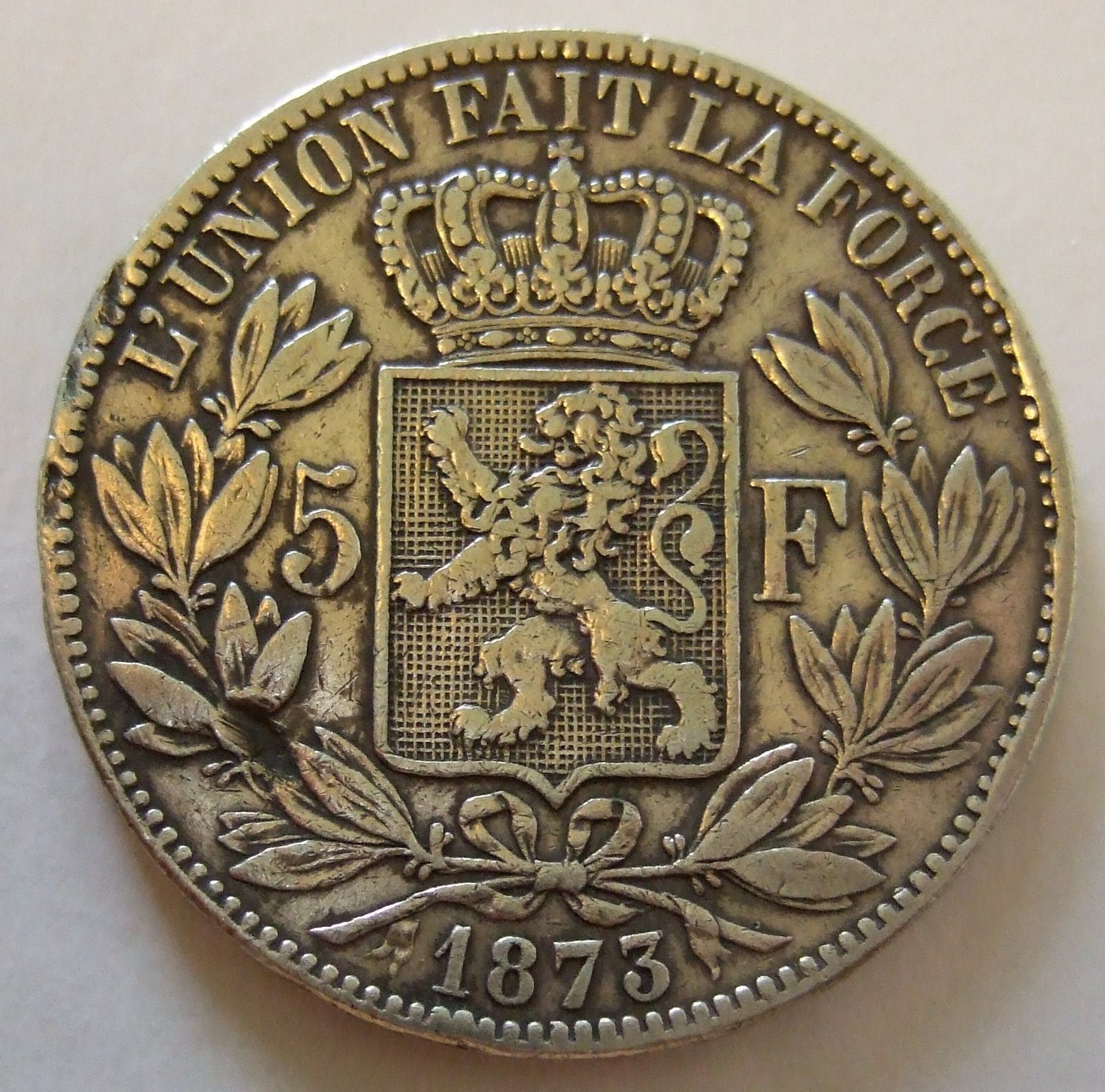
The defining clue on this coin is its dating: the reverse legend L'AN 9 DE LA REPUBLIQUE, which is the revolutionary calendar's way of writing 1800–1801. Combined with REPUBLIQUE FRANCAISE on the obverse and the value 5 FRANCS on the reverse, this identifies the piece as a First Republic 5-franc silver crown rather than a later franc coin using ordinary Gregorian dates.
The obverse shows a profile head of Liberty facing right; the reverse displays a heraldic shield alongside the denomination and date phrase. As a 5-franc silver crown of this era, it is a large, heavy coin — on the order of 37 mm across and about 25 grams in roughly 0.900 fine silver — with a lettered or reeded edge rather than a plain one.
Look for a small mint-mark letter on the coin, which identifies the French mint that struck it, and sometimes an additional privy or engraver's symbol. Genuine strikes of this size and silver content have a specific weight and diameter; a piece that is noticeably underweight, undersized, off-colour, or magnetic does not match the standard for a silver 5 francs.
Value & Collectibility
First Republic 5-franc silver crowns carry value on two levels: their silver content and their appeal as early republican coins. As a large piece of roughly 0.900 fine silver weighing about 25 grams, even a worn example has a meaningful bullion floor that tracks the silver price, while collector demand for genuine, well-preserved First Republic crowns adds a premium above melt.
Condition, mint, and eye appeal drive the range. Heavily worn or damaged coins sit closer to their silver value, whereas sharp, problem-free examples with clear legends and a strong Liberty profile are sought after by collectors of French and revolutionary-era coinage. Specific dates and mint combinations from this period vary in scarcity.
Because popular early French crowns are widely reproduced, condition and authenticity matter more than any headline figure. To gauge value, confirm the coin's weight, diameter, and silver fineness, read the mint mark, and then compare it with recent sales of genuine First Republic 5-franc pieces in similar grade rather than relying on a single quoted price.
Frequently asked questions
What year is 'L'an 9' on this 5 francs?
"L'an 9" means Year 9 of the French Republic, counted from the Republic's founding in September 1792. It corresponds to roughly late 1800 to late 1801 in the ordinary calendar, which is why this coin is dated 1800–1801.
Is the First Republic 5 francs made of silver?
Yes. It is a large silver crown-sized coin, struck in roughly 0.900 fine silver and weighing about 25 grams. That silver content gives even a worn example a baseline value tied to the silver price.
Who is on the obverse of the coin?
The obverse shows a profile head of Liberty facing right, the personification of the French Republic, surrounded by the legend REPUBLIQUE FRANCAISE. Liberty was a central symbol of revolutionary-era French coinage.
How big is a 5-franc silver crown of this era?
It is a substantial coin, on the order of 37 mm in diameter and about 25 grams in weight. Its large size and heft are typical of European crown-sized silver pieces of the period.
Why does the coin use a revolutionary calendar date?
After the Revolution, France adopted a new calendar counting years from the Republic's founding in 1792. Coins of the period were dated in that system, so this piece reads L'AN 9 rather than 1800 or 1801.
5 Francs (First Republic) guides
In-depth guides for identifying, valuing, and collecting 5 Francs (First Republic).
Other coins you may enjoy
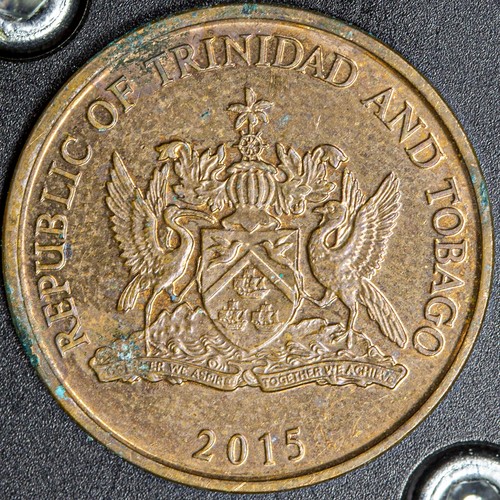
Trinidad and Tobago Dollar
2015
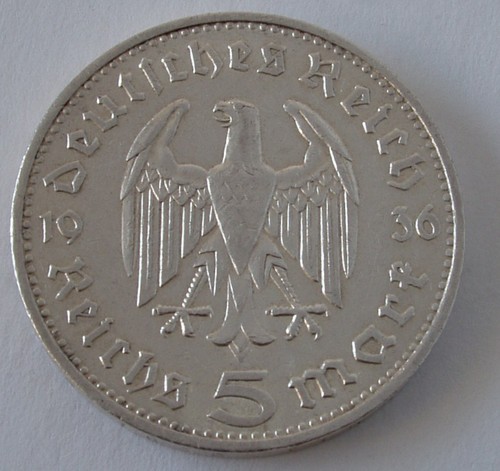
German 5 Reichsmark (Hindenburg)
1935–1936 (Hindenburg type with swastika)
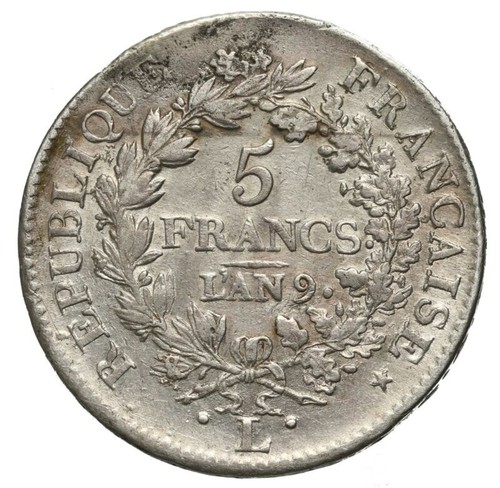
5 Francs Semeuse
1960–1969
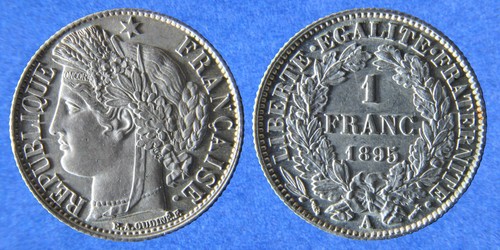
French Cérès 1 Franc
1849–1895
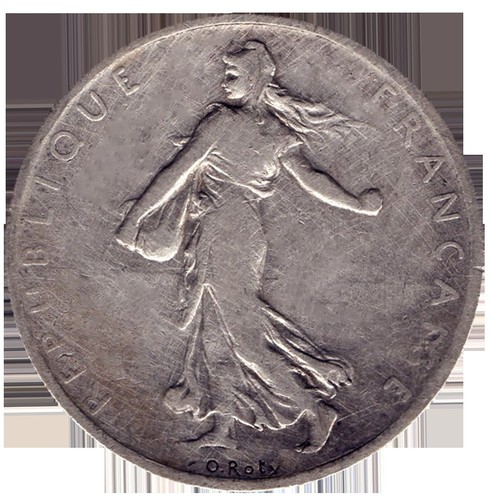
French Semeuse 2 Francs
1898–1920 (silver issues; pictured example dated 1899)
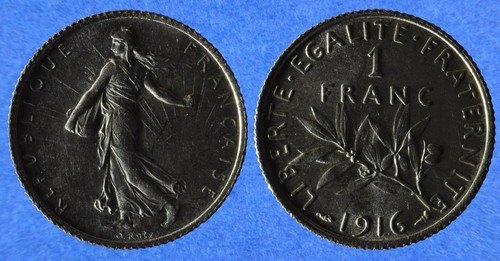
French Semeuse 1 Franc
1898–1920 (silver Semeuse 1 franc type)
France 50 Cent Euro
1999–present
Swiss 1 Franc
1861
France 20 Centimes
1962–2001 (Fifth Republic, Marianne / Lagriffoul type)
Swiss 2 Francs
1860
Austria-Hungary 15 Kreuzer
1807
Austria-Hungary 10 Kreuzer
1872 (issue shown)