
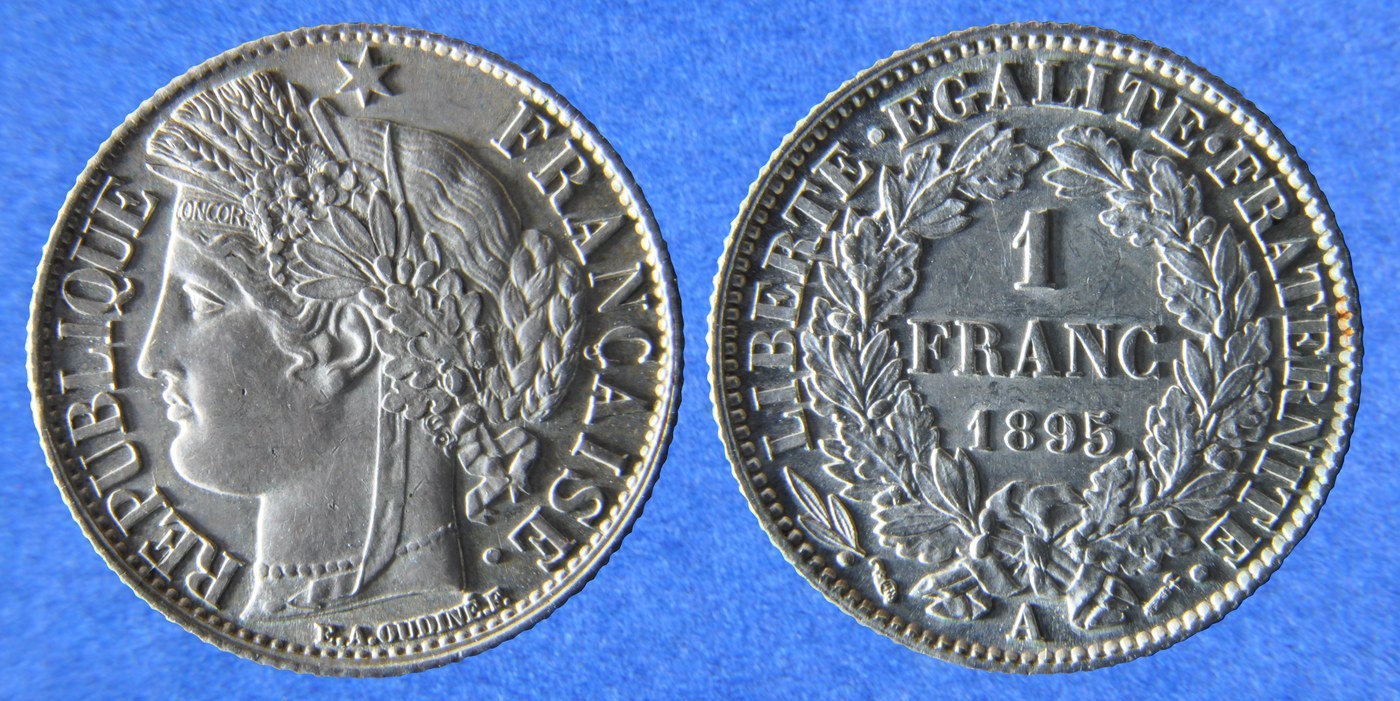
French Cérès 1 Franc
A .835 silver French 1 Franc showing the goddess Cérès in a liberty cap; this example is an 1895 Third Republic issue with a wreath-and-value reverse.
- Country
- France
- Denomination
- 1 Franc
- Metal
- Silver
Got a coin like this?
Identify any coin from a photo, free.
Overview
The French Cérès 1 Franc is a small silver circulation coin of France featuring the head of Cérès (Ceres), the Roman goddess of agriculture and the harvest, adopted here as a symbol of the Republic. The example shown is dated 1895, a Third Republic issue.
The obverse shows Cérès facing left, wearing a liberty (Phrygian) cap wreathed with grain and an olive branch, embodying liberty and abundance. The reverse carries the denomination 1 FRANC and the date within a wreath of two branches, framed by the national legend.
At roughly 23 mm across and about 5 grams of low-fineness silver, it is the workhorse one-franc piece of its era—common enough to survive in quantity today, yet historically tied to the imagery France used across coins, stamps, and seals of the 19th century.
History & Background
The Cérès design first appeared on French silver in 1849 under the Second Republic, engraved by Louis Merley, whose Ceres head replaced the monarchic portraits of the July Monarchy. The motif drew on the Republic's fondness for allegorical female figures representing liberty and the fruitfulness of the nation.
After a long gap during the Second Empire—when Napoleon III's portrait occupied the coinage—the Third Republic revived the Cérès type for the 50 centimes, 1 franc, and 2 francs silver in the 1870s, striking it into the 1890s. The 1895 one franc belongs to this later Republican run, by which point the Ceres franc was a familiar everyday coin.
The denomination followed the standards of the Latin Monetary Union, the mid-19th-century agreement that fixed the weight and fineness of French, Belgian, Italian, Swiss, and other silver coins so they could circulate interchangeably. The Cérès franc was eventually succeeded by the Semeuse (Sower) type introduced at the turn of the century.
How to Identify
Confirm the obverse: the head of Cérès facing left, wearing a liberty cap bound with a wreath of grain ears and an olive branch, typically encircled by RÉPUBLIQUE FRANÇAISE. The engraver's name may appear along the truncation of the neck.
Check the reverse: the value 1 FRANC with the date (here 1895) inside a wreath of two branches, with a mint mark and small privy marks at the base of the design. On Third Republic coins the mint letter—commonly A for Paris—sits near the bottom, flanked by tiny symbols identifying the mint engraver's period.
Physically the coin should measure about 23 mm in diameter, weigh roughly 5 grams, be struck in .835 fine silver, and have a reeded edge. Do not confuse it with the later Semeuse (Sower) 1 franc, which shows a striding woman sowing seed rather than a classical head, or with the 50 centimes and 2 francs Cérès coins, which differ in size and stated value.
Value & Collectibility
The Cérès 1 Franc is largely a common-date silver coin, and most circulated examples trade for a modest premium over their small silver content (about 5 g of .835 fine metal, a little over a tenth of a troy ounce of pure silver). Expect worn pieces to sell in the low single-digit to low double-digit dollar range, moving with the silver market.
Date, mint, and condition drive collector premiums. Scarcer years and mints, and especially uncirculated coins with full detail on Cérès's cap and grain wreath, can bring meaningful multiples of bullion value, while heavily worn common dates stay near melt.
As always, treat any figure as a range rather than a fixed price. For higher-grade or scarce-date pieces, condition and eye appeal matter most, and third-party grading can help when value climbs beyond bullion level.
Frequently asked questions
Who is the figure on the French Cérès 1 Franc?
It is Cérès (Ceres), the Roman goddess of agriculture and the harvest, used by the French Republic as an allegory of liberty and abundance. She wears a liberty cap wreathed with grain and an olive branch.
Is the 1895 Cérès 1 Franc real silver?
Yes. It was struck in .835 fine silver, weighing about 5 grams, following the Latin Monetary Union standard. That works out to roughly a tenth of a troy ounce of pure silver.
What is on the reverse of the coin?
The reverse shows the denomination '1 FRANC' and the date inside a wreath of two branches, with a mint mark and small privy symbols near the base identifying where and when it was struck.
How is it different from the Semeuse (Sower) 1 franc?
The Cérès franc shows a classical head in a liberty cap, while the later Semeuse type shows a full-length woman striding and sowing seed. The Sower design replaced the Ceres franc around the turn of the century.
Is the Cérès 1 Franc valuable?
Most circulated examples are common and sell for a small premium over their silver content. Scarce dates and mints, and uncirculated coins with sharp detail, can be worth considerably more.
French Cérès 1 Franc guides
In-depth guides for identifying, valuing, and collecting French Cérès 1 Franc.
Other coins you may enjoy
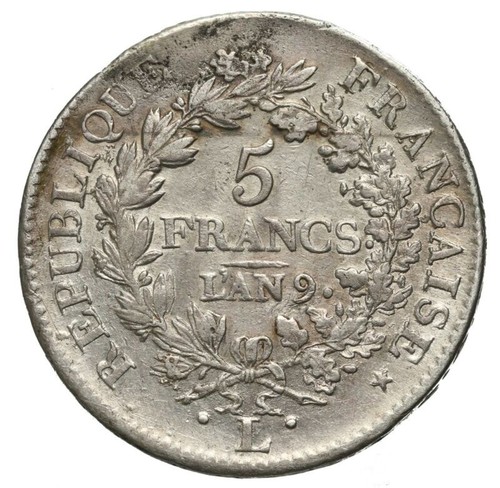
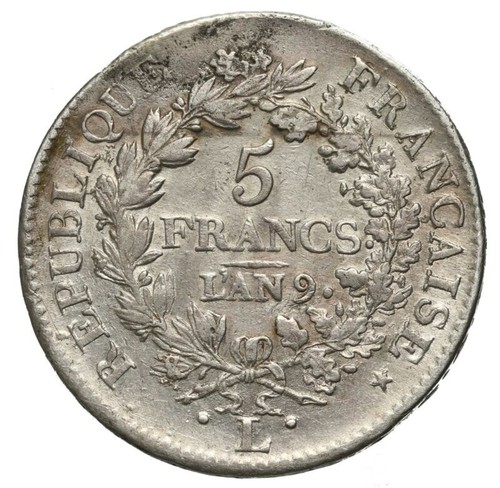
5 Francs (First Republic)
L'an 9 (1800–1801)
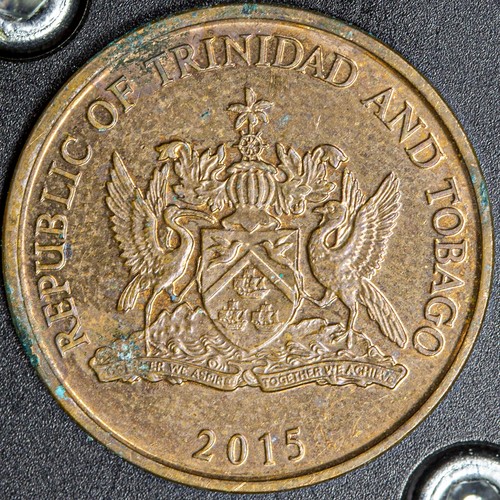
Trinidad and Tobago Dollar
2015
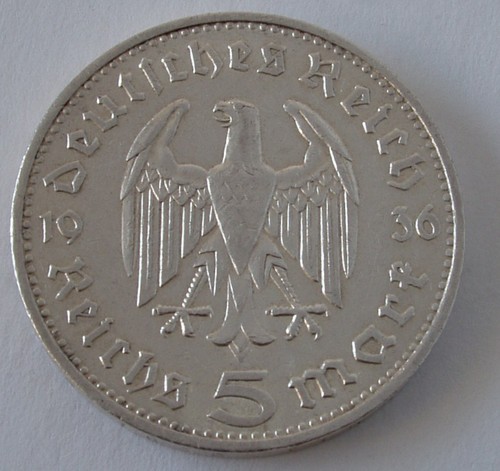
German 5 Reichsmark (Hindenburg)
1935–1936 (Hindenburg type with swastika)
5 Francs Semeuse
1960–1969
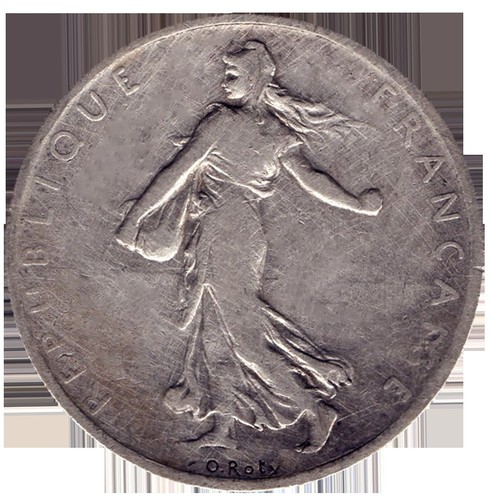
French Semeuse 2 Francs
1898–1920 (silver issues; pictured example dated 1899)
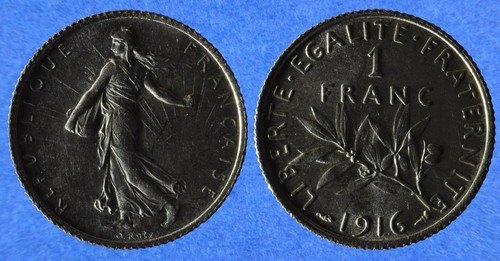
French Semeuse 1 Franc
1898–1920 (silver Semeuse 1 franc type)
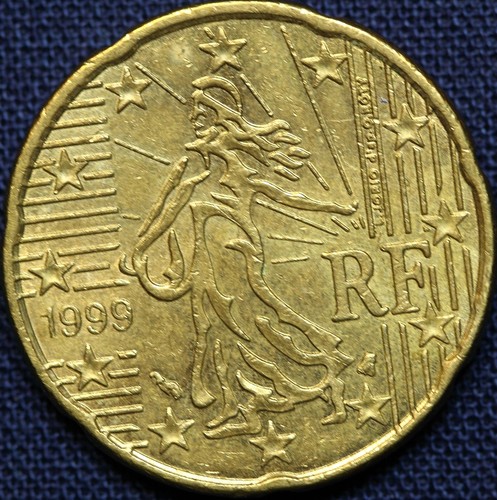
France 50 Cent Euro
1999–present
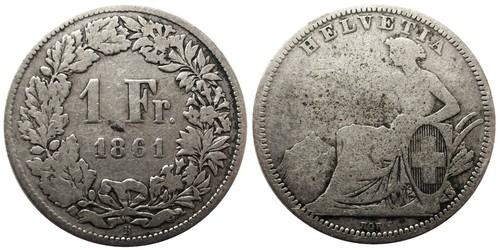
Swiss 1 Franc
1861
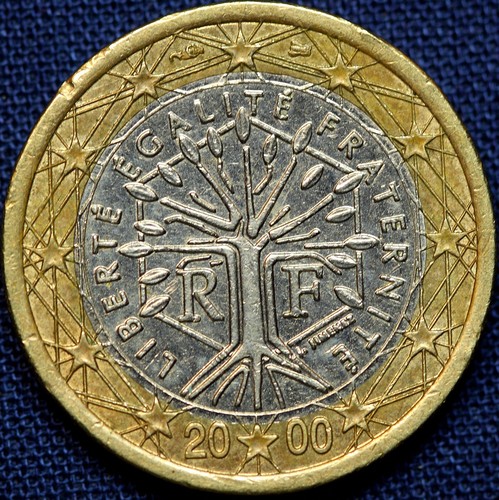
France 20 Centimes
1962–2001 (Fifth Republic, Marianne / Lagriffoul type)
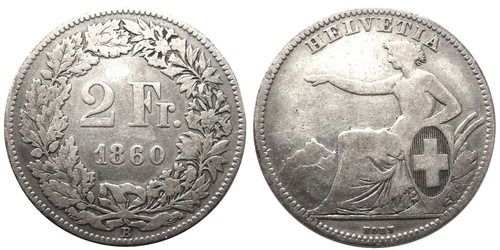
Swiss 2 Francs
1860
Austria-Hungary 15 Kreuzer
1807
Austria-Hungary 10 Kreuzer
1872 (issue shown)