
How to Identify the German 5 Reichsmark (Hindenburg)
A collector's guide to recognizing the Third Reich silver 5 Reichsmark by its Hindenburg portrait, eagle-and-swastika design, size and mint marks.
Read the full German 5 Reichsmark (Hindenburg) encyclopedia entry →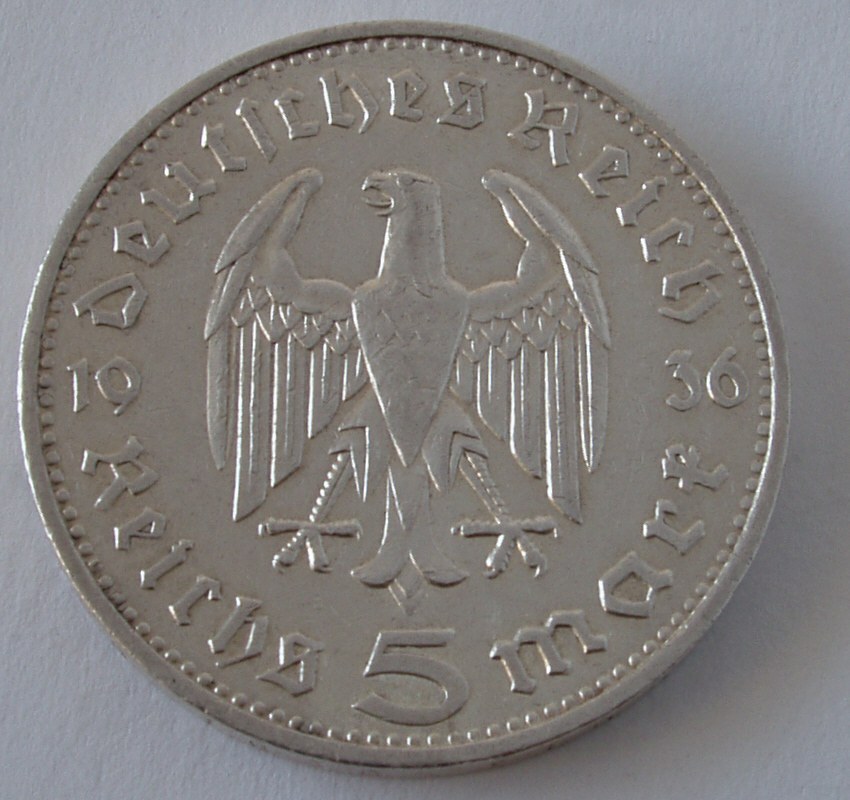
Begin with the two design sides. One face carries the German Reichsadler — a spread-winged eagle gripping a wreath that encloses a swastika — surrounded by the legend DEUTSCHES REICH and the value FÜNF REICHSMARK. The other face, which may be the one facing up on any given coin, shows a profile bust of Paul von Hindenburg with his name and the life dates 1847–1934. Seeing both together confirms the type immediately.
Confirm size, weight and metal. This is a crown-size silver coin about 29 mm in diameter, struck in .900 fine silver, weighing roughly 13.9 grams, with a reeded edge. A genuine piece feels heavy for its size and rings when struck; a coin of the right design but noticeably light, off-colour or with a smooth edge should be treated with suspicion.
Read the date and locate the mint mark. The year — 1936 on this example — appears with the design, and a single letter (A for Berlin, plus D, E, F, G and J for other German mints) tells you which mint struck it. Date and mint mark together identify the exact issue and matter for pinning down scarcer combinations.
Distinguish it from look-alikes. Note the 1935-only Hindenburg variety whose eagle carries no swastika, as well as earlier Weimar-era 5 Reichsmark types with entirely different designs (such as the oak-tree or Schiller/Kant commemoratives). If the eagle lacks a swastika, or the portrait is not Hindenburg, you are looking at a different coin or a different year.
Finally, weigh authentication. This historically significant silver type is sometimes counterfeited or altered, and cast copies, tooled dates and gilded or "novelty" versions exist. Check weight and diameter precisely, inspect the edge reeding and strike sharpness, and for higher-value or high-grade examples rely on a trusted dealer or third-party grading service rather than appearance alone.
Frequently asked questions
What is the fastest way to confirm this coin?
Look for the Hindenburg portrait with the dates 1847–1934 on one side and the eagle clutching a wreath with a swastika, legend DEUTSCHES REICH and value FÜNF REICHSMARK on the other.
Where is the mint mark and why does it matter?
A single letter (A, D, E, F, G or J) appears with the design and identifies the German mint that struck the coin. Together with the date it defines the exact issue and affects scarcity.
How do I separate it from the no-swastika version?
Check the eagle. The first 1935 Hindenburg 5 Mark shows an eagle with no swastika, while the 1935–1936 revised type — including this 1936 coin — has the eagle gripping a wreath enclosing a swastika.
How can I guard against fakes?
Verify the diameter (about 29 mm), weight (about 13.9 g of .900 silver) and reeded edge, and inspect strike detail. For valuable examples, use a reputable dealer or grading service to authenticate.