
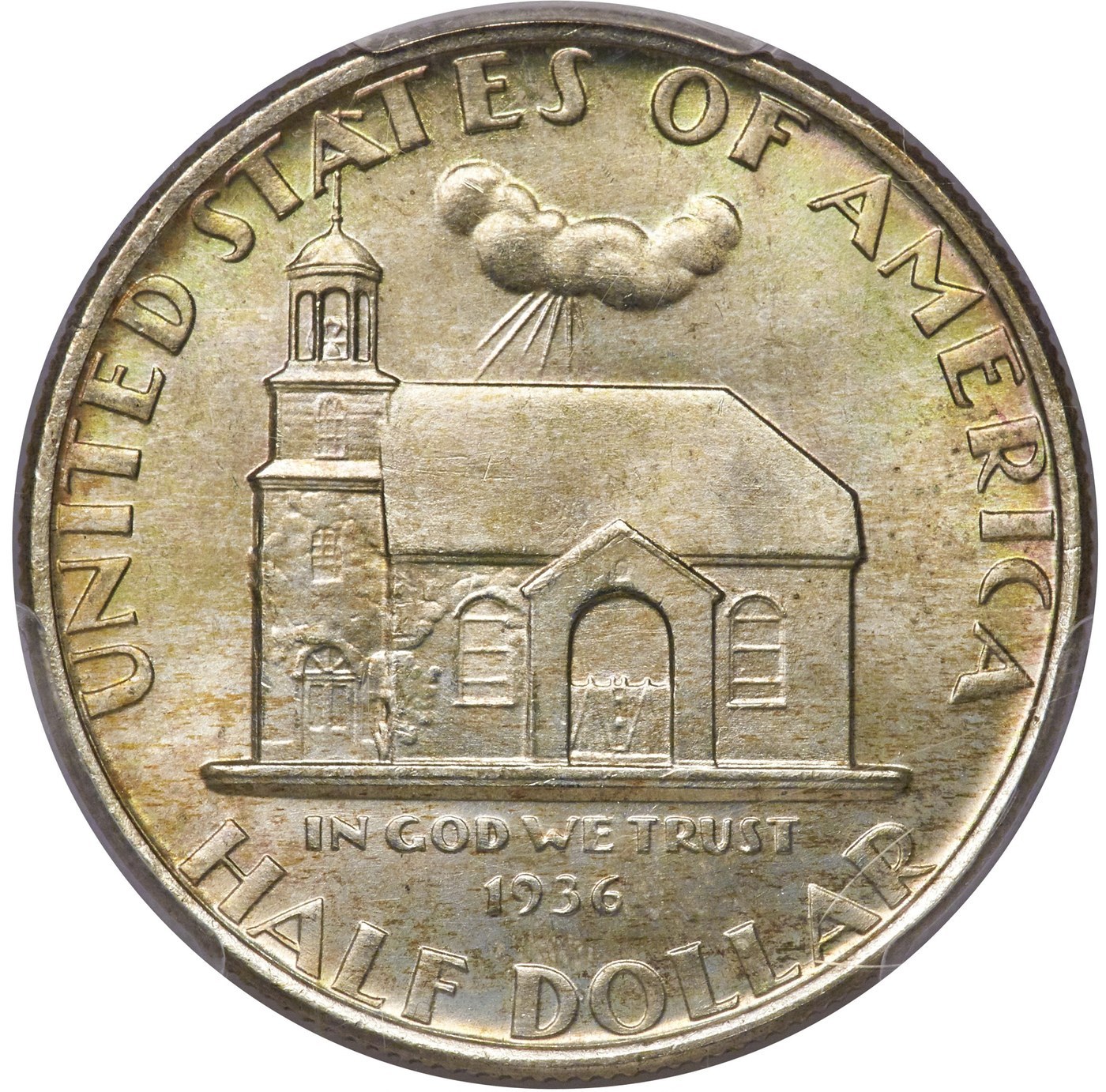
Delaware Tercentenary Half Dollar
A 1936 U.S. silver half dollar marking 300 years since Swedish colonists landed in Delaware, showing Old Swedes Church on one side and the ship Kalmar Nyckel on the other.
- Country
- United States
- Denomination
- 50¢
- Metal
- Silver
Got a coin like this?
Identify any coin from a photo, free.
Overview
The Delaware Tercentenary Half Dollar is a United States silver commemorative fifty-cent piece struck to mark the 300th anniversary of the 1638 landing of Swedish colonists at what became Wilmington, Delaware. It belongs to the "classic" commemorative series that ran from 1892 to 1954, in which Congress authorized special half dollars to honor an event, to be sold at a premium above face value to raise funds.
The coin was designed by sculptor Carl L. Schmitz. One side depicts Old Swedes Church (Holy Trinity Church) in Wilmington, a still-standing house of worship built by the early Swedish settlers, shown with its distinctive steeple. The other side shows the Kalmar Nyckel, the ship that carried the colonists across the Atlantic. The church side is the design visible in these photographs.
Struck in the standard 90% silver alloy of a regular half dollar, the coin was never meant for circulation. Today it is collected as a single-issue type within the classic commemorative half dollar set and is prized for its maritime and colonial theme.
History & Background
Congress authorized the Delaware commemorative to honor the tercentenary of the Swedish settlement on the Delaware River, where colonists founded the colony of New Sweden and built Fort Christina in 1638. Proceeds from selling the coins above face value supported the anniversary celebration, following the fundraising model used throughout the classic commemorative program.
The issue carries a well-known dating quirk. Although the coins bear the year 1936 in the legally required position, they were actually struck in 1937, and the design also displays the anniversary span of the settlement (1638 on the church side and 1938 on the ship side) — so several dates appear on the piece even though it is cataloged as a 1936 commemorative. All were produced at the Philadelphia Mint.
The design came from Carl L. Schmitz, whose work was selected for the project. The coins were distributed in modest numbers — on the order of roughly twenty thousand pieces reached the public after unsold examples were returned and melted — making it a relatively low-mintage single issue compared with the multi-mint commemorative sets of the same decade.
How to Identify
Identify the type by its two pictorial designs and lettering. The side seen here shows Old Swedes Church, a masonry church with a prominent steeple, set against a sky. Around it is lettering naming the coin and, on this side, the date 1638 tied to the settlement's founding. The opposite side, not visible in this image, depicts the sailing ship Kalmar Nyckel under sail, with the anniversary date 1938.
The coin is a standard-size half dollar: about 30.6 mm in diameter, roughly 12.5 grams, struck in 90% silver with a reeded edge. Because it was produced only at the Philadelphia Mint, a genuine example carries no mint mark. The statutory year 1936 appears on the coin even though the pieces were struck in 1937.
Neither side resembles the Walking Liberty half dollars circulating at the time; the church-and-ship pairing and the Delaware and Swedish tercentenary lettering are the surest identifiers of the type.
Value & Collectibility
As a classic silver commemorative, the Delaware Tercentenary Half Dollar trades well above its 50-cent face value and its silver content. Because it is a single-issue coin with only a modest number distributed, it is a steady favorite among commemorative collectors.
Circulated and lower-grade examples generally sell in the range of roughly one to two hundred dollars, while well-preserved uncirculated pieces bring more, and premium high-grade coins with strong eye appeal command the highest prices. Condition, original surfaces, toning, and third-party grade all strongly influence value.
Because prices move with the collector market and with a coin's grade, any specific example should be checked against recent auction results and current price guides rather than a single fixed figure.
Frequently asked questions
What does the Delaware Tercentenary Half Dollar commemorate?
It marks the 300th anniversary of the 1638 landing of Swedish colonists on the Delaware River, who founded New Sweden and built Fort Christina at present-day Wilmington.
What is shown on each side?
One side depicts Old Swedes Church (Holy Trinity Church) in Wilmington with its steeple; the other shows the ship Kalmar Nyckel that carried the settlers. The church side is the one pictured here.
Why does the coin show more than one date?
It carries the statutory year 1936 but was actually struck in 1937, and the design also displays the settlement's anniversary span, with 1638 on the church side and 1938 on the ship side.
Is it made of silver?
Yes. Like a regular U.S. half dollar of the era, it is 90% silver and 10% copper, about 12.5 grams and 30.6 mm across, with a reeded edge.
Does it have a mint mark?
No. The coins were struck only at the Philadelphia Mint, so genuine examples carry no mint mark.
Delaware Tercentenary Half Dollar guides
In-depth guides for identifying, valuing, and collecting Delaware Tercentenary Half Dollar.
Other coins you may enjoy
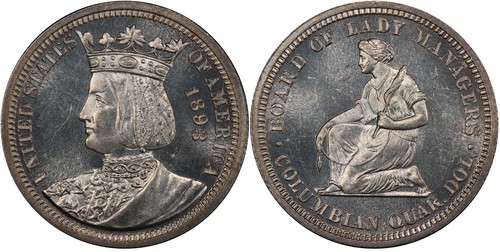
Isabella Quarter
1893
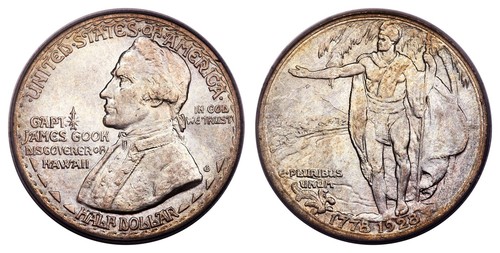
Hawaiian Sesquicentennial Half Dollar
1928
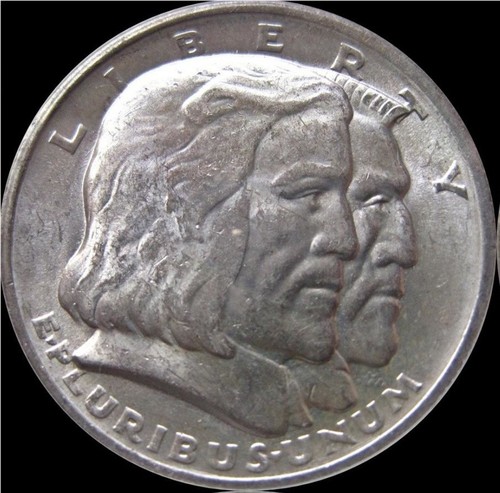
Long Island Tercentenary Half Dollar
1936
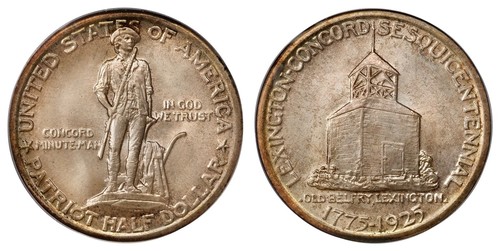
Lexington-Concord Sesquicentennial Half Dollar
1925
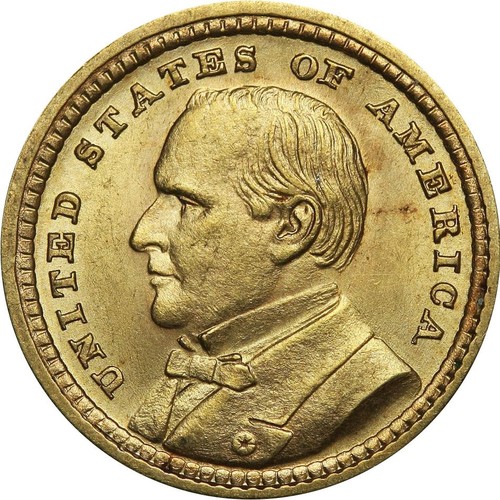
Louisiana Purchase Exposition Dollar (Jefferson)
1903
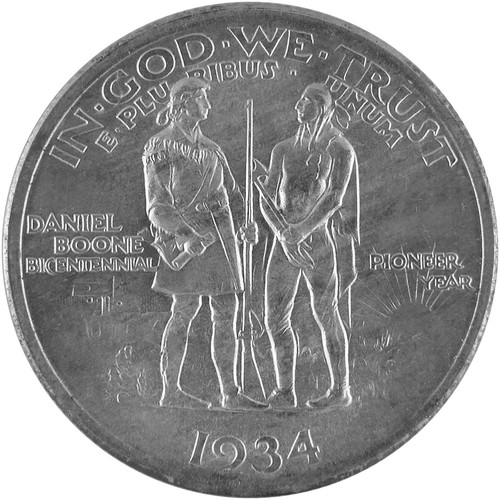
Daniel Boone Bicentennial Half Dollar
1934–1938
Cincinnati Music Center Half Dollar
1936
Elgin Illinois Centennial Half Dollar
1936
Connecticut Tercentennial Half Dollar
1935
Columbia South Carolina Sesquicentennial Half Dollar
1936
Sesquicentennial of American Independence Quarter Eagle
1926
Pilgrim Tercentenary Half Dollar
1920-1921