
How to Identify the Delaware Tercentenary Half Dollar
A collector's checklist for confirming a Delaware Tercentenary half dollar — the church and ship designs, its multiple dates, silver specs, and authentication cautions.
Read the full Delaware Tercentenary Half Dollar encyclopedia entry →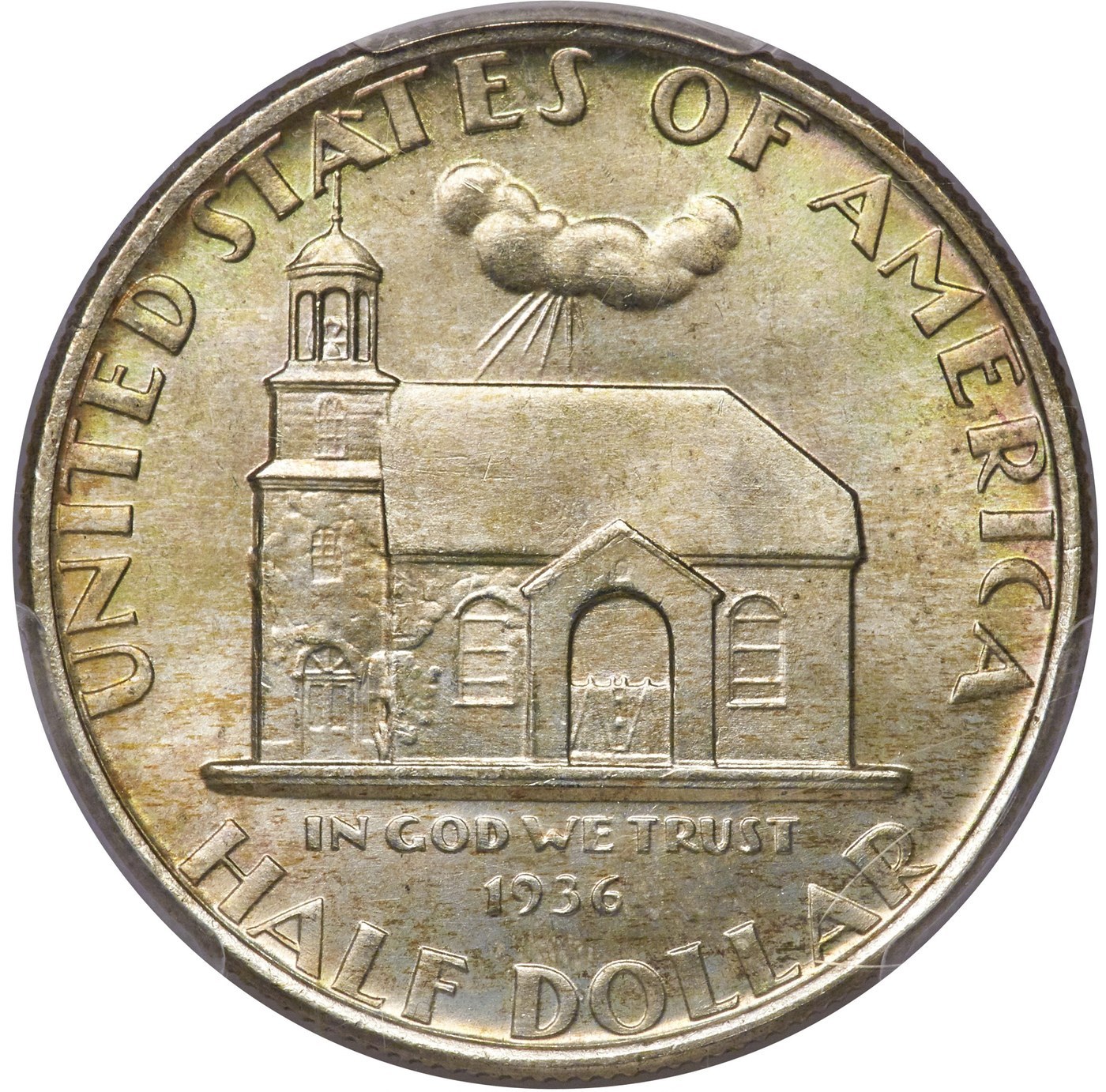
Start with the two pictorial designs, which are unlike any circulating coin. One side shows Old Swedes Church, a masonry church with a tall steeple; the other shows the sailing ship Kalmar Nyckel under full sail. If you have only one side in view — as in a photo showing the church and steeple — you can still identify the type from that scene plus the Delaware and Swedish tercentenary lettering. The church-and-ship pairing is the fastest way to separate this coin from the Walking Liberty half dollars of the same period.
Read the dates carefully, because this issue is famous for carrying several. The coin bears the statutory year 1936, yet the pieces were struck in 1937, and the design also shows the settlement anniversary span — 1638 near the church and 1938 near the ship. Seeing more than one date is normal for this type and is not a sign of alteration.
Verify the physical specifications. The coin is a standard half dollar: roughly 30.6 mm in diameter, about 12.5 grams, struck in 90% silver with a reeded edge. A calibrated scale and calipers are the best tools; a piece that is off in weight, diameter, or edge reeding for a silver half dollar is a warning sign. Expect no mint mark, since all genuine examples were struck at Philadelphia.
Be cautious with authentication, as desirable single-issue commemoratives are targets for counterfeits and for cleaned or artificially toned surfaces. Watch for mushy or doubled lettering, an incorrect weight, a color that does not match 90% silver, or a design detail that looks tooled. For any higher-value or high-grade purchase, rely on reputable dealers and third-party grading (PCGS, NGC) rather than eye appeal alone.
Frequently asked questions
How can I identify the coin from just the church side?
The church side shows Old Swedes Church with its steeple, along with Delaware tercentenary lettering and the date 1638. That scene, unlike any circulating design, identifies the type even without the ship side visible.
Why are there several dates on the coin?
It carries the statutory year 1936 but was struck in 1937, and the design also shows the settlement anniversary of 1638 (church side) to 1938 (ship side). Multiple dates are normal for this issue.
What should a genuine example weigh and measure?
About 12.5 grams and roughly 30.6 mm in diameter, in 90% silver with a reeded edge. Figures that don't match a standard silver half dollar are a counterfeit warning sign.
Should the coin have a mint mark?
No. All were struck at the Philadelphia Mint with no mint mark. A mint mark on this type warrants caution.