
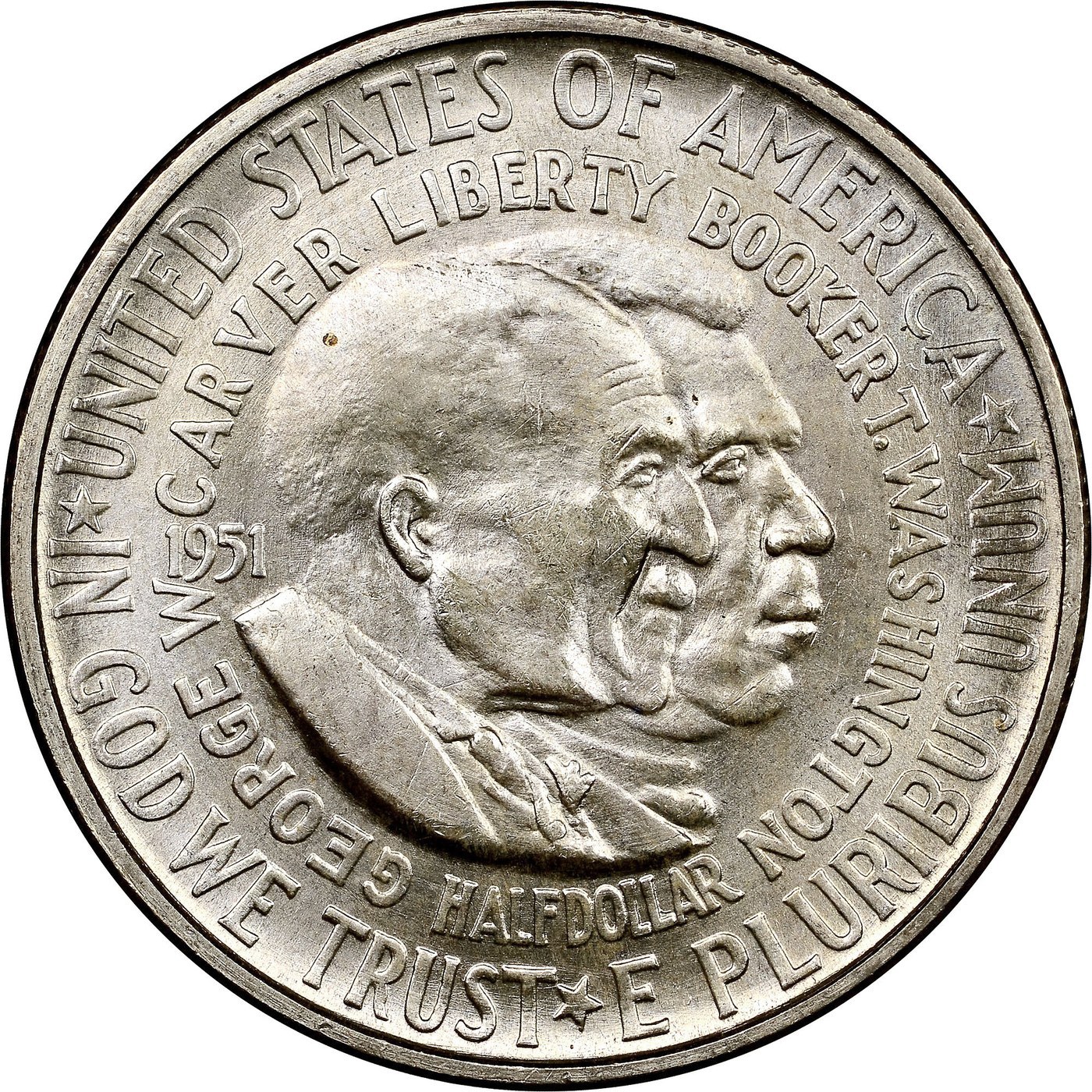
Carver-Washington Half Dollar
A U.S. silver commemorative half dollar (1951–1954) honoring George Washington Carver and Booker T. Washington, with their jugate profiles on the obverse.
- Country
- United States
- Denomination
- 50¢
- Metal
- Silver
Got a coin like this?
Identify any coin from a photo, free.
Overview
The Carver-Washington Half Dollar is a United States silver commemorative fifty-cent piece struck from 1951 through 1954. It honors two prominent African American figures: scientist and educator George Washington Carver and educator Booker T. Washington. The obverse shows their conjoined (jugate) profile busts facing right, and the photographed 1951 example displays exactly this pairing.
The coin belongs to the classic commemorative series that ran from 1892 to 1954, in which Congress authorized special half dollars to mark people or events and sold them at a premium to raise funds. It followed directly on the earlier Booker T. Washington Memorial half dollar of 1946–1951, sharing the same designer and much of the same distribution structure.
Struck in the standard 90% silver alloy of a regular half dollar, it was never meant for circulation. Today it is collected as one of the final issues of the classic commemorative program and as a coin of notable historical significance for its subjects.
History & Background
Congress authorized the Carver-Washington half dollar in 1951, extending the earlier Booker T. Washington Memorial coinage program. The stated purposes included promoting the memory of both men and opposing the spread of communism among African Americans, reflecting the Cold War rhetoric of the era. Proceeds from sales above face value were directed to these causes.
The designs are the work of Isaac Scott Hathaway, the same sculptor who created the preceding Booker T. Washington half dollar and who was among the first African American artists to design a United States coin. His obverse pairs Carver and Washington in overlapping right-facing profiles.
The coins were issued each year from 1951 to 1954 across all three operating mints of the period — Philadelphia, Denver, and San Francisco — usually in three-coin annual sets. Distribution was handled largely by the Sesquicentennial-style commission behind the program. Sales were uneven and much of the authorized coinage went unsold and was melted, so surviving mintages for individual date-and-mint combinations vary from the hundreds of thousands down to far smaller numbers.
How to Identify
Identify the type by its obverse portraits and lettering. A genuine Carver-Washington half dollar shows two overlapping right-facing busts — George Washington Carver and Booker T. Washington — with their names and the words "UNITED STATES OF AMERICA" and "HALF DOLLAR" among the surrounding inscriptions. The photographed 1951 coin matches this jugate portrait exactly.
The reverse, not visible in this image, carries a stylized map of the continental United States with the letters "USA" and the mottoes "FREEDOM AND OPPORTUNITY FOR ALL" and "AMERICANISM." The coin is a standard-size half dollar: about 30.6 mm in diameter, roughly 12.5 grams, struck in 90% silver with a reeded edge.
Date and mint are the key variables. The coin was issued 1951 through 1954; Philadelphia strikes carry no mint mark, while Denver (D) and San Francisco (S) strikes show a small mint mark on the reverse. Because the jugate Carver-Washington obverse is unlike the single Booker T. Washington bust of the 1946–1951 issue, the two portraits are the surest way to separate this type from its predecessor.
Value & Collectibility
As a classic silver commemorative, the Carver-Washington half dollar is worth more than its face value and its silver content, but it is one of the more affordable coins in the series because many dates were made in relatively large numbers. Common circulated and lightly worn examples typically trade from the low tens of dollars upward.
Value depends heavily on the specific date and mint mark, the grade, and eye appeal. Certain low-mintage date-and-mint combinations and high-grade uncirculated pieces command stronger premiums, while original three-coin sets and well-preserved examples are more desirable than worn singles.
Because prices move with the collector market and vary by date, mint, and condition, any particular coin should be checked against recent auction results and current price guides rather than a single fixed figure.
Frequently asked questions
Who is pictured on the Carver-Washington Half Dollar?
The obverse shows conjoined right-facing busts of George Washington Carver, the scientist and educator, and Booker T. Washington, the educator and founder of Tuskegee Institute.
What years was it made?
It was struck from 1951 through 1954 at the Philadelphia, Denver, and San Francisco mints, usually issued in annual three-coin sets.
Is it made of silver?
Yes. Like a regular U.S. half dollar of the era, it is struck in 90% silver with 10% copper, about 12.5 grams and 30.6 mm across, with a reeded edge.
How is it different from the Booker T. Washington half dollar?
The earlier 1946–1951 coin shows a single portrait of Booker T. Washington. The Carver-Washington issue adds George Washington Carver, showing both men together as overlapping busts.
Does it have a mint mark?
Philadelphia coins have no mint mark. Denver and San Francisco coins carry a small D or S mint mark on the reverse, near the U.S. map design.
Carver-Washington Half Dollar guides
In-depth guides for identifying, valuing, and collecting Carver-Washington Half Dollar.
Other coins you may enjoy
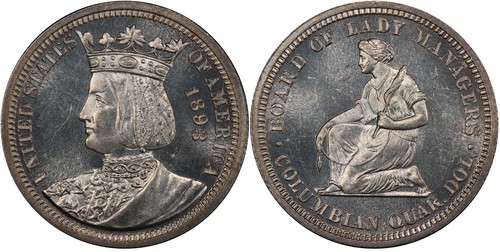
Isabella Quarter
1893
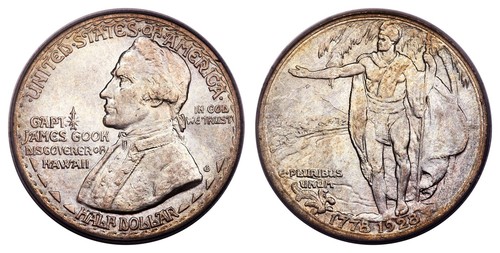
Hawaiian Sesquicentennial Half Dollar
1928
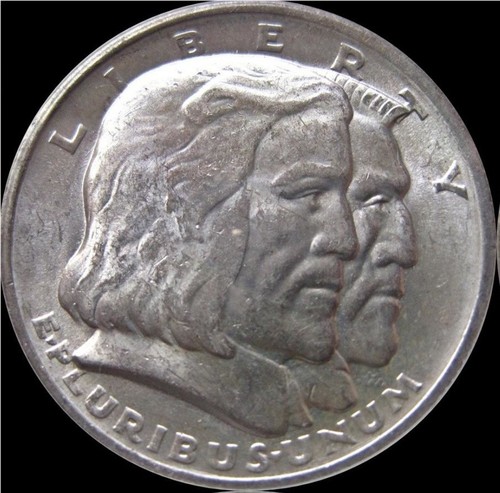
Long Island Tercentenary Half Dollar
1936
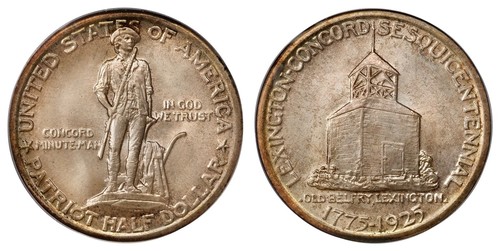
Lexington-Concord Sesquicentennial Half Dollar
1925
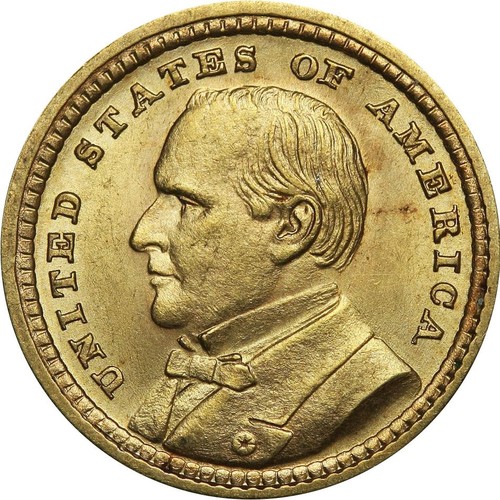
Louisiana Purchase Exposition Dollar (Jefferson)
1903
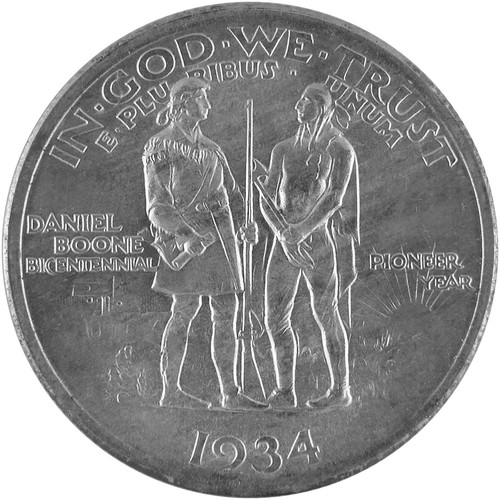
Daniel Boone Bicentennial Half Dollar
1934–1938
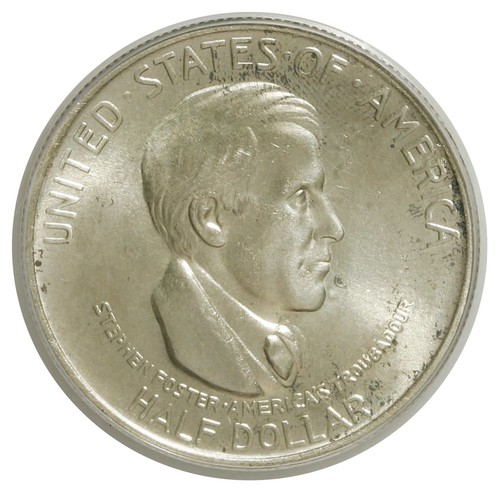
Cincinnati Music Center Half Dollar
1936
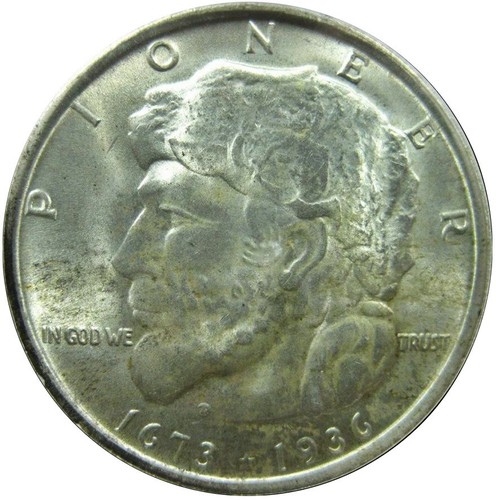
Elgin Illinois Centennial Half Dollar
1936
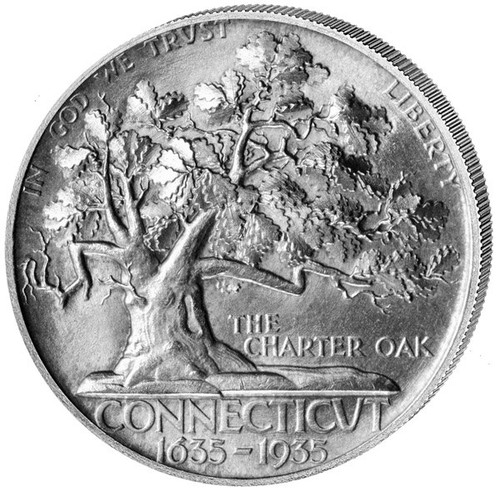
Connecticut Tercentennial Half Dollar
1935
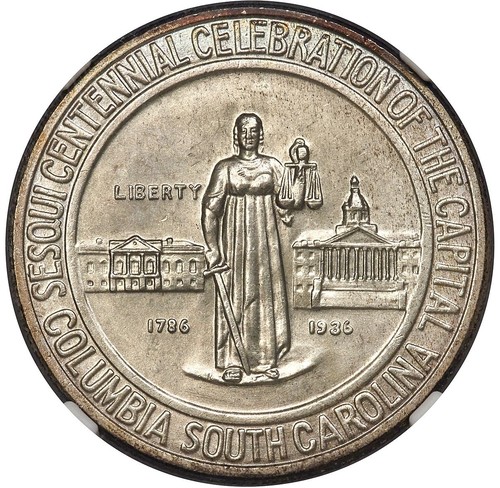
Columbia South Carolina Sesquicentennial Half Dollar
1936
Sesquicentennial of American Independence Quarter Eagle
1926
Pilgrim Tercentenary Half Dollar
1920-1921