
How to Identify the Carver-Washington Half Dollar
A collector's checklist for confirming a Carver-Washington half dollar — the twin busts, U.S. map reverse, silver specs, dates, mint marks, and look-alikes.
Read the full Carver-Washington Half Dollar encyclopedia entry →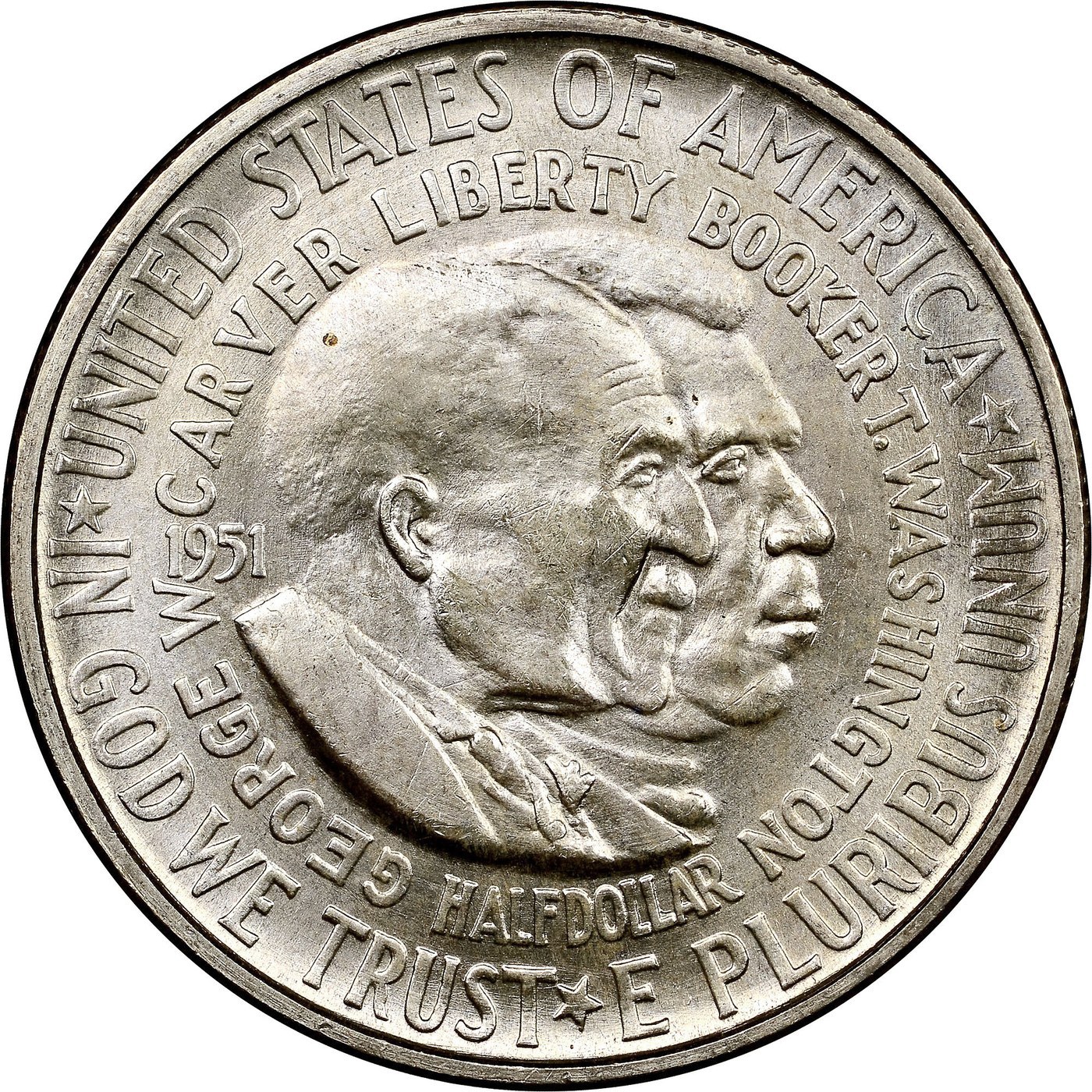
Start with the obverse portraits. A genuine Carver-Washington half dollar shows two overlapping right-facing busts — George Washington Carver and Booker T. Washington — identified by name in the surrounding lettering, along with "UNITED STATES OF AMERICA" and "HALF DOLLAR." The photographed 1951 coin shows exactly this jugate pairing, which is the single fastest way to confirm the type.
Check the reverse for the map design. The reverse carries a stylized outline of the continental United States with the letters "USA" and the mottoes "FREEDOM AND OPPORTUNITY FOR ALL" and "AMERICANISM." This map-and-motto reverse is unlike any circulating half dollar of the period, so it reliably separates the coin from Franklin or Walking Liberty halves.
Distinguish it from the earlier Booker T. Washington half dollar (1946–1951). That predecessor, by the same designer, shows only a single bust of Washington. If you see just one portrait, you have the earlier BTW issue; two overlapping busts mean the Carver-Washington type. This is the most common point of confusion for the two.
Verify the physical specifications and the date and mint. The coin should measure roughly 30.6 mm in diameter, weigh about 12.5 grams, and be struck in 90% silver with a reeded edge; a calibrated scale and calipers are the best tools. The date should fall in 1951–1954. Philadelphia strikes have no mint mark, while Denver (D) and San Francisco (S) coins carry a small mint mark on the reverse — note it, because scarcer date-and-mint pairings affect value.
Be cautious with authentication. Values are modest for common dates but higher for scarce ones and high grades, so watch for altered mint marks, tooling, weight or color that does not match 90% silver, and mushy or doubled lettering. For any higher-value purchase, rely on reputable dealers and third-party grading (PCGS, NGC) rather than eye appeal alone.
Frequently asked questions
How do I tell it from the Booker T. Washington half dollar?
Count the portraits. The Carver-Washington coin shows two overlapping busts — Carver and Washington. The earlier 1946–1951 Booker T. Washington half dollar shows a single bust of Washington alone.
What is on the reverse?
A stylized map of the continental United States with the letters USA and the mottoes FREEDOM AND OPPORTUNITY FOR ALL and AMERICANISM. This map design is not found on any circulating half dollar of the era.
What should a genuine example weigh and measure?
About 12.5 grams and roughly 30.6 mm in diameter, struck in 90% silver with a reeded edge. Figures that don't match a standard silver half dollar are a counterfeit warning sign.
Where is the mint mark?
On the reverse. Philadelphia coins carry none, while Denver and San Francisco coins show a small D or S near the U.S. map. The date should be between 1951 and 1954.