Capped Head Quarter Eagle
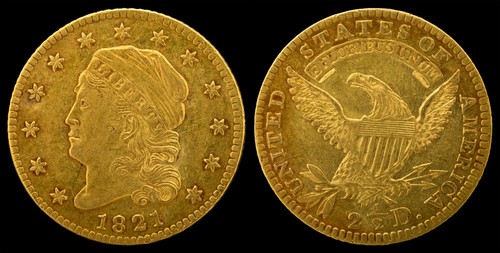
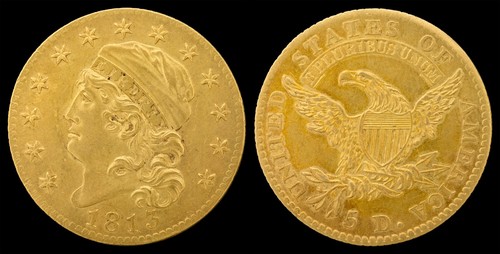
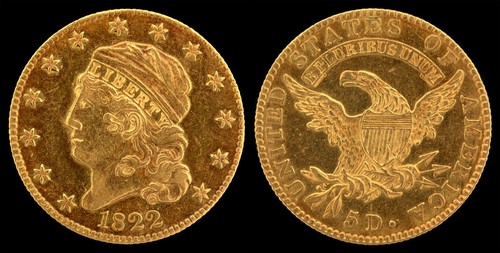
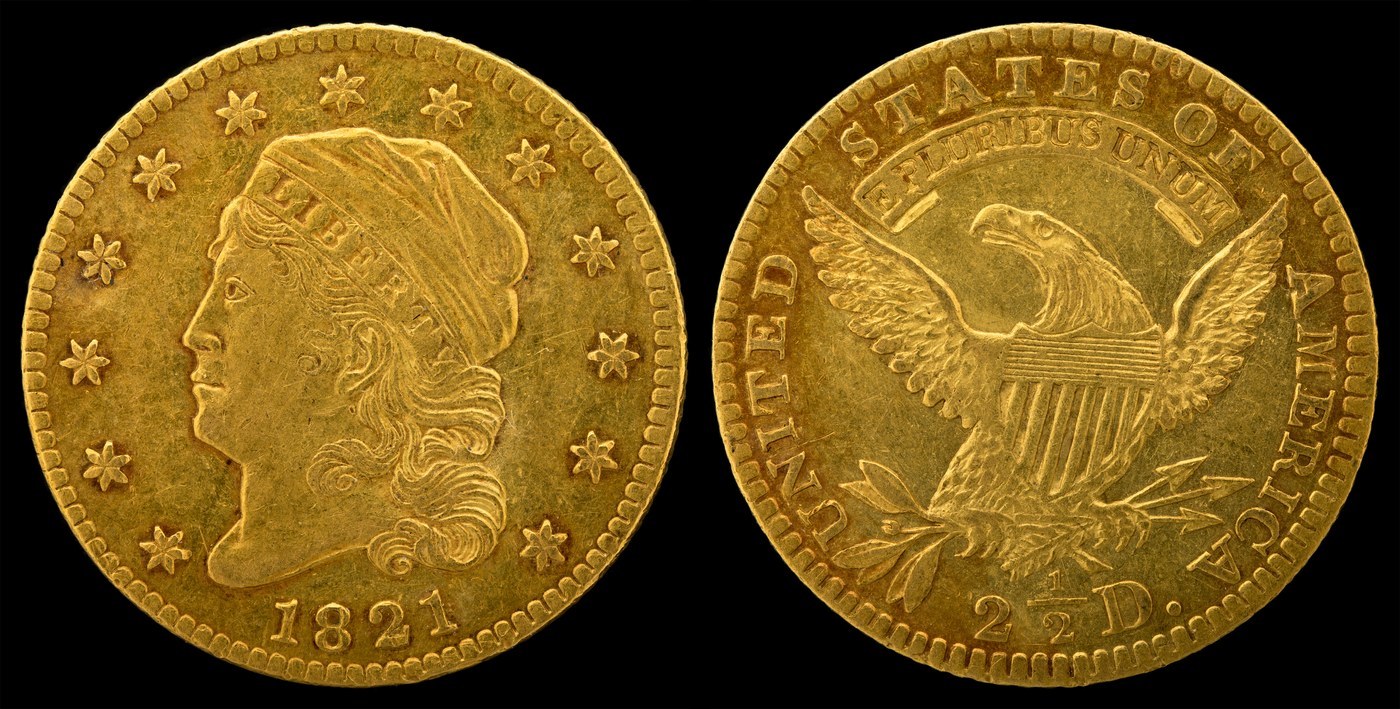
A rare early U.S. $2.50 gold coin struck 1821–1834, showing a left-facing capped Liberty head amid stars and a heraldic eagle with shield and E PLURIBUS UNUM.
- Country
- United States
- Denomination
- Two and a Half Dollars ($2.50)
- Metal
- Gold (.9167 fine)
Got a coin like this?
Identify any coin from a photo, free.
Overview
The Capped Head Quarter Eagle is a United States two-and-a-half-dollar gold coin produced at the Philadelphia Mint from 1821 through 1834. Its obverse shows Liberty facing left in a soft cap, encircled by stars with the date below, while the reverse carries a heraldic eagle with a shield on its breast, spread wings, and the motto E PLURIBUS UNUM. The photographed 1821 coin is the first year of the type.
Struck in very small numbers during a period when gold coins were widely hoarded and melted, surviving examples of every date are scarce, and the type is one of the more difficult early gold series to complete. It is prized by collectors of early American gold both for its rarity and for John Reich's refined neoclassical portrait of Liberty.
History & Background
The quarter eagle was authorized by the Coinage Act of 1792, but production was intermittent in the Mint's early decades. The Capped Head design was introduced in 1821, replacing the earlier Capped Bust quarter eagles. The obverse portrait is generally attributed to John Reich, whose capped Liberty appears across several denominations of this era.
The series is usually divided into two sub-types: a larger-diameter format struck from 1821 to 1827, and a reduced-diameter format struck from 1829 to 1834, the latter reworked by engraver William Kneass. Throughout the period, gold's market value stood above its face value, so quarter eagles rarely circulated and were frequently melted for bullion — a key reason mintages were tiny and survivors are so few. The type ended in 1834, when the Coinage Act of that year reduced the gold content and ushered in the Classic Head quarter eagle.
How to Identify
The obverse depicts Liberty in left profile wearing a cap over curled hair, with the word LIBERTY on a band across the cap, stars arranged around the rim, and the date at the bottom. The reverse shows a heraldic eagle with a shield on its breast, wings spread, an olive branch and arrows in its talons, the motto E PLURIBUS UNUM on a ribbon above, the legend UNITED STATES OF AMERICA, and the denomination 2 1/2 D. below the eagle.
The coin is struck in gold of .9167 fineness and weighs roughly 4.37 grams. The 1821–1827 issues are about 18.5 mm in diameter, while the 1829–1834 issues were struck on a slightly smaller, thicker planchet near 18.2 mm. The edge is reeded. There is no mint mark, as every Capped Head Quarter Eagle was struck at Philadelphia.
Value & Collectibility
Because mintages were minuscule and most pieces were melted, Capped Head Quarter Eagles are rare and valuable in every grade. Even well-worn, problem-free examples generally trade from the low five figures upward, and choice or high-grade coins can bring well into five and six figures at auction. Precise values swing widely with date, die variety, strike, and surface condition.
Several dates in the series are recognized as major rarities with only small numbers known. Given the high values and the prevalence of counterfeits and altered pieces in early gold, third-party authentication and grading are strongly recommended before any purchase or sale.
Frequently asked questions
What is a Capped Head Quarter Eagle?
It is a United States $2.50 gold coin struck at the Philadelphia Mint from 1821 to 1834, with a left-facing capped Liberty head and a heraldic eagle reverse.
What does the 1821 date signify?
1821 is the first year the Capped Head design was used on the quarter eagle, marking the start of the type that ran through 1834.
What is it made of?
It is struck in gold of .9167 fineness, weighs about 4.37 grams, is roughly 18.5 mm across on the earlier issues, and has a reeded edge.
Does it have a mint mark?
No. All Capped Head Quarter Eagles were struck at the Philadelphia Mint, which used no mint mark in this period.
Why are they so rare?
Mintages were very small, and because the coins' gold was worth more than face value, most were hoarded or melted, leaving few survivors of any date.
Capped Head Quarter Eagle guides
In-depth guides for identifying, valuing, and collecting Capped Head Quarter Eagle.