Capped Bust Half Eagle
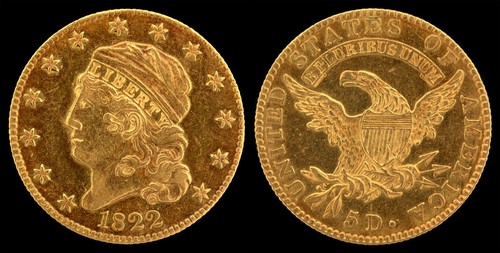
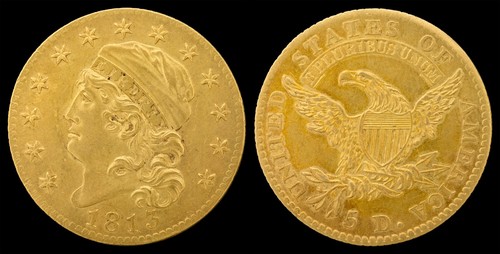
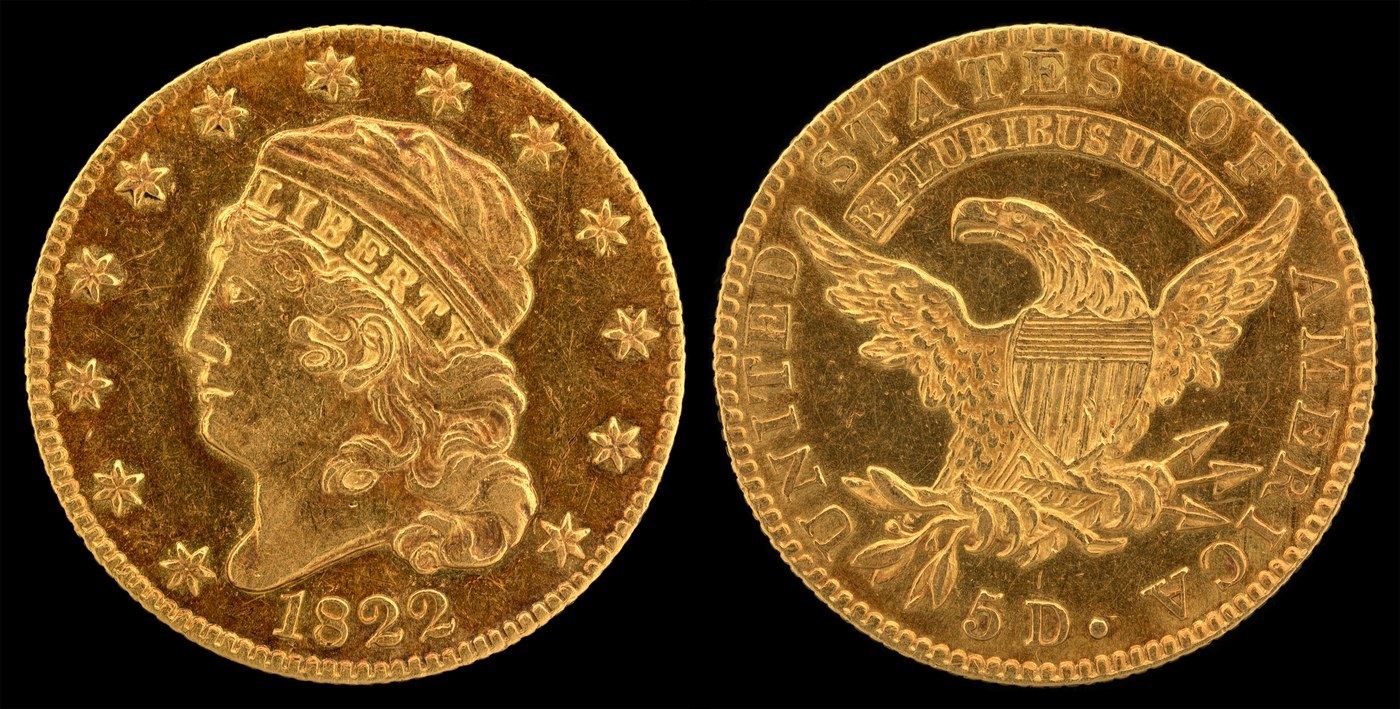
Early U.S. five-dollar gold coin with a left-facing capped Liberty and a shield-breasted eagle marked "5 D."; the 1822 shown is a legendary rarity.
- Country
- United States
- Denomination
- 5 dollars
- Metal
- 91.67% Gold, 8.33% Silver and Copper
Got a coin like this?
Identify any coin from a photo, free.
Overview
The Capped Bust Half Eagle is an early United States five-dollar gold coin. The example shown here is the left-facing "Capped Head" type, with Liberty wearing a soft cap and facing left on the obverse and a spread-winged eagle carrying a Union shield on the reverse, where the value appears as "5 D." It is dated 1822.
Struck in a high-purity gold alloy at the Philadelphia Mint, the half eagle was the workhorse gold denomination of the young republic. The 1822 date, however, is anything but ordinary: it is one of the most famous rarities in all of American numismatics, with only a tiny number of authenticated survivors known. Any coin presenting this date warrants especially careful, professional scrutiny.
History & Background
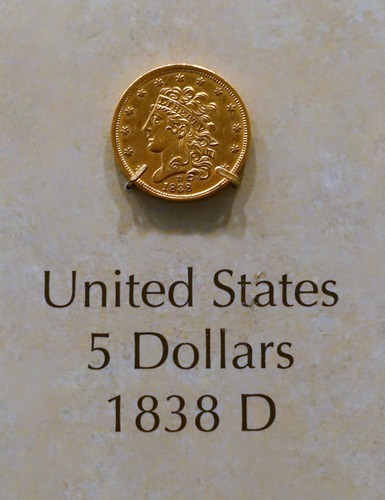
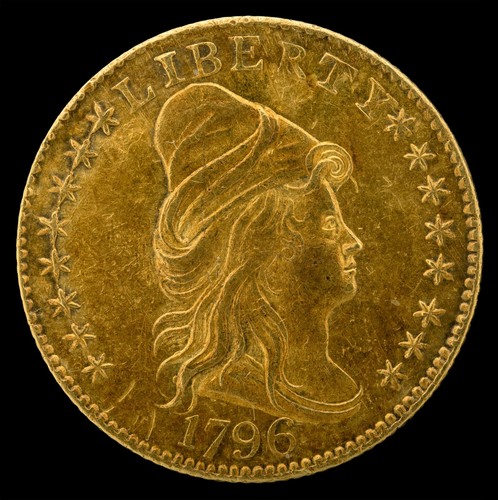
The Capped Bust half eagle family was engraved by John Reich, whose design first appeared on the five-dollar gold piece in 1807 as a left-facing, cap-wearing Liberty. In 1813 the portrait was modified into the tighter "Capped Head Left" style seen on the 1822 coin, and this type continued through 1834. During these years the Mint standard for gold remained the original .9167 fineness (about 22 karats) inherited from the 1790s.
Because U.S. gold coins were valued at less than the market price of their bullion for much of this period, enormous numbers of early half eagles were exported and melted, which is why so many dates from the 1810s through early 1830s are rare today. The 1822 is the most celebrated casualty of that era: although the Mint recorded a delivery of 1822-dated half eagles, only three examples are known to survive, two of them held permanently in the Smithsonian's National Numismatic Collection. In 1834 the gold standard was lowered and the design was replaced by the smaller Classic Head half eagle.
How to Identify
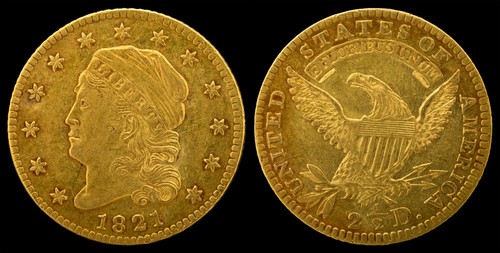
The obverse shows Liberty facing left in a soft, rounded cap, encircled by stars with the date below. The reverse depicts an eagle with wings spread, a striped Union shield on its breast, clutching an olive branch and arrows, with "UNITED STATES OF AMERICA" around the rim, the motto "E PLURIBUS UNUM" on a scroll above, and the denomination expressed as "5 D." at the bottom.
The coin is small but heavy for its size: the Capped Head half eagle weighs about 8.75 grams in a gold alloy of roughly 91.7% gold with silver and copper. Early-style pieces of this era measure about 25 mm across (the diameter was reduced later in the type, from 1829). All were struck at the Philadelphia Mint and therefore carry no mint mark.
Given that a genuine 1822 half eagle is one of the rarest U.S. coins in existence, a piece bearing that date should be treated with caution: examine the weight, diameter, and edge reeding, and be aware that most 1822-dated half eagles encountered outside major collections are replicas, altered-date coins, or counterfeits.
Value & Collectibility
As a type, early Capped Head half eagles are scarce and valuable gold coins, with even common dates in worn grades trading well above their gold content because of strong collector demand and low survival rates. Condition, originality, and specific date drive prices, which range broadly from four figures into much higher territory for better dates and high grades.
The 1822 stands entirely apart. With only three known and two of them off the market permanently, it ranks among the most valuable coins ever sold; the single privately held example has changed hands for figures in the millions of dollars. For that reason, the realistic value of an 1822-dated piece hinges first on authentication: a verified original is a landmark rarity, while the far more common replicas and altered coins carry little or no numismatic premium. Cleaning, tooling, and mount marks sharply reduce the value of any genuine early gold coin, so originality and professional certification are decisive.
Frequently asked questions
What is a Capped Bust Half Eagle made of?
It is an early U.S. gold five-dollar coin struck in roughly 91.7% gold with the balance silver and copper. The Capped Head type weighs about 8.75 grams and measures around 25 mm across for the early-diameter issues.
Why does the reverse say "5 D." instead of "FIVE DOLLARS"?
Early U.S. gold coins abbreviated the value. On the half eagle the denomination is expressed as "5 D." for five dollars, shown at the bottom of the reverse beneath the eagle.
Is an 1822 Capped Bust Half Eagle really that rare?
Yes. The 1822 half eagle is one of the most famous rarities in American numismatics, with only three authenticated examples known and two held permanently by the Smithsonian. Almost any 1822 seen for sale should be assumed to be a replica or altered coin until professionally authenticated.
Does a Capped Bust Half Eagle have a mint mark?
No. All Capped Head half eagles were struck at the Philadelphia Mint, which used no mint mark in this era, so a genuine coin carries no mint-mark letter.
Capped Bust Half Eagle guides
In-depth guides for identifying, valuing, and collecting Capped Bust Half Eagle.