
How to Identify the Capped Bust Half Eagle
Identify a Capped Bust Half Eagle by its left-facing capped Liberty, shield-breasted eagle, small heavy gold planchet, "5 D." value, and no mint mark.
Read the full Capped Bust Half Eagle encyclopedia entry →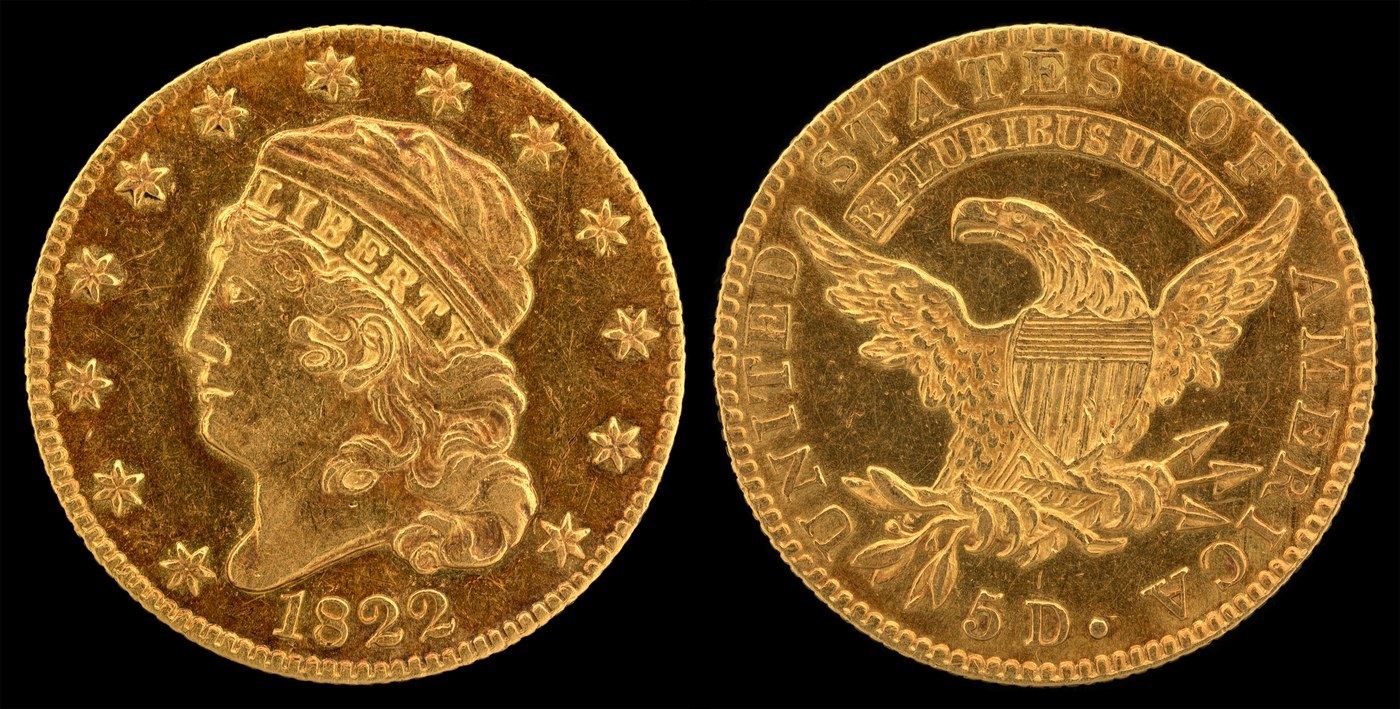
What It Is
The Capped Bust Half Eagle is an early United States five-dollar gold coin engraved by John Reich. The coin pictured is the left-facing "Capped Head Left" type struck from 1813 to 1834, and it is dated 1822—a date that carries extraordinary significance, since a genuine 1822 half eagle is among the rarest of all U.S. coins.
Obverse (Front)
Look for Liberty facing left, wearing a soft rounded cap, surrounded by stars with the four-digit date below. The left-facing, cap-wearing portrait distinguishes this type from the earlier Capped Bust Right half eagles (1795–1807), which face right. The head fills much of the field on the Capped Head style.
Reverse (Back)
The reverse shows an eagle with wings spread and a striped Union shield on its breast, holding an olive branch and arrows. "UNITED STATES OF AMERICA" curves around the rim, a scroll above the eagle reads "E PLURIBUS UNUM," and the denomination "5 D." sits at the bottom. There is no mint mark on any coin of this type.
Size, Metal, and Edge
This is a small but dense coin—about 25 mm across for the early-diameter issues and roughly 8.75 grams, struck in gold of about 91.7% purity. It should feel notably heavy for its size and show a reeded edge. Weight and diameter are among the most practical first checks: a piece that is too light, too large, or non-magnetic-but-wrong in heft is a warning sign.
Look-Alikes and Cautions
Do not confuse this type with the right-facing Capped Bust Right half eagle (1795–1807) or the smaller Classic Head half eagle that replaced it after 1834. The most important caution concerns the date: because the genuine 1822 half eagle has only three known survivors, the overwhelming majority of 1822-dated pieces in circulation are replicas, souvenir strikes, or coins with altered dates (often re-cut from a more common year). Cast counterfeits, added mint marks, tooling, and solder or mount marks are all common. Any coin presenting as an 1822 half eagle—or indeed any early U.S. gold—should be authenticated by a reputable third-party grading service before it is bought, sold, or insured.
Frequently asked questions
How can I tell a Capped Bust Half Eagle from a Classic Head or Capped Bust Right half eagle?
The Capped Head type shows Liberty in a soft cap facing left with a spread-winged, shield-breasted eagle reading "5 D." The earlier Capped Bust Right type faces right, and the later Classic Head is smaller with a bare-headed Liberty. The left-facing capped portrait is the key tell.
Where is the mint mark on a Capped Bust Half Eagle?
There isn't one. Every coin of this type was struck at the Philadelphia Mint, which did not use a mint mark in this period, so a genuine example shows no mint-mark letter.
I have an 1822 half eagle—could it be genuine?
It is extremely unlikely without authentication. Only three genuine 1822 half eagles are known, and two are permanently in the Smithsonian. Most 1822-dated pieces are replicas or altered-date coins, so have any candidate examined by a professional grading service before drawing conclusions.
How do I check that an early gold half eagle is authentic?
Verify the weight (about 8.75 g), diameter (about 25 mm for early issues), gold color and heft, and a proper reeded edge, and inspect the date and surfaces for tooling or alteration. Because early U.S. gold is heavily counterfeited, certification by a reputable grading service is the reliable test.