Andrew Jackson Presidential Dollar
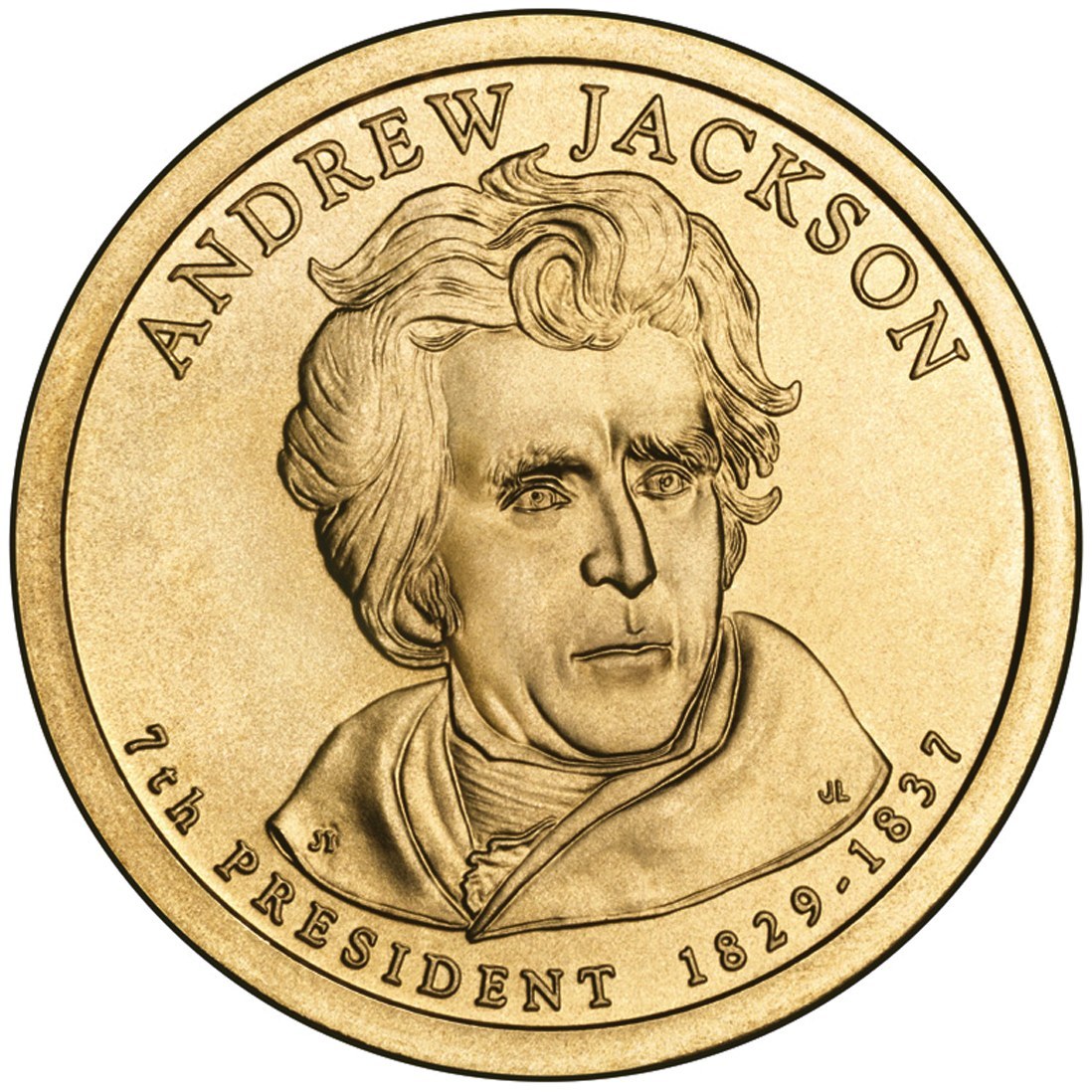
2008 U.S. golden dollar honoring Andrew Jackson, the seventh president; part of the Presidential $1 Coin Program with edge-lettered inscriptions.
- Country
- United States
- Denomination
- 1 dollar
- Metal
- Manganese brass (copper core clad in manganese-brass)
Got a coin like this?
Identify any coin from a photo, free.
Overview
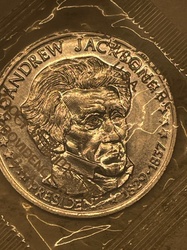
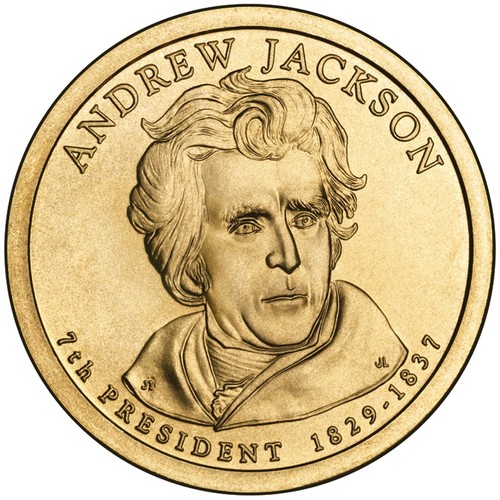
The Andrew Jackson Presidential Dollar is a United States one-dollar coin issued in 2008 as part of the Presidential $1 Coin Program, which honored former presidents in the order they served. Jackson, the seventh president, was the third of the four presidents featured in 2008, following James Monroe and John Quincy Adams and preceding Martin Van Buren. The obverse shows a left-facing portrait of Jackson with the legends "ANDREW JACKSON," "7th PRESIDENT," and his years in office, "1829–1837"; unlike later issues, this face carries no "IN GOD WE TRUST," which appears instead on the edge.
Like all Presidential dollars of the series, the coin has a distinctive golden color from its manganese-brass outer layer, a plain (non-reeded) edge carrying incused inscriptions, and a shared reverse depicting the Statue of Liberty. The example pictured is a 2008 issue showing the Jackson obverse; the reverse is not visible in the photograph but is the standard Statue of Liberty design used throughout the program.
History & Background
The Presidential $1 Coin Program was established by the Presidential $1 Coin Act of 2005 and ran from 2007 through 2016, with a final 2020 issue for Ronald Reagan. Four different presidents were released each year in order of service. Andrew Jackson's coin appeared in 2008 alongside those of James Monroe, John Quincy Adams, and Martin Van Buren. The program was intended to encourage everyday use of dollar coins and to spotlight each president in turn.
The coins share a common reverse featuring the Statue of Liberty, designed by U.S. Mint sculptor-engraver Don Everhart, while each obverse carries an individual presidential portrait prepared by Mint artists. A notable feature of the early program is edge lettering: on 2007 and 2008 issues, the date, mint mark, "E PLURIBUS UNUM," and "IN GOD WE TRUST" were all incused on the edge rather than the faces. Public complaints about coins that escaped edge lettering—and about "In God We Trust" being placed on the edge—led the Mint to move "IN GOD WE TRUST" to the obverse beginning with 2009 issues, so the 2008 Jackson dollar belongs to the edge-inscription period.
How to Identify
The obverse displays a bare-headed, left-facing bust of Andrew Jackson with the inscriptions "ANDREW JACKSON," "7th PRESIDENT," and "1829–1837" (his years in office). The shared reverse shows the Statue of Liberty with "UNITED STATES OF AMERICA" and the denomination "$1." The edge is plain and carries incused lettering: the year, the mint mark, "E PLURIBUS UNUM," and "IN GOD WE TRUST."
A Presidential dollar measures about 26.5 mm in diameter, weighs roughly 8.1 grams, and has a golden appearance from its manganese-brass clad composition (a pure copper core with an outer layer of copper, zinc, manganese, and nickel). Because the date and mint mark are on the edge rather than the faces, the coin must be examined on its rim to read them. Circulation coins carry a "P" (Philadelphia) or "D" (Denver) mint mark; proof coins struck at San Francisco carry an "S."
Value & Collectibility
The Andrew Jackson Presidential Dollar was produced in large quantities for circulation, so ordinary worn or uncirculated examples are common and typically worth only their one-dollar face value. Well-preserved uncirculated rolls, mint-set coins, and San Francisco proof strikes carry modest premiums with collectors, and high-grade certified examples can bring more.
The most sought-after pieces are error and variety coins. Missing edge lettering (so-called "plain edge" errors), doubled or overlapping edge inscriptions, and off-center or die errors can command significant premiums when authenticated. Because edge-lettering errors are easy to misjudge and can be faked or altered, any coin claimed to be a valuable error should be verified by a reputable third-party grading service before paying a premium. Ordinary circulated Jackson dollars have no silver or precious-metal value.
Frequently asked questions
Is the Andrew Jackson Presidential Dollar made of gold?
No. Despite its golden color, the coin contains no gold. It is struck in manganese brass—a copper core clad with a manganese-brass alloy—which gives it its golden tone.
Where is the date on the Jackson dollar?
On 2008 issues the date and mint mark are not on the front or back; they are incused on the edge of the coin along with "E PLURIBUS UNUM" and "IN GOD WE TRUST." You must look at the rim to read them.
What is on the reverse of the coin?
All Presidential dollars share the same reverse: a depiction of the Statue of Liberty with "UNITED STATES OF AMERICA" and the "$1" denomination. The reverse is not shown in this photo but is the standard series design.
Is my Jackson dollar worth more than a dollar?
Most circulated examples are worth face value. Uncirculated coins, proofs, and authenticated errors such as missing edge lettering can be worth more, but common coins carry little premium.
Andrew Jackson Presidential Dollar guides
In-depth guides for identifying, valuing, and collecting Andrew Jackson Presidential Dollar.
Andrew Jackson Presidential Dollar identified by the community
Real coins identified with Coin Identifier.