
How to Identify the Capped Head Quarter Eagle
A collector's guide to recognizing the 1821–1834 $2.50 gold quarter eagle by its left-facing capped Liberty, eagle reverse, small size, and authentication cautions.
Read the full Capped Head Quarter Eagle encyclopedia entry →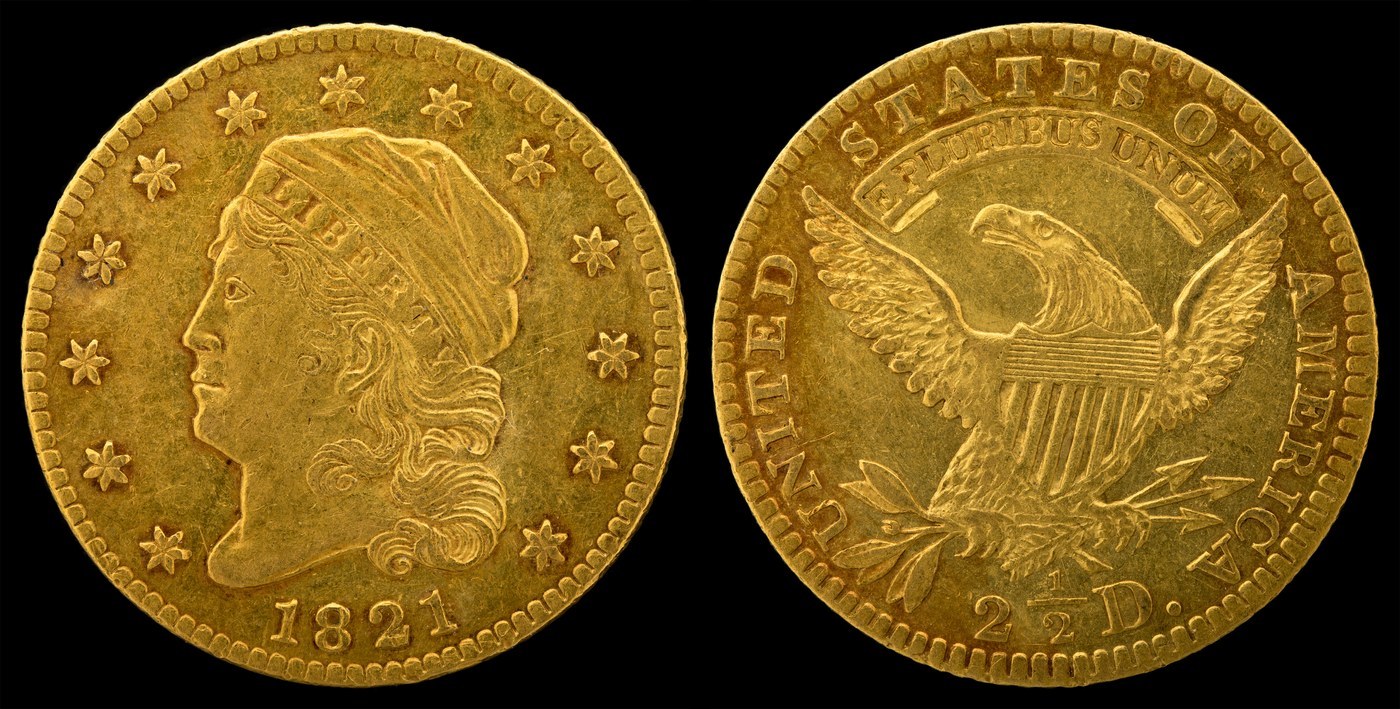
Begin with the obverse portrait. A Capped Head Quarter Eagle shows Liberty in left profile wearing a soft cap over curls, with LIBERTY on a band across the cap, stars around the rim, and the date below. The leftward-facing capped head is the fastest way to separate this type from the earlier Capped Bust quarter eagles, whose Liberty faces right, and from the later Classic Head (1834 onward) and Coronet/Liberty Head quarter eagles, which show a different headdress and lack the cap band.
Read the reverse next. The correct reverse is a heraldic eagle with a shield on its breast, wings spread, an olive branch and arrows in the talons, E PLURIBUS UNUM on a ribbon above, UNITED STATES OF AMERICA around the top, and the denomination 2 1/2 D. at the bottom. The presence of the 2 1/2 D. denomination confirms the quarter-eagle denomination and distinguishes it from the similarly styled half eagle ($5) and eagle ($10) of the era.
Confirm the physical specifications. The coin should measure roughly 18.5 mm on 1821–1827 issues (slightly smaller near 18.2 mm on the reduced 1829–1834 planchet), weigh about 4.37 grams, and be struck in yellow gold of .9167 fineness with a reeded edge. There is no mint mark; the type was struck only at Philadelphia. Weight or diameter far outside these figures is an immediate red flag.
Treat authentication as essential. Early U.S. gold of this rarity is a frequent target for counterfeits, cast copies, tooled surfaces, and altered dates, and a common denomination or date can be re-engraved to mimic a rarer one. Because genuine pieces are scarce and valuable in every grade, do not rely on visual inspection alone.
Compare against look-alikes and confirm through certification. Genuine coins show crisp, hand-finished lettering, honest wear consistent with the surfaces, and correct weight and diameter, while replicas often display mushy detail, seams, wrong weight, or the word COPY. Given the stakes, insist on certification by a major third-party grading service before buying or selling.
Frequently asked questions
How do I tell a Capped Head from a Capped Bust quarter eagle?
On the Capped Head type (1821–1834) Liberty faces left, while on the earlier Capped Bust quarter eagles she faces right. Both wear a cap, so the direction of the portrait is the key difference.
How do I confirm it is a quarter eagle and not a half eagle?
Check the denomination below the eagle on the reverse: a quarter eagle reads 2 1/2 D. The half eagle and eagle of the era share the same portrait style but state 5 D. or 10 D.
Where is the mint mark?
There is none. Every Capped Head Quarter Eagle was struck at Philadelphia, which used no mint mark during this period.
Should I have one authenticated before buying?
Yes. These coins are rare and valuable in all grades and are frequently counterfeited or altered, so certification by a reputable third-party grading service is strongly advised.