
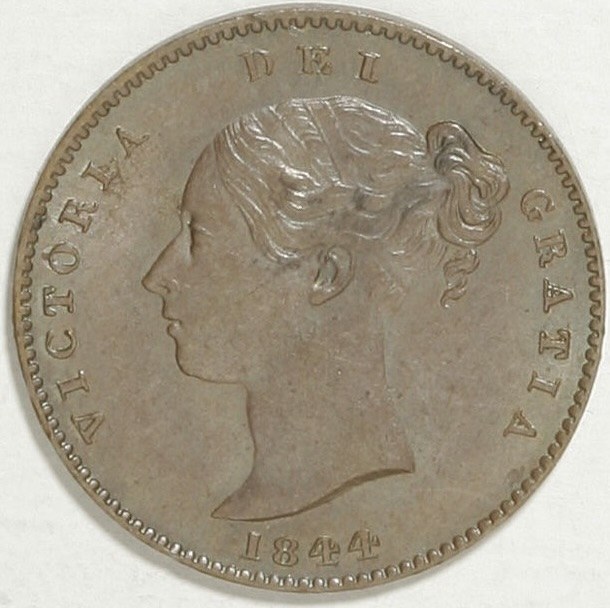
British Third Farthing
A tiny 1844 Victoria copper coin: young left-facing queen's bust obverse, crowned value reverse. One of Britain's smallest denominations, struck for Malta.
- Country
- United Kingdom
- Denomination
- 1/3 Farthing
- Metal
- Copper
Got a coin like this?
Identify any coin from a photo, free.
Overview
The British third farthing is one of the smallest denominations Britain ever produced, worth a third of a farthing—that is, one twelfth of a penny. This example dates to 1844 and shows the young Queen Victoria facing left on the obverse, ringed by a Latin legend beginning VICTORIA D:G:, with a crowned reverse carrying the coin's value.
Struck in copper, the piece is a small, thin coin roughly the size of a modern British five-pence or smaller. Though denominated in sterling terms, the third farthing was not intended for the British home market: it was produced chiefly to serve as a convenient small coin in Malta, where local reckoning made a one-third-farthing piece genuinely useful.
History & Background
The third farthing was created to meet the needs of Malta, a British possession where the old Maltese grano was valued at about one third of a British farthing. To supply a coin matching that unit, the Royal Mint struck third farthings intermittently through the 19th century, beginning under George IV and William IV and continuing into Victoria's reign.
This 1844 issue is the first Victorian third farthing and was struck in copper, in keeping with Britain's pre-bronze coinage. Later Victorian third farthings, from 1866 onward, were struck in the lighter bronze introduced across British copper denominations in 1860, which makes the copper 1844 date a distinct early type within the series.
Because it circulated principally in Malta rather than mainland Britain, the third farthing occupies an unusual place in British numismatics: a British-denominated coin bearing the British monarch, yet made for a specific colonial need. The denomination was eventually discontinued as Malta's currency arrangements changed.
How to Identify
Start with the obverse: a young, left-facing bust of Queen Victoria, surrounded by a Latin legend that opens VICTORIA D:G: ("Victoria, by the Grace of God"). This youthful left-facing portrait is characteristic of Victoria's early copper coinage.
The reverse is dominated by a crown above the coin's value and the date 1844, set within a design of laurel or oak. The tiny size is itself a key clue: the third farthing is markedly smaller than a farthing, half-farthing, and of course the penny.
Confirm the coin is copper, not bronze—the 1844 issue predates Britain's 1860 switch to bronze. On this date collectors also note a legend variety in which the abbreviation reads RE rather than REG; checking the exact spelling of the legend can help attribute the specific variety.
Value & Collectibility
As a genuine Victorian copper coin over 175 years old, the 1844 third farthing carries collector value well above its minuscule face value. It is, however, a collectible rather than a great rarity: the 1844 date was struck in reasonable numbers and is the most commonly encountered Victorian third farthing.
Condition drives price. Well-worn brown examples are inexpensive and accessible to beginning collectors, while sharply struck pieces retaining original mint color ("red") command a substantial premium. Legend varieties and problem-free surfaces can add further interest.
Because values move with grade and eye appeal, compare any specific coin against recent dealer and auction results for its exact condition rather than assuming a fixed figure. Harsh cleaning, corrosion, or damage on so small a coin can reduce value sharply.
Frequently asked questions
Why did Britain make a third-farthing coin?
It was struck mainly for Malta, where the local grano was worth roughly one third of a British farthing. The coin gave Maltese users a convenient small denomination tied to sterling.
How much is a third farthing worth today?
Its face value was one third of a farthing—one twelfth of a penny—but as a collectible the 1844 copper coin is worth considerably more, from modest sums for worn pieces to a premium for high-grade examples with original color.
Is the 1844 third farthing copper or bronze?
The 1844 issue is copper. Britain switched its small change to bronze in 1860, so later third farthings from 1866 onward are bronze, but this early Victorian date is copper.
How big is a third farthing?
It is a very small, thin coin—smaller than a farthing and much smaller than a penny. Its tiny diameter is one of the quickest ways to recognize the denomination.
British Third Farthing guides
In-depth guides for identifying, valuing, and collecting British Third Farthing.
Other coins you may enjoy
5 Francs (First Republic)
L'an 9 (1800–1801)
Trinidad and Tobago Dollar
2015
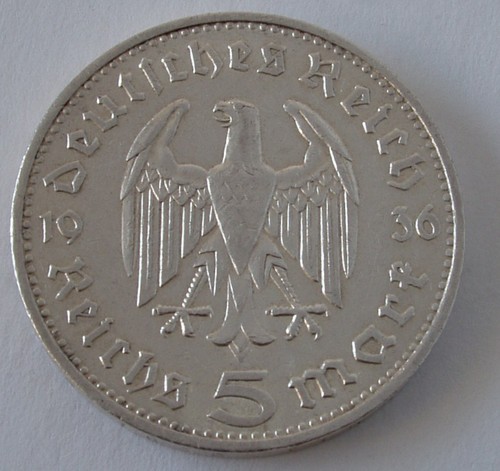
German 5 Reichsmark (Hindenburg)
1935–1936 (Hindenburg type with swastika)
5 Francs Semeuse
1960–1969
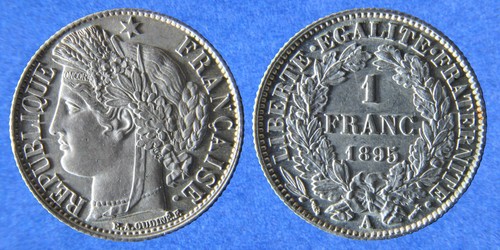
French Cérès 1 Franc
1849–1895
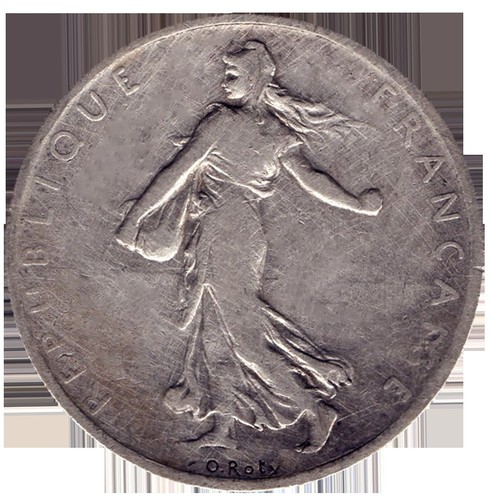
French Semeuse 2 Francs
1898–1920 (silver issues; pictured example dated 1899)
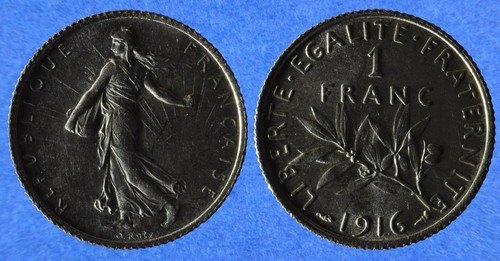
French Semeuse 1 Franc
1898–1920 (silver Semeuse 1 franc type)
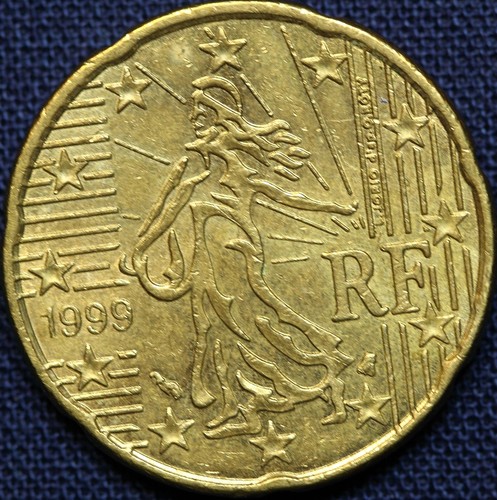
France 50 Cent Euro
1999–present
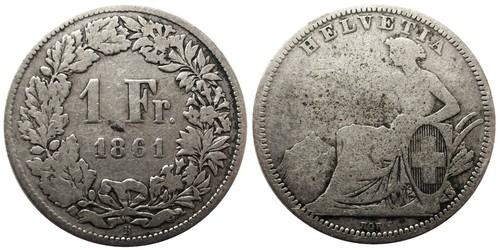
Swiss 1 Franc
1861
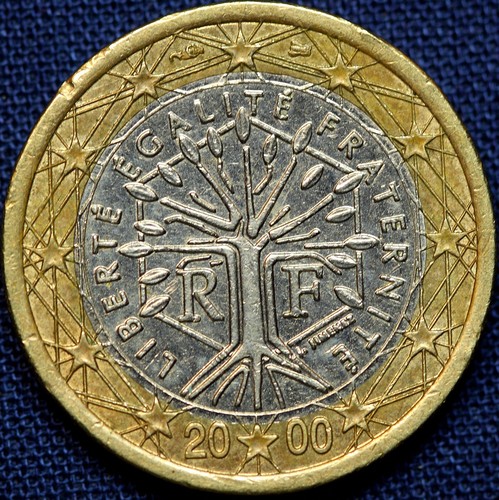
France 20 Centimes
1962–2001 (Fifth Republic, Marianne / Lagriffoul type)
Swiss 2 Francs
1860
Austria-Hungary 15 Kreuzer
1807