
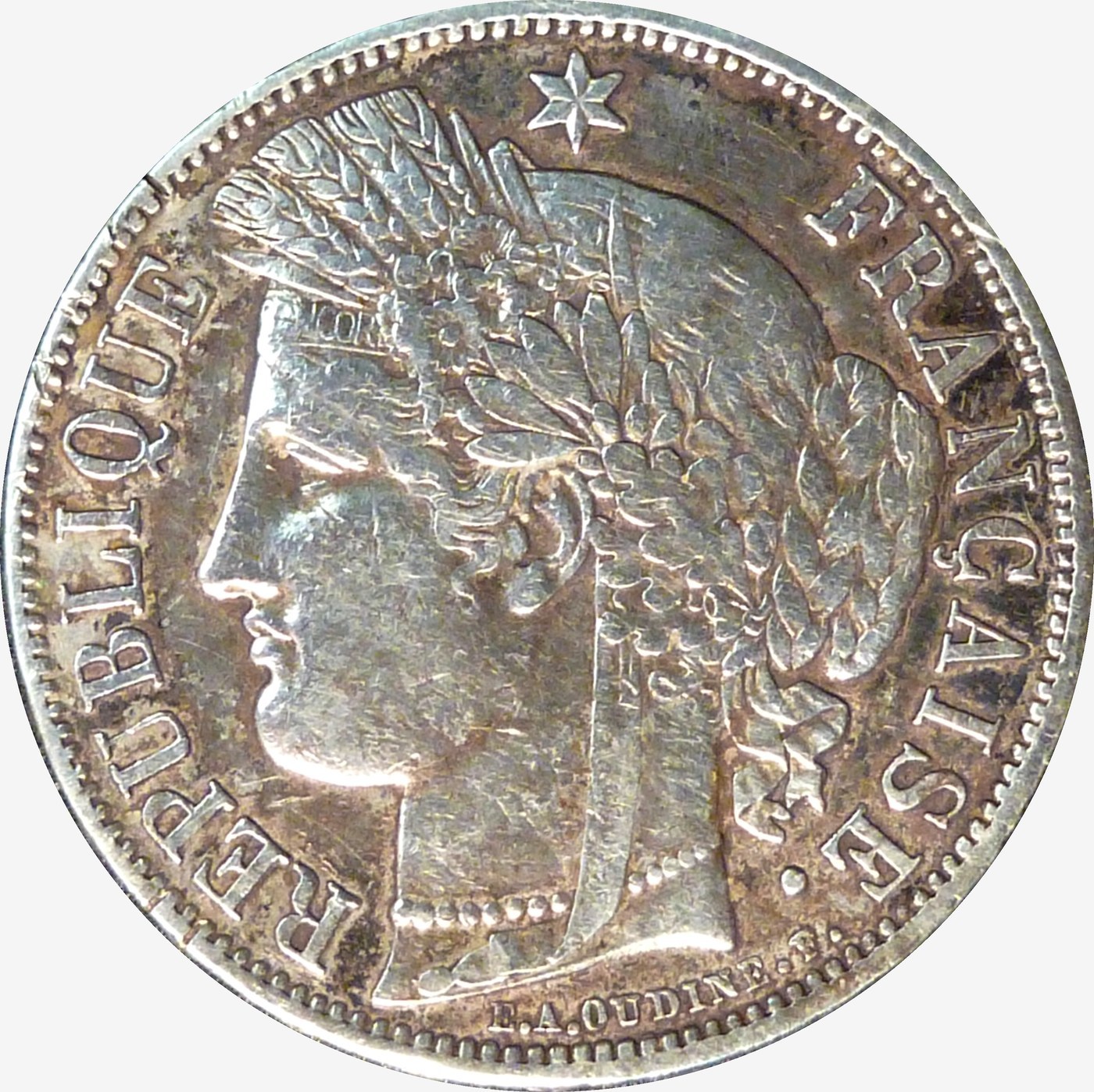
5 Francs Ceres
France's large silver 5 francs bearing the wreathed head of Cérès, goddess of the harvest, with the value framed by laurel on the reverse.
- Country
- France
- Denomination
- 5 Francs
- Metal
- Silver
Got a coin like this?
Identify any coin from a photo, free.
Overview
The 5 Francs Cérès is a large silver French circulation coin whose obverse carries the head of Cérès—the Roman goddess of the harvest and agriculture—facing left and crowned with a wreath of grain. The reverse states the value 5 FRANCS with the date inside a laurel wreath, encircled by the republican motto LIBERTÉ ÉGALITÉ FRATERNITÉ. The observed example is dated 1870.
Struck in silver at the traditional "écu" size of the five-franc piece, the coin is broad, heavy and reeded on the edge. It represents the revival of an earlier republican design and is one of the classic crown-sized silver coins of nineteenth-century France, collected both for its neoclassical portrait and for its silver content.
History & Background
The Cérès head was engraved by Eugène-André Oudiné and first appeared on French silver five-franc coins under the Second Republic around 1849–1851. When the Second Empire fell and the Third Republic was proclaimed in September 1870, France returned to this republican motif, and the silver 5 Francs Cérès was struck from 1870 through 1878. The observed 1870 piece belongs to the very first year of this Third Republic revival, coinciding with the turmoil of the Franco-Prussian War.
Because 1870 was a year of upheaval, coinage was produced under difficult conditions and at more than one mint, and the type includes early varieties from its opening year. The design carried the young Republic's harvest goddess and its founding motto back onto the nation's flagship silver coin.
The 5 Francs Cérès was the last of the large silver five-franc "crowns" for circulation; after 1878 the big silver five-franc piece was effectively discontinued as France moved away from the heavy silver écu. Later French five-franc coins used different designs and, eventually, smaller silver or base-metal formats, which makes the Cérès a natural bookend to the era of the large circulating silver crown.
How to Identify
The obverse is the key identifier: the head of Cérès facing left, her hair bound and crowned with a wreath of wheat ears (and sometimes grapes and other fruits of the harvest), surrounded by the legend for the French Republic. The engraver's name (Oudiné) appears on the neck or below the truncation of the bust.
The reverse shows the value 5 FRANCS above the date, all enclosed within a wreath of laurel, with the motto LIBERTÉ ÉGALITÉ FRATERNITÉ running around the rim. The observed coin is dated 1870. The edge is reeded. In hand the piece is unmistakably a large silver crown: broad (about the size of a silver dollar), notably heavy, pale grey-white, and completely non-magnetic.
A small mintmark and an engraver's privy mark sit near the bottom of the reverse beside the date, identifying which mint struck the coin. Distinguish the Cérès from other silver 5 francs of the century—such as the Hercules group (three standing figures) and the seated-figure Napoléon types—by the single wreathed female head on the obverse and the laurel-wreath value on the reverse.
Value & Collectibility
The 5 Francs Cérès is valued first as a large silver crown, so it carries a bullion floor set by its silver content that rises and falls with the silver market. Well-worn, common examples typically trade at a modest premium over that melt value, making the type an accessible piece of nineteenth-century French silver.
Above the bullion floor, price depends heavily on the date, the mint, and the state of preservation. First-year 1870 coins, scarcer mint issues, and the several 1870 varieties can draw collector interest, and any example in high grade with sharp detail in the wreath and the goddess's hair commands a clear premium over an ordinary worn coin.
Because values swing with both silver prices and the specific year/mint, check recent sales for the exact date, mintmark and grade rather than relying on a single figure. Attractive, problem-free examples with original surfaces are always worth the most.
Frequently asked questions
Who is the figure on the 5 Francs Ceres?
The obverse shows Cérès (Ceres), the Roman goddess of agriculture and the harvest, facing left and wearing a wreath of grain. She was used as a republican emblem of abundance and appears here on France's large silver five-franc coin.
Is the 5 Francs Ceres made of real silver?
Yes. It is a large silver crown-sized coin, which gives it a heavy feel, a pale silver-grey color, a reeded edge and a bullion value. It is non-magnetic, unlike later base-metal five-franc pieces.
What does the reverse say?
The reverse carries the value 5 FRANCS and the date—here 1870—inside a laurel wreath, encircled by the republican motto LIBERTÉ ÉGALITÉ FRATERNITÉ. A small mintmark sits near the date.
How much is an 1870 5 Francs Ceres worth?
As a large silver coin, most circulated examples are worth a modest premium over their silver melt value. Scarcer mints, 1870 varieties, and high-grade coins bring stronger premiums; check recent sales for the exact date, mint and grade.
5 Francs Ceres guides
In-depth guides for identifying, valuing, and collecting 5 Francs Ceres.
Other coins you may enjoy
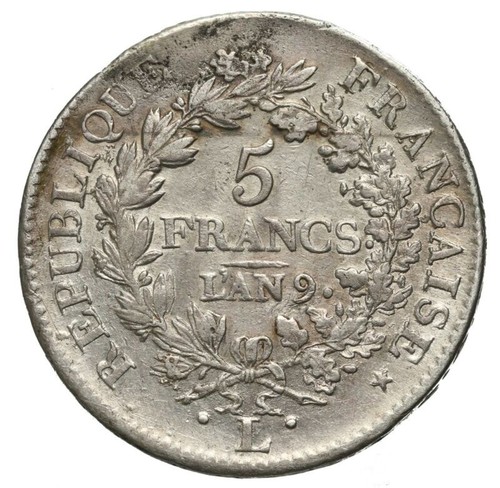
5 Francs (First Republic)
L'an 9 (1800–1801)
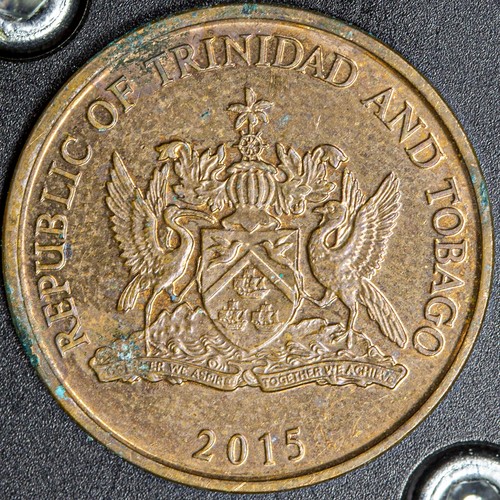
Trinidad and Tobago Dollar
2015
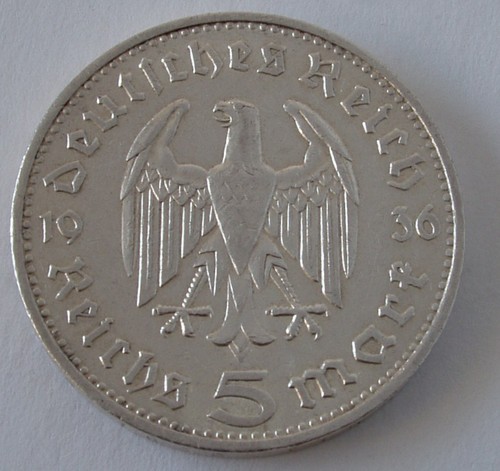
German 5 Reichsmark (Hindenburg)
1935–1936 (Hindenburg type with swastika)
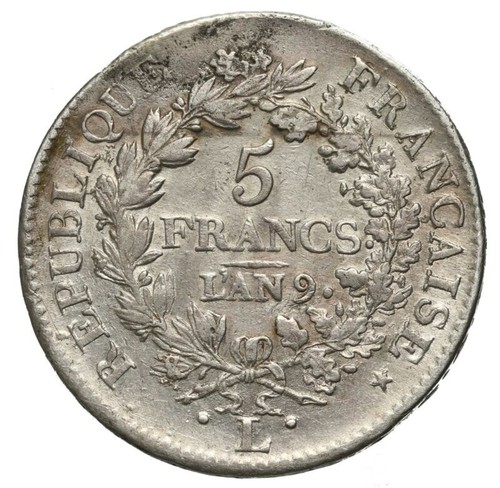
5 Francs Semeuse
1960–1969
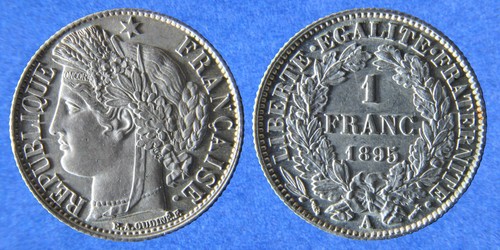
French Cérès 1 Franc
1849–1895
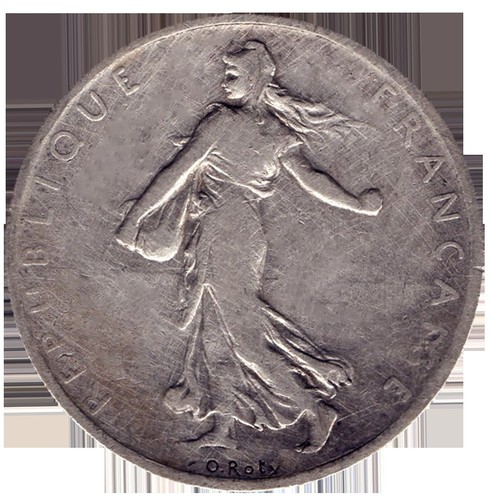
French Semeuse 2 Francs
1898–1920 (silver issues; pictured example dated 1899)
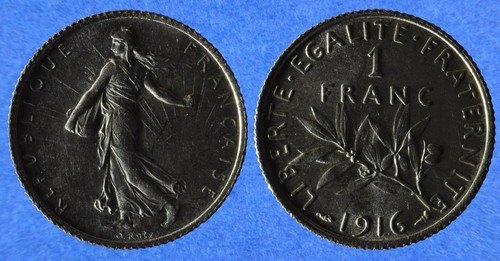
French Semeuse 1 Franc
1898–1920 (silver Semeuse 1 franc type)
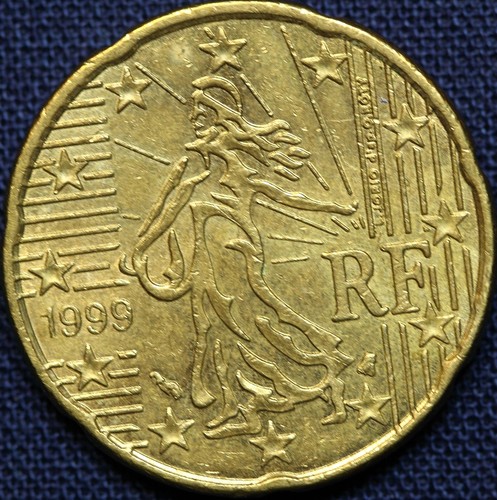
France 50 Cent Euro
1999–present
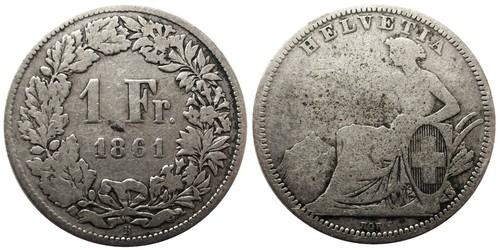
Swiss 1 Franc
1861
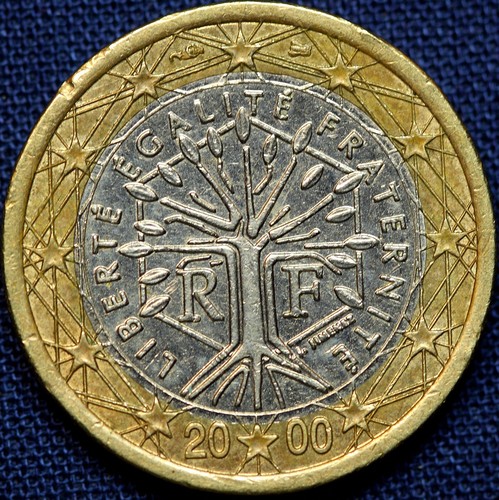
France 20 Centimes
1962–2001 (Fifth Republic, Marianne / Lagriffoul type)
Swiss 2 Francs
1860
Austria-Hungary 15 Kreuzer
1807