
How to Identify the 5 Francs Ceres
A collector's guide to recognizing France's silver 5 francs Cérès by its wreathed harvest-goddess head, laurel-wreath reverse, crown size and silver weight.
Read the full 5 Francs Ceres encyclopedia entry →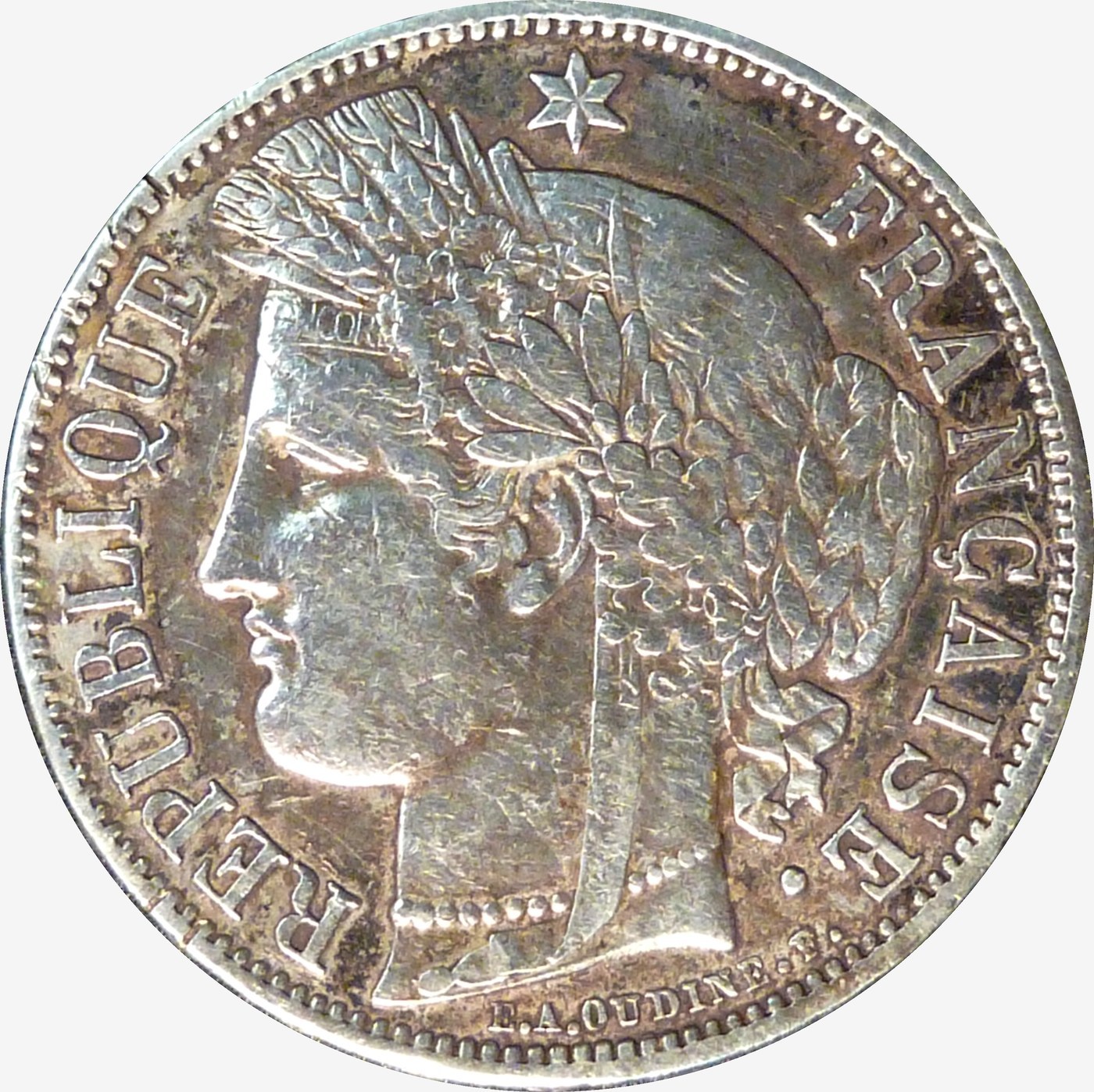
Begin with the obverse, which is the surest identifier. The 5 Francs Cérès shows a single female head facing left, crowned with a wreath of wheat ears (often with grapes and other harvest fruits woven in) and her hair drawn back. This is Cérès, the harvest goddess. The legend naming the French Republic runs around the rim, and the engraver's name, Oudiné, appears on or just below the neck. A lone wreathed female head—not a standing group or a seated allegory—is what marks the Cérès type.
Read the reverse to confirm the value and date. It states 5 FRANCS above the year, all enclosed in a wreath of laurel, with the motto LIBERTÉ ÉGALITÉ FRATERNITÉ around the edge. On the observed coin the date is 1870, which places it in the first year of the Third Republic series. A small mintmark and an engraver's privy mark sit near the bottom of the reverse beside the date and tell you which mint struck the coin.
Confirm the physical characteristics. This is a large silver "crown": broad—roughly the diameter of a silver dollar—clearly heavy for its size, pale silver-grey in color, with a reeded (grooved) edge, and completely non-magnetic. A genuine silver crown also gives a long, high ring when balanced and tapped. These simple checks separate the real silver piece from lighter base-metal coins of similar look.
Watch for the main look-alikes. France issued several different silver 5 francs in the nineteenth century: the Hercules type shows three standing figures, and the Napoléon III and earlier types show a portrait of a ruler rather than a wreathed goddess. The earlier Second Republic Cérès (about 1849–1851) uses the same goddess head but is dated two decades before this coin, so read the date and the surrounding legend carefully to place the exact issue.
For authentication, weigh and measure the coin against published specifications for the large silver 5 francs and compare the date and mintmark to reference listings, since date and mint drive any premium above melt. Crown-sized silver is a common counterfeiting target: be wary of soft, mushy detail in the wreath and hair, edge seams, incorrect weight or diameter, or any magnetic response, all of which point to a cast copy or a base-metal fake rather than a genuine silver Cérès.
Frequently asked questions
How do I tell the Ceres 5 francs from other French silver 5 francs?
Look at the obverse. The Cérès type shows a single female head wearing a wreath of grain. The Hercules type shows three standing figures, and the Napoléon types show a ruler's portrait. Only the Cérès pairs the wreathed goddess head with a laurel-wreath value on the reverse.
Where are the date and mintmark on the coin?
Both are on the reverse. The date sits below 5 FRANCS inside the laurel wreath, and a small mintmark with an engraver's privy mark appears near the bottom of the reverse beside the date; together they identify the year and the striking mint.
Is the 1870 date the same as the earlier Ceres 5 francs?
No. The same Cérès head was first used on a Second Republic 5 francs around 1849–1851. The 1870 coin belongs to the later Third Republic revival struck from 1870 to 1878, so the date and legend are what separate the two.
What quick tests confirm it is genuine silver?
Check that it is non-magnetic, feels heavy for its broad size, has a reeded edge, and rings when tapped. Then weigh and measure it against published specifications for the large silver 5 francs and compare the detail to trusted reference images.