
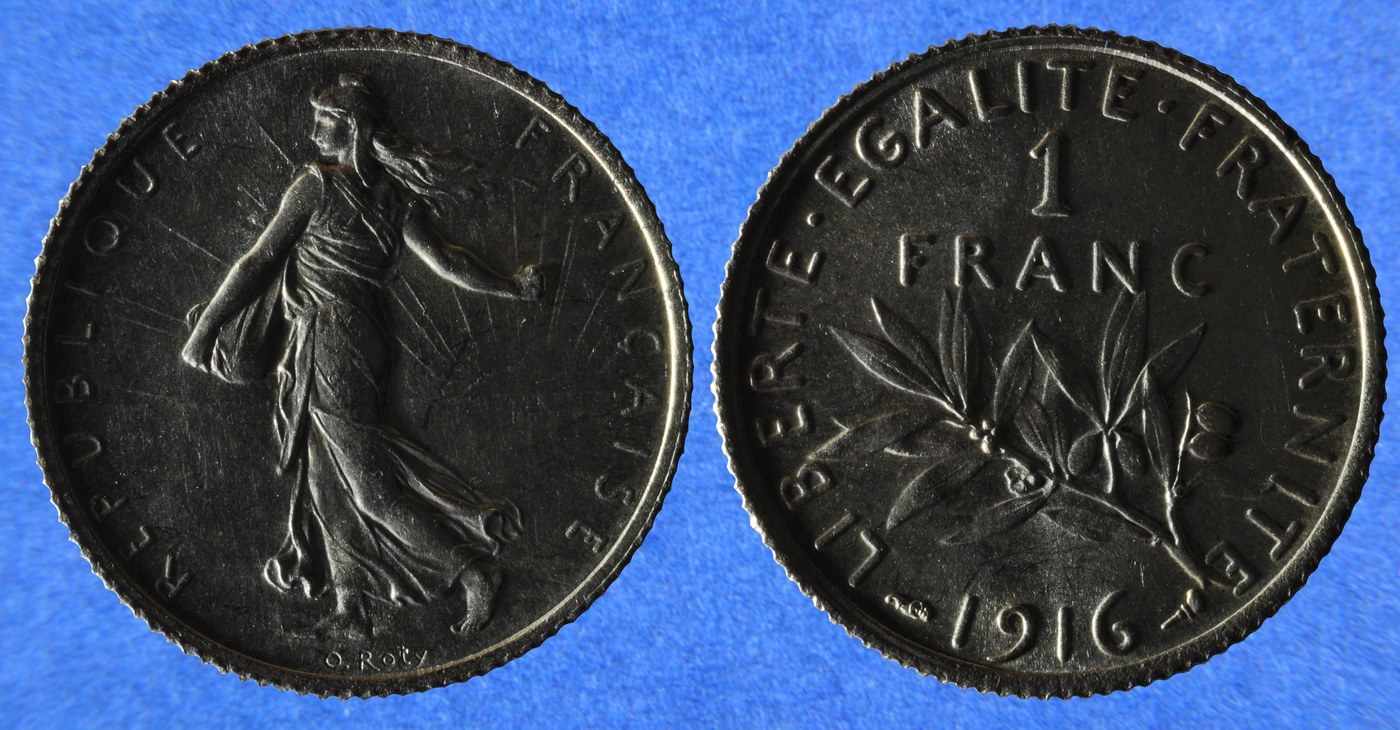
1 Franc Semeuse
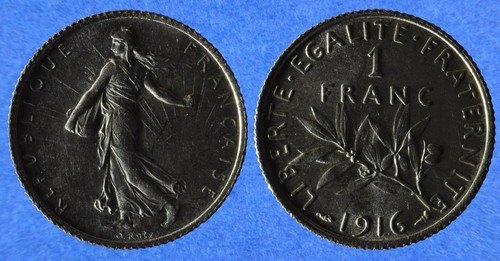
A small silver French franc showing Roty's Semeuse, the striding Sower scattering seed at dawn, with the 1916 date on the LIBERTE EGALITE FRATERNITE reverse.
- Country
- France
- Denomination
- 1 Franc
- Metal
- Silver
Got a coin like this?
Identify any coin from a photo, free.
Overview
The 1 Franc Semeuse is a small silver coin of the French Third Republic, named for its obverse figure, the Semeuse or "Sower" — a woman striding forward and casting seed by hand as the sun rises behind her. The design was created by the medallist Louis-Oscar Roty and became one of the most enduring and recognisable images in French coinage. This example is dated 1916, placing it within the silver series struck for everyday circulation.
The coin is modest in size and value: a single franc was a low denomination, and the piece was made in a relatively low-purity silver rather than as a prestige issue. The reverse carries the republican motto LIBERTE EGALITE FRATERNITE together with the denomination 1 FRANC and the date, framed by olive or laurel branches.
Because the Semeuse motif was later revived on nickel and other base-metal francs of the twentieth century, it helps to remember that the original silver 1 Franc Semeuse belongs specifically to the pre-1920 period, when the coin still carried real silver content.
History & Background
The Semeuse design was introduced on French silver coinage at the turn of the twentieth century, with Roty's Sower first appearing on the franc and its fractions in 1898. The image drew on an earlier medal Roty had engraved and quickly came to symbolise the Republic itself — a forward-moving figure sowing the seeds of a new France against the wind.
The silver 1 Franc Semeuse was produced through the opening decades of the century and into the era of the First World War, which is when this 1916-dated piece was struck. Wartime pressures on precious metal eventually forced changes: silver small change grew scarce, and by around 1920 the silver franc gave way to lighter base-metal coinage.
The Semeuse proved so popular that the French state returned to it repeatedly across the century, including on later cupro-nickel and nickel francs of the Fifth Republic and, later still, on the silver bullion and commemorative pieces of the euro era. The 1898–1920 silver franc, however, is the original circulating incarnation of the type.
How to Identify
The silver 1 Franc Semeuse is a small coin, roughly 23 mm across and about 5 g in weight, struck in a silver alloy of moderate fineness (around .835 silver). The obverse shows the Sower striding to the left across a field, scattering seed, with the sun rising low behind her and the engraver's name O. ROTY along the lower edge; RF (République Française) usually appears in the design.
The reverse displays the value 1 FRANC and the date within a wreath of branches, encircled by the motto LIBERTE EGALITE FRATERNITE and REPUBLIQUE FRANÇAISE. On this piece the date reads 1916. Small privy symbols — typically a cornucopia and a second engraver's or mint mark — flank the date and identify the Paris mint and its officials.
The combination of the striding Sower obverse, the branch-framed 1 FRANC reverse, the small module and the silver colour together confirm the type. The specific denomination is read directly from the reverse, since the same Semeuse figure was also used on the 50 centimes and 2 francs.
Value & Collectibility
The silver 1 Franc Semeuse is a common coin, produced in large numbers over more than two decades, so most circulated examples are valued modestly. As a small piece of roughly .835 silver weighing about 5 g, it carries a base worth tied to its silver content — a fraction of a troy ounce — which sets a floor of a few dollars or euros for well-worn pieces regardless of date.
Above that bullion floor, value depends on date, mint marks and condition. Common dates in average circulated grade trade for only a small premium, while scarcer dates or coins in sharp, lightly worn or uncirculated condition can command considerably more from collectors.
As with any silver type coin, condition and originality matter: cleaned, damaged or heavily worn pieces sit at the low end, while an attractive, well-struck example with clear Sower detail is worth seeking out. For precise figures, compare recent sales for the exact date and mint mark rather than relying on a single catalogue number.
Frequently asked questions
What does the figure on the front represent?
It is the Semeuse, or Sower — a woman striding forward and casting seed by hand as the sun rises. Designed by Louis-Oscar Roty, she is an allegory of the French Republic sowing the seeds of progress, and she became one of the most famous images in French coinage.
Is the 1 Franc Semeuse made of silver?
The original circulating 1 Franc Semeuse struck from 1898 to about 1920, including this 1916 example, is silver of roughly .835 fineness. Later twentieth-century francs reused the same Sower design but in nickel and other base metals, so the metal depends on the era.
Who designed the coin?
The medallist Louis-Oscar Roty created the Semeuse, and his signature O. ROTY appears along the lower edge of the obverse. The design was adapted from one of his earlier medals.
How big is the silver 1 Franc Semeuse?
It is a small coin, about 23 mm in diameter and roughly 5 g in weight — noticeably smaller than the 2 franc piece that shares the same Sower design.
Is a 1916 1 Franc Semeuse valuable?
Most examples are common and valued modestly, with a floor set by their silver content. Scarcer dates and mint marks, or coins in high grade, are worth more; check recent sales for the exact date and mint mark.
1 Franc Semeuse guides
In-depth guides for identifying, valuing, and collecting 1 Franc Semeuse.
Other coins you may enjoy
5 Francs (First Republic)
L'an 9 (1800–1801)
Trinidad and Tobago Dollar
2015
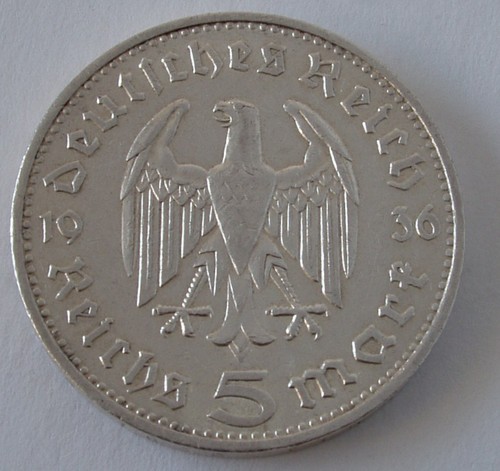
German 5 Reichsmark (Hindenburg)
1935–1936 (Hindenburg type with swastika)
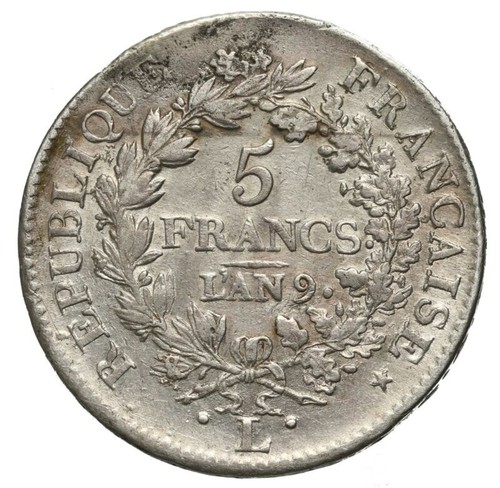
5 Francs Semeuse
1960–1969
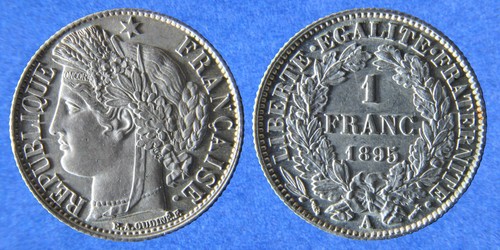
French Cérès 1 Franc
1849–1895
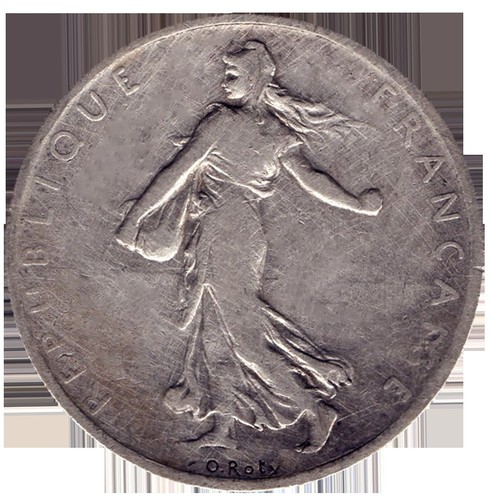
French Semeuse 2 Francs
1898–1920 (silver issues; pictured example dated 1899)
French Semeuse 1 Franc
1898–1920 (silver Semeuse 1 franc type)
France 50 Cent Euro
1999–present
Swiss 1 Franc
1861
France 20 Centimes
1962–2001 (Fifth Republic, Marianne / Lagriffoul type)
Swiss 2 Francs
1860
Austria-Hungary 15 Kreuzer
1807