
How to Identify the 1 Franc Semeuse
A collector's guide to the silver 1 Franc Semeuse — reading the Sower obverse, the branch-framed reverse, the mint privy marks, and telling silver from later base-metal francs.
Read the full 1 Franc Semeuse encyclopedia entry →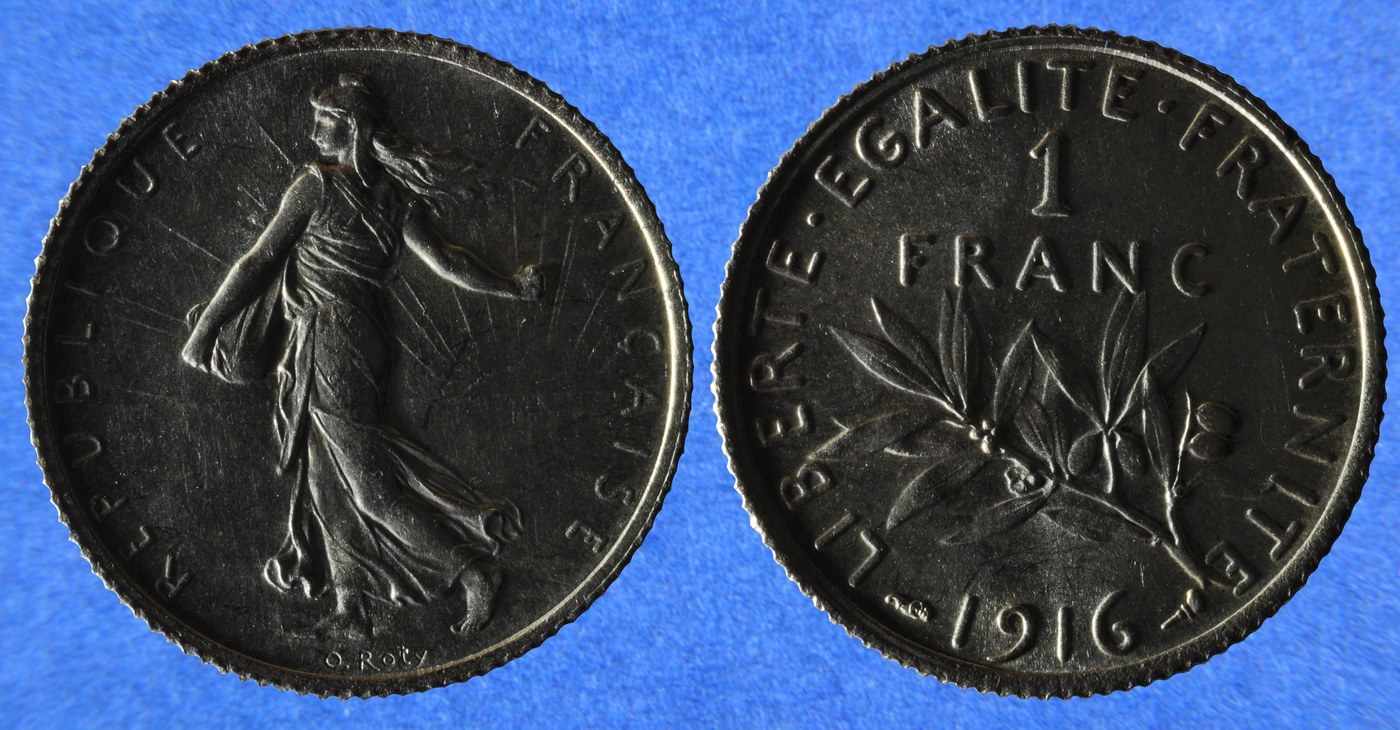
Begin with the two designs. The obverse of a 1 Franc Semeuse shows the Sower — a standing woman striding to the left, one arm swinging back to scatter seed, with a low sun and its rays behind her and the ground beneath her feet. Look along the bottom edge for the engraver's signature O. ROTY, and for the letters RF within the field. The reverse carries the value 1 FRANC and the date inside a wreath of branches, ringed by LIBERTE EGALITE FRATERNITE and REPUBLIQUE FRANÇAISE; on this coin the date is 1916.
Confirm the denomination from the reverse, not the figure. Roty's Sower was used on the 50 centimes, 1 franc and 2 francs, so the striding woman alone does not fix the value — the wording 1 FRANC does. Note the size while you are there: the silver 1 franc is a small coin of about 23 mm and roughly 5 g, distinctly smaller and lighter than the 2 franc piece.
Check the metal and colour. The original circulating Semeuse franc of 1898–1920 is struck in silver of moderate fineness (about .835), giving a bright, slightly grey-white tone and a soft ring. Later twentieth-century 1 franc coins reused the same Sower but in nickel or cupro-nickel; a franc dated in the 1960s or later, or one that looks and feels like base metal, is not the silver type even though the design matches.
Read the small privy marks beside the date. French coins of this period carry tiny symbols flanking the reverse date — commonly a cornucopia for the Paris mint and a second engraver's or director's mark. These identify where and under whom the coin was struck and are part of a correct attribution; note them rather than ignore them, as they can affect scarcity.
Finally, weigh authentication against value. Because the silver franc is common and low in face value, outright counterfeits are less of a concern than with rare coins, but cleaning, wear and damage are widespread and depress value. If a date or mint mark appears scarce or a coin seems unusually fine, weigh and measure it, compare the design details to reference images, and consult recent sales or a dealer before assuming a premium.
Frequently asked questions
How do I tell the silver franc from the later nickel Semeuse?
Check the date and the metal. The silver 1 Franc Semeuse belongs to roughly 1898–1920 and has a bright silver-white tone and about 5 g weight at 23 mm. Francs dated from the 1960s onward with the same Sower are nickel or cupro-nickel and are not the silver type.
The same figure is on other coins — how do I know it is a 1 franc?
Read the reverse. Roty's Sower appears on the 50 centimes, 1 franc and 2 francs, but only the 1 franc shows the value 1 FRANC in the wreath. Size helps too: the 1 franc is smaller and lighter than the 2 franc.
What are the little symbols next to the date?
They are mint privy marks — typically a cornucopia for the Paris mint plus an engraver's or director's mark — that flank the reverse date. They identify the striking authority and can matter for attributing scarcer dates.
Is it worth authenticating a common silver franc?
For ordinary dates in worn condition, formal authentication rarely pays, since the coin is common and close to silver-bullion value. Reserve closer study or a dealer's opinion for apparently scarce dates, mint marks, or high-grade examples.