William IV One Rupee
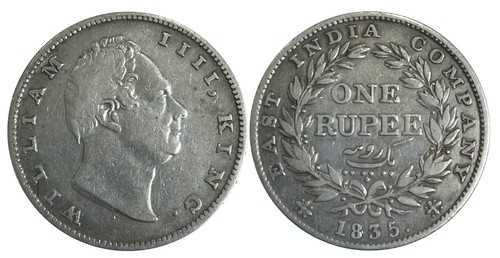
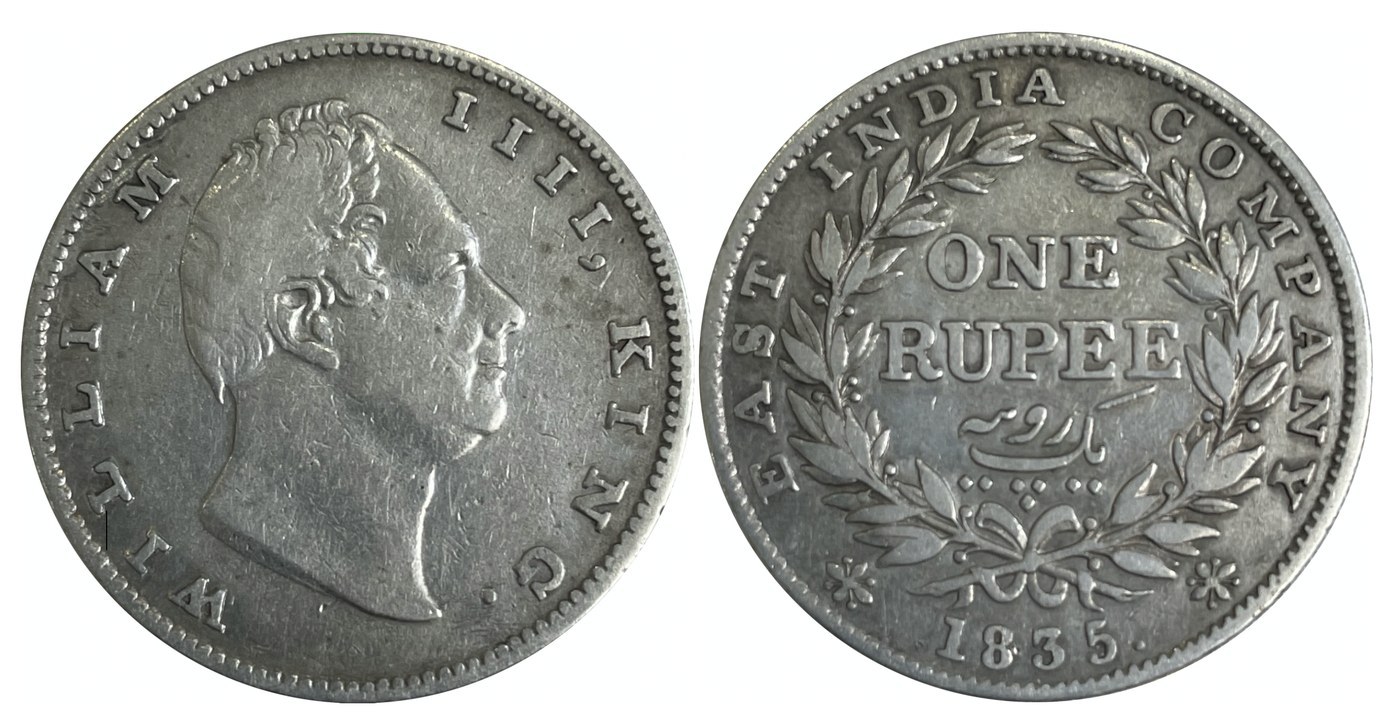
Silver one-rupee coin of British India struck in 1835 under the East India Company, bearing the right-facing bust of King William IV.
- Country
- British India
- Denomination
- 1 Rupee
- Metal
- Silver
Got a coin like this?
Identify any coin from a photo, free.
Overview
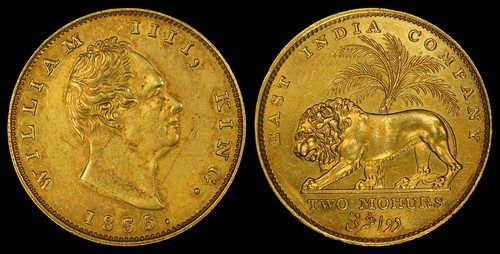
The William IV One Rupee is a silver rupee of British India issued by the East India Company and dated 1835. Its obverse shows the bare, right-facing bust of King William IV surrounded by the legend "WILLIAM IIII KING," while the reverse displays the value "ONE RUPEE" and the date "1835" within a laurel wreath, with "EAST INDIA COMPANY" around the top. The example pictured here is the 1835 issue.
This coin is historically significant as the first Company rupee to carry the portrait of a reigning British monarch. It was struck in high-grade silver, roughly the weight of later Victoria rupees, and formed part of the sweeping uniform coinage reform of 1835 that gave India a single standard rupee in place of the many earlier presidency issues.
History & Background
Before 1835 the East India Company's separate Bengal, Bombay, and Madras presidencies each struck their own rupees, creating a confusing mix of standards and designs. The Coinage Act of 1835 replaced these with a single, uniform coinage for the whole of British India, and the William IV rupee was the flagship silver denomination of that reform.
William IV had come to the throne in 1830, and although he died in 1837, the entire circulating series carries the fixed date 1835. This makes it a short-lived but important type: it introduced the format of a British royal portrait on the obverse and an English value-and-date reverse that Queen Victoria's rupees would later follow. After William IV, the design passed to the Victoria issues.
The rupees were produced at Company mints, chiefly Calcutta and Bombay, though the circulation strikes generally do not carry an obvious mint distinction. Proof and restrike examples were also made and are prized by specialists today.
How to Identify
Start with the obverse: a bare-headed bust of William IV facing right, encircled by the legend "WILLIAM IIII KING" (the king's name is rendered with four I's rather than "IV"). This right-facing, uncrowned bust immediately separates it from Victoria's crowned, left-facing rupees. The reverse shows "ONE RUPEE" and the date "1835" enclosed in a laurel wreath, with "EAST INDIA COMPANY" curving around the upper field; a Persian inscription also appears on the type.
The coin is silver, about 30-31 mm in diameter and roughly 11.6-11.7 grams, with a reeded (milled) edge. All genuine circulation pieces are dated 1835. Minor varieties exist, including examples with or without small engraver's initials (such as an "F") on the bust truncation and differences in the reverse lettering; these do not change the basic type but matter to specialists.
Value & Collectibility
Most William IV rupees in worn, circulated grades are affordable and trade at a modest premium over their silver content, each coin containing roughly a third of an ounce of silver. Because the whole series is dated 1835 and was struck in quantity, well-worn examples are relatively accessible entry points into East India Company coinage.
Value climbs steeply with condition and variety. Sharp, lightly worn coins and especially uncirculated pieces with original luster bring strong premiums, and proof or restrike examples and certain die varieties are sought after by collectors. As always, cleaning, tooling, mount marks, or heavy damage sharply reduce value, so original surfaces are preferred.
Frequently asked questions
Why is the date always 1835 on the William IV rupee?
The type was introduced by the East India Company's uniform coinage reform of 1835, and the circulating series carries that fixed date even though it was produced over a short period around William IV's reign.
Why does the coin read "WILLIAM IIII" instead of "WILLIAM IV"?
The legend spells the regnal number with four I's (IIII) rather than the usual Roman "IV." This is normal for the type and not an error or a fake.
Is the William IV One Rupee real silver?
Yes. It was struck in high-grade silver and weighs roughly 11.6-11.7 grams, so it contains close to a third of an ounce of silver.
How is it different from a Victoria rupee?
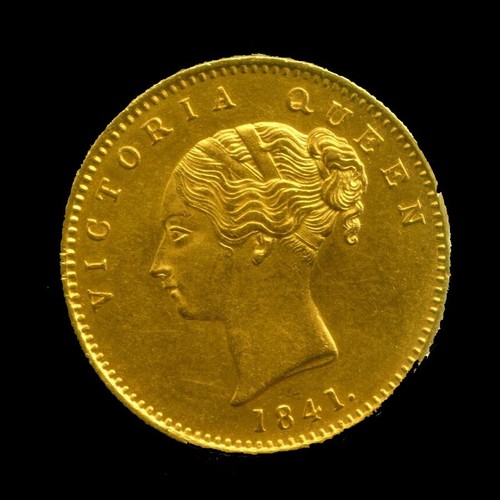
William IV's bust is bare-headed and faces right with the legend "WILLIAM IIII KING," whereas Victoria's bust is crowned, faces left, and reads "VICTORIA QUEEN" or "VICTORIA EMPRESS."
William IV One Rupee guides
In-depth guides for identifying, valuing, and collecting William IV One Rupee.