East India Company Quarter Anna
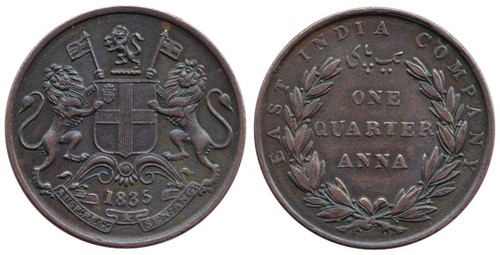
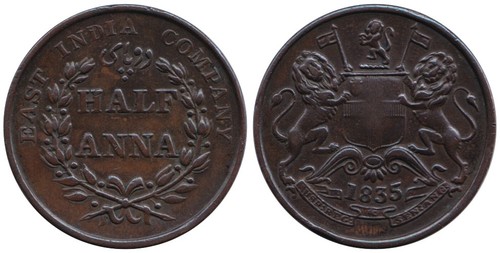
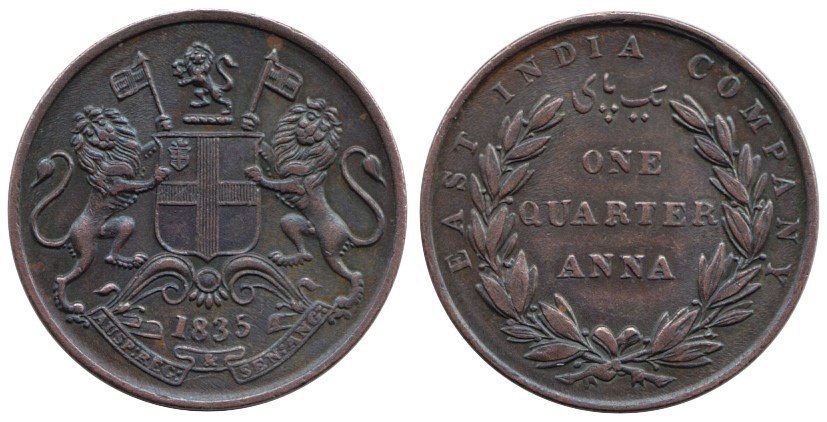
Large copper 1/4 anna of the East India Company dated 1835, with a heraldic lion-and-shield obverse and a laurel-wreath reverse.
- Country
- British India
- Denomination
- 1/4 Anna
- Metal
- Copper
Got a coin like this?
Identify any coin from a photo, free.
Overview
The East India Company Quarter Anna is a large copper coin struck for circulation across British India as part of the Company's uniform coinage. The photographed piece is dated 1835 and shows, on one face, a heraldic design of lions with a central shield above the year, and on the other a laurel wreath enclosing the legend 'EAST INDIA COMPANY ONE QUARTER ANNA.'
The quarter anna was a workhorse low-denomination coin used for everyday small purchases. At sixteen annas to the rupee and four quarter-annas (or four pice) to the anna, this piece represented a modest fraction of a rupee, and its substantial copper flan made it a familiar, heavily handled coin in circulation.
History & Background
In 1835 the East India Company introduced a standardized coinage intended to replace the varied issues of the Bengal, Madras, and Bombay presidencies with a single uniform system across its Indian territories. The copper quarter anna, along with the half anna, pice, and silver rupee, belongs to this reform.
The coins of this series carry the year 1835 prominently, and that date was retained on copper issues struck over a span of years rather than changing annually, so a 1835-dated quarter anna does not necessarily mean it left the mint in that calendar year. The design bears the Company's armorial devices and English legends, reflecting British administrative control while the coinage still circulated under Company rather than direct Crown authority; the Crown would only take over the government of India after 1858.
Production ran at the Company's Indian mints, and the type continued in service into the reign of Queen Victoria before later portrait-based British India coinage superseded it.
How to Identify
Identify this type first by its two English-legend faces and its size. One side shows a heraldic arrangement of lions with a shield and the date 1835; the other shows a laurel or leafy wreath encircling the words 'EAST INDIA COMPANY' and the denomination 'ONE QUARTER ANNA.' The complete spelled-out denomination in English is the quickest confirmation.
The coin is struck in copper, appears brown to reddish-brown when honest, and is a large, heavy piece for its low value, notably bigger than the half-anna is proportionally small. Expect considerable wear on circulated survivors, since these coppers saw hard use. Because the same 1835 date was used across multiple striking years, the date alone does not distinguish sub-varieties; fine differences in the heraldry, lettering, and wreath are what separate types for specialists.
Value & Collectibility
As a widely produced copper coin, the East India Company quarter anna of 1835 is common and generally affordable. Well-worn circulated examples typically trade in the low single digits to low tens of US dollars, with the price rising for pieces that retain sharp detail, even surfaces, and original color.
Examples with substantial mint red, problem-free surfaces, or scarce die varieties can bring meaningful premiums, and high-grade certified pieces sell for considerably more than average circulated coins. Corrosion, cleaning, and heavy pitting, all common on old copper, reduce value. Treat any single figure as broad context and compare recent sales of coins in similar grade and color rather than relying on one quoted price.
Frequently asked questions
What is a quarter anna worth in old Indian money?
There were sixteen annas to a rupee, and four quarter-annas (or four pice) to one anna. The quarter anna was therefore a small-change copper coin used for everyday minor purchases.
Does an 1835 date mean the coin was made in 1835?
Not necessarily. The East India Company retained the 1835 date on copper quarter annas struck over several years, so the date marks the coinage type rather than the exact year of manufacture.
Is the East India Company quarter anna rare?
No. These copper coins were produced in large numbers and are common today, though high-grade examples with original color and sharp detail are much scarcer than well-worn ones.
What metal is this coin made of?
It is copper. Genuine examples show a brown to reddish-brown surface, and the large, heavy flan relative to the coin's low denomination is characteristic of the type.
Why does the coin say 'East India Company' instead of naming a monarch?
In 1835 India was governed by the East India Company, not directly by the British Crown. The Company's own name and armorial devices appear on the coinage; Crown rule and royal portrait coinage came later.
East India Company Quarter Anna guides
In-depth guides for identifying, valuing, and collecting East India Company Quarter Anna.