East India Company One Mohur
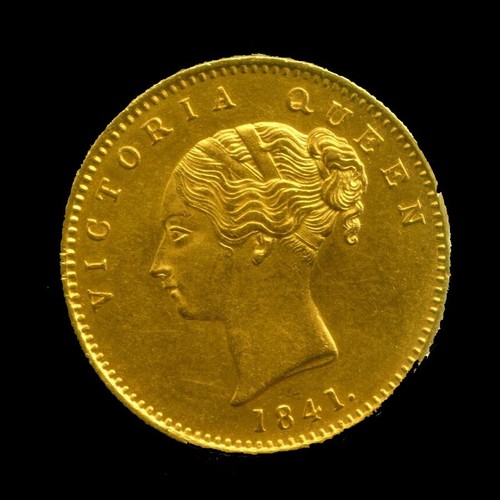
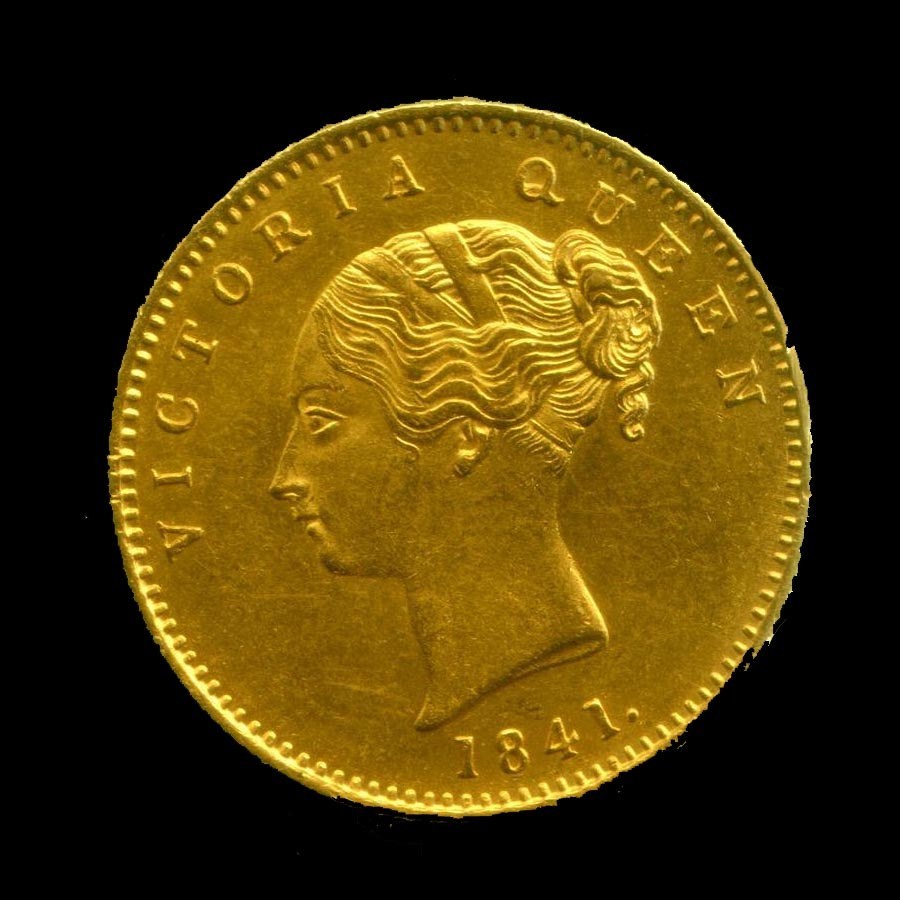
A machine-struck gold mohur of the East India Company bearing the young Queen Victoria, with a left-facing bust and the legend 'VICTORIA QUEEN', dated 1841.
- Country
- India
- Denomination
- 1 Mohur
- Metal
- Gold
Got a coin like this?
Identify any coin from a photo, free.
Overview
The East India Company One Mohur is a milled gold coin issued under the Company's uniform coinage for British-controlled India. The example shown carries a left-facing bust of the young Queen Victoria on the obverse, encircled by the legend 'VICTORIA QUEEN', and is dated 1841.
The mohur was the principal gold denomination of the period and was struck to the same weight standard as the silver rupee, making it a substantial and carefully engraved piece. Unlike the hand-struck, all-Persian coinage of the earlier Mughal and princely issues, this is a modern machine-made coin with a European-style royal portrait and Latin lettering.
As the reverse is not visible in the image here, identification rests on the obverse: the youthful Victoria portrait, the 'VICTORIA QUEEN' legend and the 1841 date together mark it as a One Mohur of the East India Company's Victorian series.
History & Background
By 1835 the East India Company had introduced a uniform coinage across its Indian territories, replacing a patchwork of presidency and local standards with common designs. The earliest uniform issues bore the portrait of King William IV; following his death in 1837 and the accession of Queen Victoria, new dies carrying the young Queen's portrait were prepared.
Coins of this Victorian series, including the gold mohur, appeared dated 1841. The portrait was engraved in the neoclassical style then favoured at the Royal Mint in London, where the master dies were cut before coining took place at the Company's Indian mints. The 1841 mohur exists in several die varieties reflecting small differences in the legend arrangement, the portrait and the date punches.
The East India Company continued to strike coinage in its own name until the aftermath of the 1857 rebellion, after which the Crown assumed direct rule of India in 1858. Coins in the Company's name, dated 1841, thus belong to the final phase of Company administration before the British Raj.
How to Identify
The One Mohur is a gold coin struck to the mohur weight standard of roughly 11.6 grams and a diameter of about 25–26 mm. It is a milled, perfectly round coin with a defined rim and raised, evenly spaced lettering — quite different from the irregular hand-struck coins of earlier Indian series.
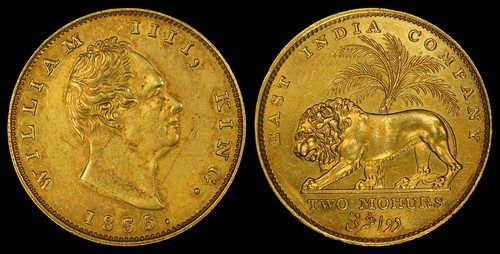
The obverse shows the diademed bust of the young Queen Victoria facing left, surrounded by the legend 'VICTORIA QUEEN'. The reverse of this type — not visible in the image here — conventionally carries a lion standing before a palm tree with the inscription 'EAST INDIA COMPANY' and 'ONE MOHUR', together with the date. The combination of the Victoria portrait, the English 'VICTORIA QUEEN' legend and the 1841 date is the surest way to attribute the coin.
Because the mohur was also matched by a silver rupee bearing a very similar Victoria portrait and legend, metal and size are important checks: the mohur is gold and noticeably heavier for its diameter than the silver rupee. Several minor die varieties of the 1841 issue exist, distinguished by details such as the arrangement of the legend and the form of the figures in the date.
Value & Collectibility
As a gold coin of roughly 11.6 grams, the East India Company One Mohur carries a substantial intrinsic gold value, which sets a firm floor beneath its market price regardless of condition. Beyond that bullion value, the coin trades as a sought-after piece of British India numismatics.
Price within the series depends heavily on the specific die variety, the sharpness of the strike, wear on the high points of the portrait, and whether the surfaces are original or have been cleaned or mounted. Scarcer varieties and coins in high, problem-free grades command significant premiums, while worn or damaged examples sell closer to their gold content.
Because this is a gold type that has been widely copied, an accurate valuation should always follow authentication. Figures here are general context rather than fixed prices; a genuine, correctly attributed mohur in collectable condition is a valuable coin, so a professional assessment of variety and grade is worthwhile before buying or selling.
Frequently asked questions
What is a mohur?
The mohur was the main gold denomination of Mughal and later British India. Under the East India Company's uniform coinage it was struck to the same weight standard as the silver rupee, making it a substantial gold coin.
Why does the coin say 'VICTORIA QUEEN' rather than 'EMPRESS'?
Victoria was only proclaimed Empress of India in 1876. In 1841 she was styled simply Queen, so Company coins of this period use the legend 'VICTORIA QUEEN' with her youthful portrait.
Is this coin real gold?
Yes. The One Mohur is a gold coin struck to the mohur weight standard of roughly 11.6 grams, giving it significant intrinsic value in addition to its collector interest.
Who issued this coin?
It was issued by the East India Company, which administered much of India until 1858. The master dies were engraved at the Royal Mint in London and the coins were struck at the Company's Indian mints.
Are 1841 mohurs rare?
The 1841 mohur exists in several die varieties of differing scarcity. As a gold coin it always retains bullion value, and genuine, well-preserved or scarce-variety examples can be quite valuable, so accurate attribution matters.
East India Company One Mohur guides
In-depth guides for identifying, valuing, and collecting East India Company One Mohur.