East India Company Two Mohurs
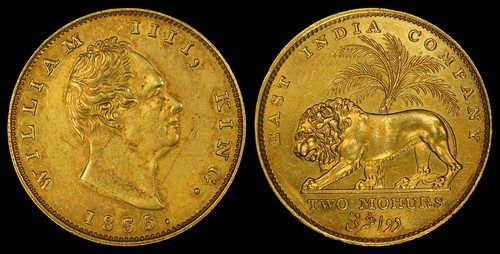
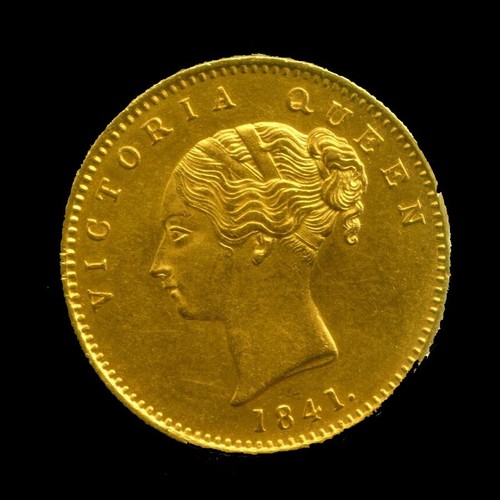
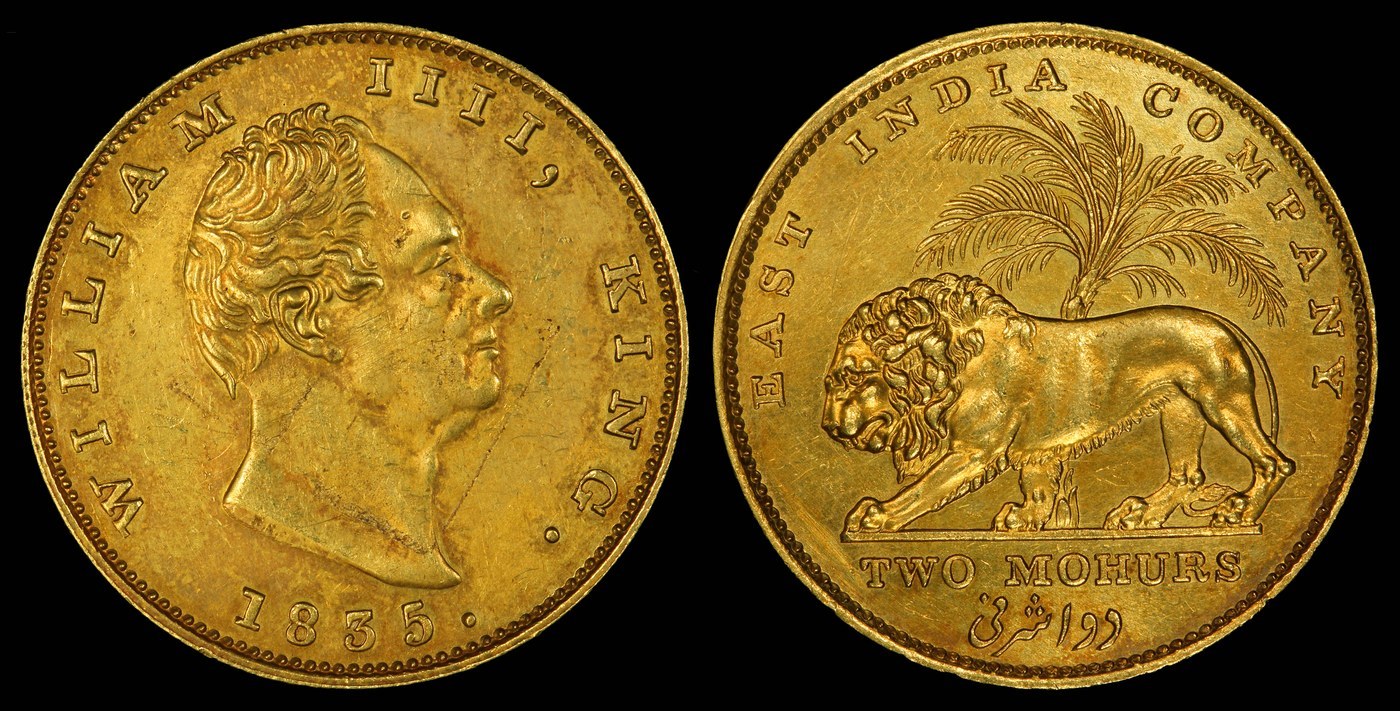
An 1835 East India Company gold two mohurs, showing William IV facing left and a lion before a palm tree above 'TWO MOHURS'.
- Country
- India
- Denomination
- 2 Mohurs
- Metal
- Gold
Got a coin like this?
Identify any coin from a photo, free.
Overview
The East India Company two mohurs is a large gold coin of the Company's 1835 uniform coinage for British India. The pictured example carries the profile bust of King William IV facing left with the date 1835 on the obverse, and on the reverse a lion set beneath a palm tree above the denomination 'TWO MOHURS'.
As a double-mohur, it is the highest gold denomination of this design series and among the most prestigious coins of the Company period. Unlike the inscriptional Mughal mohurs that preceded it, this is a machine-struck, portrait coin in the European style, produced to a uniform British India standard.
History & Background
In 1835 the East India Company introduced a uniform coinage intended to replace the many local and Mughal-derived issues circulating across its territories. The new gold, silver, and copper coins carried a royal portrait and standardized denominations, and the gold was struck in mohur and two-mohur values. The portrait of William IV (reigned 1830-1837) was engraved in the neoclassical manner associated with the Royal Mint's chief engraver William Wyon.
The reverse lion-and-palm motif became emblematic of Company gold of this era. The two mohurs was struck in only small numbers and saw very limited practical circulation, functioning more as a prestige and high-value trade piece than everyday money. Because production was brief and quantities were modest, surviving genuine examples are scarce and highly sought after, and the type has long been reproduced.
How to Identify
Confirm a large yellow gold coin with, on the obverse, a left-facing bare-head portrait of William IV and the date 1835, and on the reverse a lion positioned before or beneath a palm tree with the denomination 'TWO MOHURS' and 'EAST INDIA COMPANY' lettering. The design is fully pictorial and machine-struck, with sharp raised relief and a beaded or toothed border.
A two mohurs is roughly twice the weight of a single mohur of this coinage, on the order of about 23 grams of high-fineness gold, and correspondingly larger in diameter than the one-mohur piece. Any coin of the same design that is markedly lighter, smaller, or shows only 'ONE MOHUR' or '15 RUPEES' is a different denomination, not the two mohurs.
Value & Collectibility
The genuine 1835 two mohurs is a rare, high-value coin, and prices are driven by authenticity, grade, and provenance far more than by gold content alone. Verified examples in collector grades sell for very substantial sums at specialist auctions, typically well into five figures and higher for superior pieces, so precise figures should always come from recent auction records for comparable certified specimens.
With about 23 grams of gold, the melt value sets only a distant floor; the numismatic premium over bullion is large for authenticated pieces. Because this type is extensively copied and restruck, an unverified example should be treated as unproven value until independently authenticated, since a replica is worth only its metal.
Frequently asked questions
How much is an 1835 Two Mohurs worth?
Genuine, authenticated examples are rare and typically sell for large sums at specialist auctions, well beyond the coin's gold value. Grade and provenance matter greatly, so check recent results for certified comparable pieces.
How much gold does it contain?
As a double mohur it holds roughly 23 grams of high-fineness gold, about twice a single mohur. That metal value is only a floor; the collector premium on a genuine piece is much larger.
Who is on the obverse?
King William IV, shown as a left-facing profile bust with the date 1835, from the Company's 1835 uniform coinage.
What does the reverse show?
A lion set before a palm tree above the words 'TWO MOHURS', with 'EAST INDIA COMPANY' lettering, the emblematic reverse of Company gold of this era.
Are there many fakes and copies?
Yes. This is one of the most reproduced British India coins, with cast copies, gilt fakes, and modern restrikes common. Independent authentication is essential before assigning value.
East India Company Two Mohurs guides
In-depth guides for identifying, valuing, and collecting East India Company Two Mohurs.