East India Company Half Anna
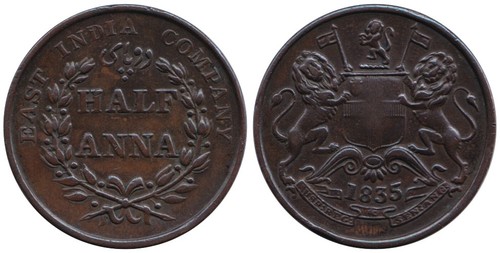
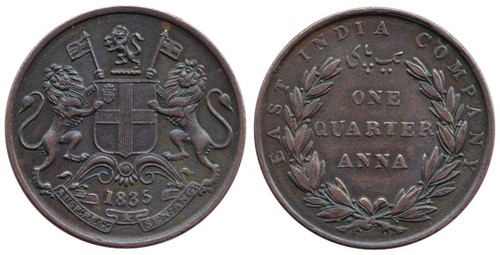
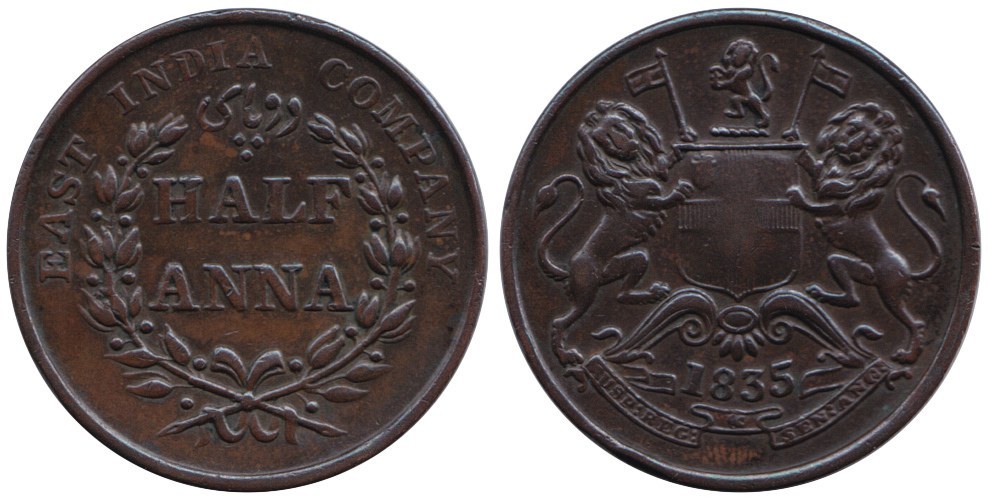
Large copper Half Anna of the East India Company, dated 1835, with laurel-wreath legend and the Company's heraldic lion-and-shield arms.
- Country
- British India
- Denomination
- Half Anna
- Metal
- Copper
Got a coin like this?
Identify any coin from a photo, free.
Overview
The East India Company Half Anna is a heavy copper coin issued under the Honourable East India Company's uniform coinage of 1835. The example photographed here shows the classic type: an obverse bearing 'EAST INDIA COMPANY HALF ANNA' flanked by laurel wreaths, and a reverse with two heraldic lions supporting a crowned shield of the Company's coat of arms, dated 1835.
As a copper minor, the Half Anna served everyday small-value transactions across the Company's Indian territories. It sits below the Rupee in the anna-based system, where sixteen annas made one rupee, making the Half Anna a modest workhorse denomination rather than a store of value.
History & Background
In 1835 the East India Company introduced a uniform coinage intended to replace the varied Presidency issues of Bengal, Bombay, and Madras with a single standardized system across British India. The reform produced a common range of gold, silver, and copper denominations, of which the copper Half Anna was one of the larger circulating pieces.
The design reflects the Company as a governing commercial power. Rather than a royal portrait, the coin carries the Company's own name and its heraldic arms, with supporting lions and a shield, an emblem of corporate authority in India. The 1835 date marks the reform year and appears on the reverse of this type.
These coins circulated widely and were struck in large numbers at Company mints, so many worn survivors exist today. The uniform coinage of 1835 remained a foundation of Indian currency until the Crown assumed direct rule after 1858, when coinage passed to the British monarch and later bore the sovereign's portrait.
How to Identify
Identify this type first by its legends and arms. The obverse reads 'EAST INDIA COMPANY HALF ANNA' with laurel wreaths to either side, while the reverse shows two lions as heraldic supporters holding a crowned shield with the Company's coat of arms and the date 1835. The denomination is spelled out, which removes ambiguity about value.
The coin is struck in copper and is a large, weighty minor, noticeably bigger than the Quarter Anna and Pice of the same series. Genuine pieces have hand-era manufacturing character, and because they saw heavy circulation most surviving examples show real wear on the high points of the lions, shield, and wreaths.
Because many were struck, minor die differences in lettering, ornament, and the exact rendering of the arms exist across specimens. Attribution to the 1835 uniform coinage is straightforward from the legend and date, but grade and surface quality vary widely from coin to coin.
Value & Collectibility
The East India Company Half Anna of 1835 is a widely available copper coin, so most circulated examples are affordable and trade in the low tens of US dollars, with heavily worn pieces at the lower end of that range. Values should be read as broad context rather than fixed prices, since condition drives most of the difference.
Problem-free coins with clear legends, sharp arms, and original surfaces command more, and exceptional high-grade or lustrous specimens are far scarcer and worth a premium. Corrosion, pitting, cleaning, and heavy wear reduce value substantially. As always, comparable recent sales of the same type and grade are the most reliable guide.
Frequently asked questions
What does 'Half Anna' mean on this coin?
The anna was a unit of British Indian currency, with sixteen annas to one rupee. A Half Anna is therefore a small-value copper coin, worth half of one anna, used for everyday minor transactions.
Why is there no king or queen on the East India Company Half Anna?
The 1835 uniform coinage was issued by the East India Company as a governing commercial body, so it carries the Company's name and heraldic arms rather than a royal portrait. Monarch portraits appear on later British India coins struck after Crown rule began.
What is shown on the reverse?
The reverse displays the East India Company's coat of arms: a crowned shield supported by two heraldic lions, with the date 1835 below.
Is the 1835 Half Anna rare or valuable?
It was struck in large numbers and is common today, so most circulated examples are inexpensive. Only high-grade, well-preserved specimens command a meaningful premium.
What metal is it made of?
It is a copper coin, and one of the larger copper minors in the 1835 uniform coinage series.
East India Company Half Anna guides
In-depth guides for identifying, valuing, and collecting East India Company Half Anna.