
How to Identify the William IV One Rupee
A collector's guide to confirming an 1835 East India Company William IV silver rupee by portrait, legend, size, edge, and varieties.
Read the full William IV One Rupee encyclopedia entry →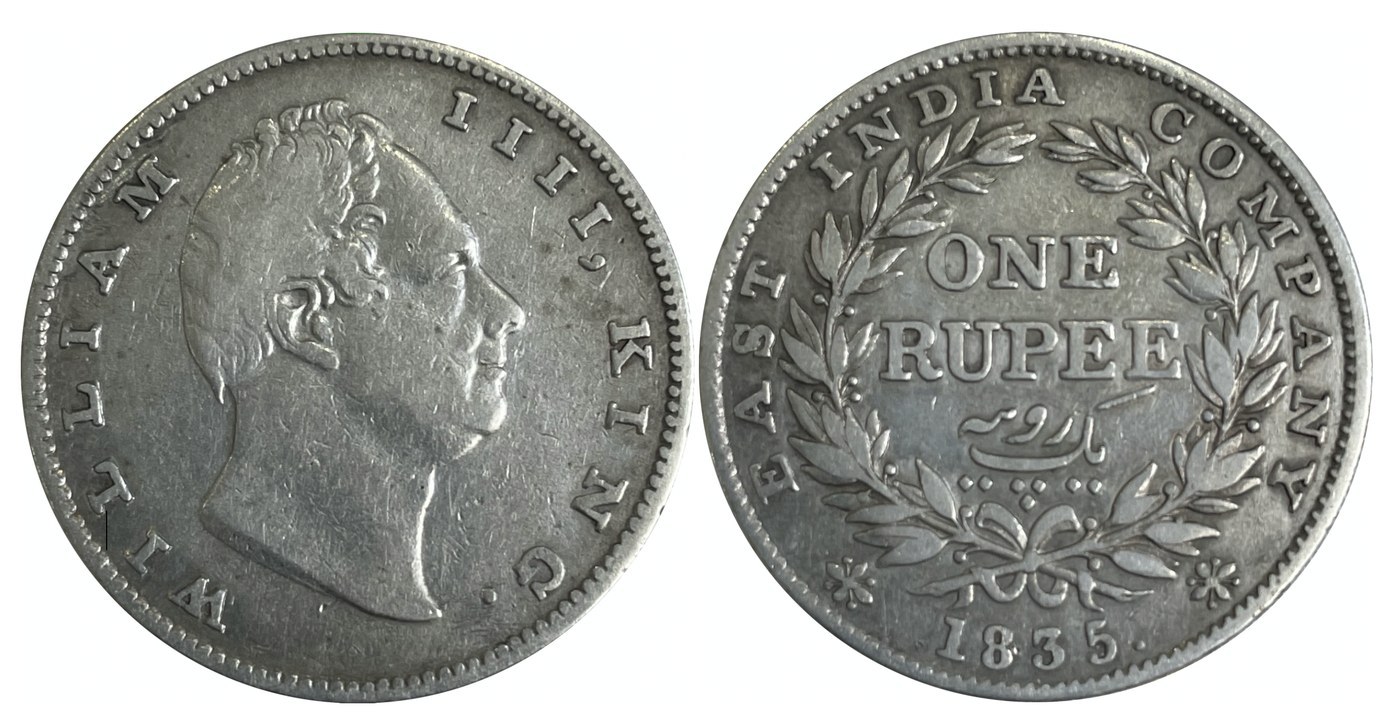
Begin with the obverse portrait and legend, which are the quickest confirmation. A genuine coin shows a bare-headed bust of William IV facing right, ringed by "WILLIAM IIII KING." The uncrowned, right-facing head and the four-I regnal number are diagnostic: a crowned or left-facing bust points to a different monarch, not William IV.
Check the reverse next. It should read "ONE RUPEE" with the date "1835" inside a laurel wreath, with "EAST INDIA COMPANY" around the top and a Persian inscription present on the type. Every genuine circulation strike of this type is dated 1835, so a different date signals either another type or a problem coin.
Confirm the physical specifications. The rupee is silver, about 30-31 mm across, roughly 11.6-11.7 grams, with a reeded edge. A coin that is noticeably light, undersized, magnetic, or has a plain or seamed edge should be treated with suspicion, since genuine pieces are non-magnetic silver with a milled edge.
Look at the fine detail for varieties and red flags. Some coins carry tiny engraver's initials (such as an "F") on the bust truncation, and there are minor differences in reverse lettering; note these, as they interest specialists. Warning signs of a counterfeit include mushy or uneven lettering, a soapy or greasy luster, casting seams on the edge, and off weight or diameter. Because higher-grade 1835 rupees, proofs, and restrikes carry real premiums, they are worth professional authentication before purchase.
Finally, watch for look-alikes. Victoria rupees and later British India issues share a similar size and wreath reverse but differ in the obverse portrait and legend, so always read the name around the bust rather than relying on shape and size alone.
Frequently asked questions
What is the fastest way to confirm a William IV rupee?
Read the obverse legend and portrait: a bare-headed bust facing right with "WILLIAM IIII KING" confirms the type. The reverse should show "ONE RUPEE" and "1835" within a laurel wreath.
Does the mint matter for identification?
The 1835 circulation strikes generally do not carry an obvious mint distinction, so identification rests mainly on the portrait, legend, date, and physical specs rather than a mint mark.
What quick checks help spot a fake?
Weigh and measure it (about 11.6-11.7 g and 30-31 mm), confirm a reeded edge with no casting seam, and check that it is non-magnetic. Off specs, mushy lettering, or a greasy luster are red flags; have valuable pieces professionally authenticated.