
Tunisia 1 Franc
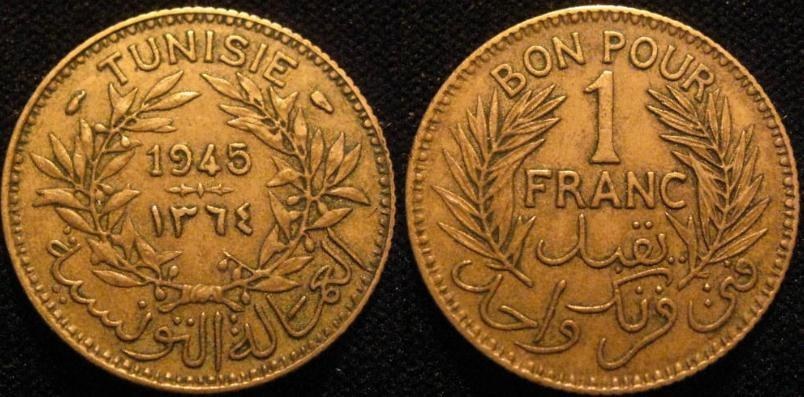
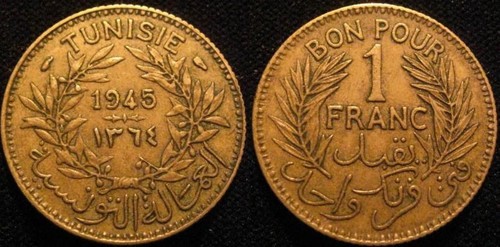
A small golden aluminum-bronze 1 franc of French-protectorate Tunisia, reading TUNISIE with a wreath and 'BON POUR 1 FRANC' beside Arabic script.
- Country
- Tunisia
- Denomination
- 1 Franc
- Metal
- Aluminum-bronze
Got a coin like this?
Identify any coin from a photo, free.
Overview
The Tunisia 1 franc is a small, golden-colored aluminum-bronze coin struck for the French Protectorate of Tunisia. The example shown is dated 1945, a year in which the denomination was produced for everyday circulation in the North African territory.
The obverse carries the country name 'TUNISIE' and the year within a wreath, while the reverse states the value in the token-like French formula 'BON POUR 1 FRANC' ('good for 1 franc') alongside Arabic script naming the Tunisian state. This bilingual French-and-Arabic layout reflects Tunisia's status as a French protectorate ruled by a local bey.
As a common circulating coin of the mid-1940s, the Tunisia 1 franc is an accessible and popular type for collectors of French colonial, North African, and Arabic-legend coinage.
History & Background
From the late nineteenth century until independence in 1956, Tunisia was a French protectorate: a nominally sovereign state under the Husainid beys of Tunis but administered under French control. Its currency was the Tunisian franc, tied to the French franc, and its coins carried both French and Arabic legends to serve a population that used both languages.
The 'BON POUR' ('good for') wording seen on this coin echoes the French practice of issuing token-style monetary pieces — a formula that treated the coin as good for a stated value rather than as a full-bodied precious-metal piece. By the 1940s the low denominations of Tunisia, like those of France itself, were struck in inexpensive base metals such as aluminum-bronze rather than silver.
The 1945 date places this coin at the very end of the Second World War, during the reign of the Husainid bey then on the throne. Coins of this general type were produced across several years of the protectorate, with the 1 franc forming part of a small-change series that also included fractional and higher franc values.
How to Identify
Look first at the obverse legend 'TUNISIE' and the four-digit year — 1945 on the example shown — set within or above a wreath of leaves. This French country name and Gregorian date are the quickest confirmation that a coin belongs to protectorate-era Tunisia.
The reverse is diagnostic: it reads 'BON POUR 1 FRANC' in French, paired with Arabic script that names the Tunisian state and typically an Islamic (AH) date corresponding to the Christian year. The combination of the French 'bon pour' value statement with Arabic lettering is the signature feature of this series.
Physically it is a small, light coin of golden aluminum-bronze, not silver, so expect a warm brassy tone rather than a white metallic look. Confirm the denomination reads '1 FRANC' (not 2 francs or a fractional value), and match the diameter and weight against published specifications for the Tunisian franc series to separate the 1 franc from its larger and smaller companions.
Value & Collectibility
The Tunisia 1 franc is a base-metal circulating coin with no precious-metal content, so its value rests entirely on condition and collector demand rather than intrinsic metal worth. Common circulated examples trade at modest levels typical of mid-twentieth-century minor coins.
Crisp, lightly worn, or uncirculated pieces with full wreath and legend detail and original golden color command a premium over worn, cleaned, or corroded coins. Aluminum-bronze can spot or darken with age, so attractive, problem-free surfaces add to desirability.
Because several dates exist across the protectorate series, some years and grades are scarcer than others; exact prices vary by date, condition, and marketplace and are best treated as ranges rather than fixed figures. For higher grades, comparison against catalog listings or a specialist opinion helps place a coin accurately.
Frequently asked questions
What country and period is this coin from?
It is a 1 franc coin of Tunisia struck during the French Protectorate (which lasted until 1956); the example shown is dated 1945, near the end of the Second World War.
What does 'BON POUR 1 FRANC' mean?
It is French for 'good for 1 franc,' a token-style value statement declaring the coin acceptable as one franc rather than being a full precious-metal piece.
Why does the coin have both French and Arabic writing?
Tunisia was a French protectorate with a French-tied currency but an Arabic-speaking population, so its coins carried French legends such as 'TUNISIE' and 'BON POUR 1 FRANC' alongside Arabic script naming the Tunisian state.
Is the coin made of silver?
No. It is struck in aluminum-bronze, a golden-toned base-metal alloy with no precious-metal content, which is why it has a warm brassy color rather than a white silver look.
Is the Tunisia 1 franc valuable?
It carries modest collector value that depends chiefly on date, grade, and eye appeal; common circulated examples are inexpensive, while sharp, uncirculated coins with original color bring more.
Tunisia 1 Franc guides
In-depth guides for identifying, valuing, and collecting Tunisia 1 Franc.
Other coins you may enjoy
5 Aurar
1926-1942
20 Kronor
1925 (denomination struck 1873-1925)
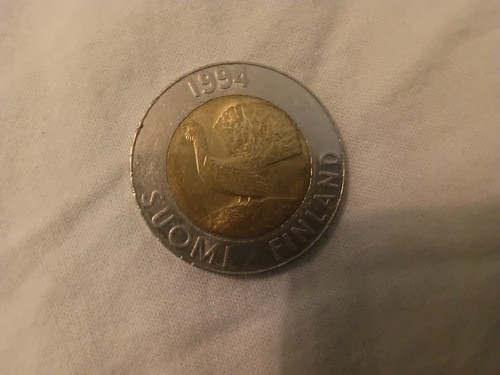
10 Markka
1993–2001
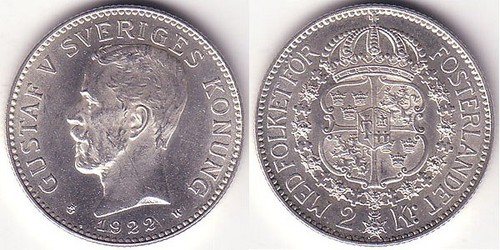
2 Kronor
1910-1940 (this example dated 1922)
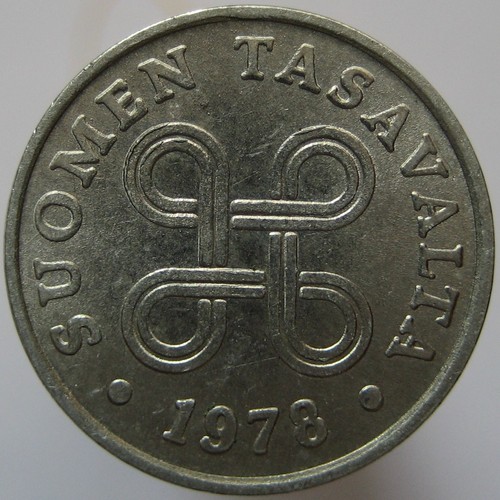
1 Penni
1969–1979
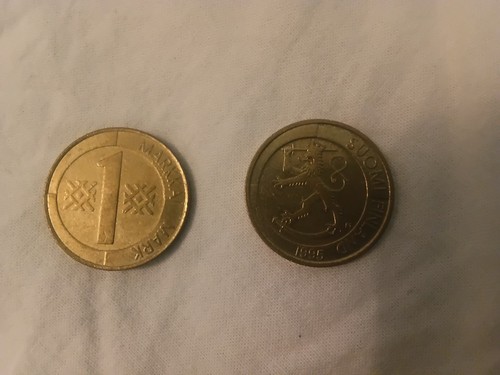
1 Markka
1993–2001
Kenya 5 Shillings
Bimetallic issues (2005–2010)
Kenya 20 Shillings
Modern issue (late 1990s–2000s)
South Africa Farthing
1923-1960
Kenya 10 Shillings
Republic of Kenya, bimetallic issues (mid-1990s to c. 2010)
Gold Sovereign
1817–present
Henri V Five Francs
1831