
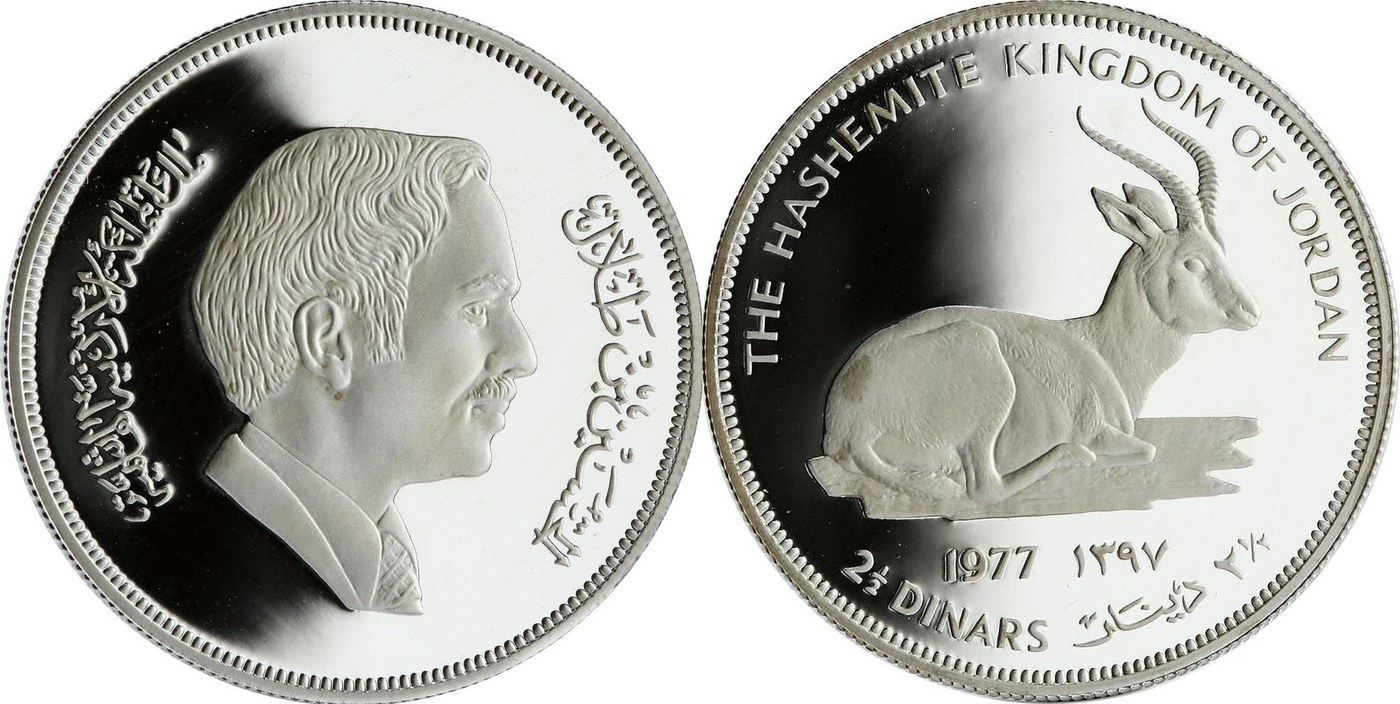
Jordanian 2½ Dinars
A crown-sized 1977 silver commemorative of the Hashemite Kingdom of Jordan, pairing King Hussein's portrait with a standing gazelle from the wildlife-conservation coin theme.
- Country
- Jordan
- Denomination
- 2½ Dinars
- Metal
- Silver
Got a coin like this?
Identify any coin from a photo, free.
Overview
The Jordanian 2½ Dinars is a large silver commemorative coin dated 1977, issued during the reign of King Hussein bin Talal. It belongs to the wildlife-conservation theme that many nations minted in the 1970s to highlight endangered animals, which is why its reverse centers on a gazelle rather than a state emblem.
Because the 2½ Dinars was a non-circulating collector issue rather than everyday money, examples were sold to collectors and typically survive in high grade, often as proofs or brilliant uncirculated pieces. It is prized more for its silver content and attractive single-animal design than for rarity or use in commerce.
The coin is denominated in dinars, Jordan's currency, with the dinar subdivided into piastres and fils. As a 2½ Dinar face value it was one of the higher denominations Jordan struck, consistent with its role as a precious-metal keepsake.
History & Background
Jordan gained full independence in 1946 as the Hashemite Kingdom, and King Hussein bin Talal ruled from 1952 until 1999, making his portrait a fixture of the kingdom's mid-20th-century coinage. The 1977 dating places this piece firmly within his long reign, and the right-facing profile follows the standard convention for his commemorative silver issues.
The reverse gazelle reflects an international wave of conservation-themed coinage in the 1970s, in which participating countries each honored native wildlife on silver commemoratives. For Jordan, a gazelle was a fitting choice given the animal's historic presence across the region's arid landscapes and its cultural resonance.
The coin was produced as a collector item for the Central Bank of Jordan, struck to commemorative standards rather than for circulation. Like most such issues it was distributed to numismatists at home and abroad rather than released as spending money.
How to Identify
Look first at the obverse: a bare-headed profile portrait of King Hussein facing right, typically surrounded by legends and the date 1977. The reverse shows a single gazelle standing and facing left, accompanied by the English inscription THE HASHEMITE KINGDOM OF JORDAN, usually paired with Arabic legends and the 2½ Dinars denomination.
This is a crown-sized silver coin, so expect a substantial piece roughly 38–39 mm across with the weight and cool, ringing feel of a large silver commemorative. The single-animal reverse, the King Hussein portrait, and the bilingual Arabic/English legends together distinguish it from ordinary Jordanian circulation coins, which are smaller and bear state emblems rather than a gazelle.
Confirm the denomination reads 2½ Dinars and the date reads 1977; do not confuse it with Jordan's minor circulating fils and piastres denominations, which are base metal and much smaller.
Value & Collectibility
As a silver crown-sized commemorative, the Jordanian 2½ Dinars carries a base worth tied to its silver content, so its value tracks the bullion price of silver as a floor. Well-preserved proof and brilliant uncirculated examples generally sell at a modest premium above melt to collectors of world silver or wildlife-theme coins.
Condition and originality drive the premium: fully struck, hairline-free proofs with original packaging command more than cleaned, scratched, or toned circulated-appearing pieces. Because it was a collector issue, high grades are common, which keeps prices moderate rather than rare-coin high.
For any specific example, weigh it, confirm the grade, and check recent sales of comparable Jordan silver commemoratives rather than relying on a single catalog figure, since realized prices vary with the silver market and demand.
Frequently asked questions
Is the Jordanian 2½ Dinars made of real silver?
Yes. It is a crown-sized silver commemorative, which gives it an intrinsic bullion value beneath any collector premium. Weigh and measure a specific coin to confirm it matches the expected silver specifications.
Was this coin used in everyday circulation?
No. The 2½ Dinars was a non-circulating collector commemorative sold to numismatists, not spending money. That is why surviving examples are usually in high grade, frequently as proofs or brilliant uncirculated pieces.
Why is there a gazelle on the reverse?
The gazelle reflects the wildlife-conservation coin theme popular in the 1970s, when many countries honored native endangered animals on silver commemoratives. Jordan chose a gazelle, a species long associated with the region's arid landscapes.
Who is the man on the obverse?
It is King Hussein bin Talal, who ruled Jordan from 1952 to 1999. His right-facing profile appears on the kingdom's commemorative silver of the period, here dated 1977.
Jordanian 2½ Dinars guides
In-depth guides for identifying, valuing, and collecting Jordanian 2½ Dinars.
Other coins you may enjoy
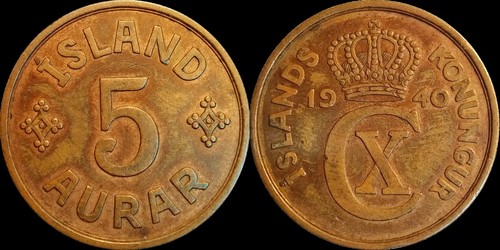
5 Aurar
1926-1942
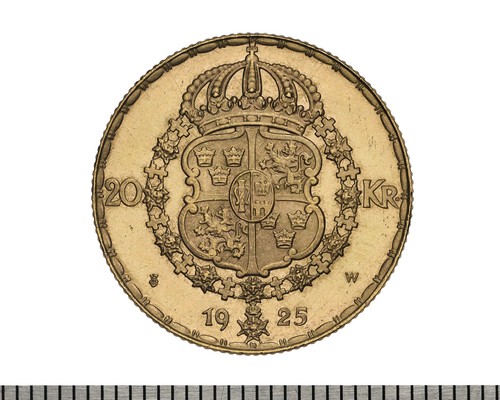
20 Kronor
1925 (denomination struck 1873-1925)
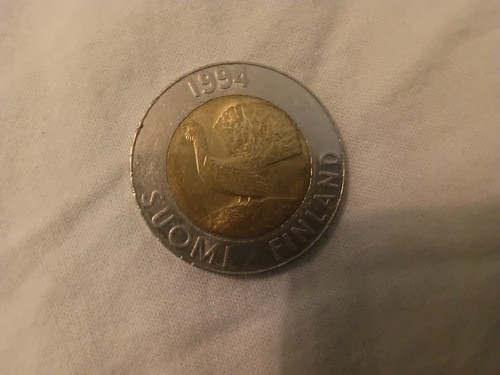
10 Markka
1993–2001
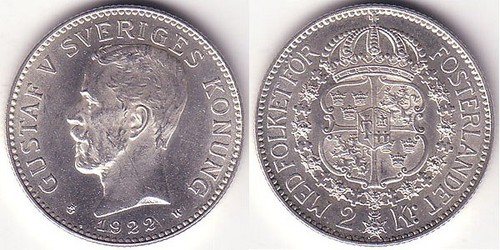
2 Kronor
1910-1940 (this example dated 1922)
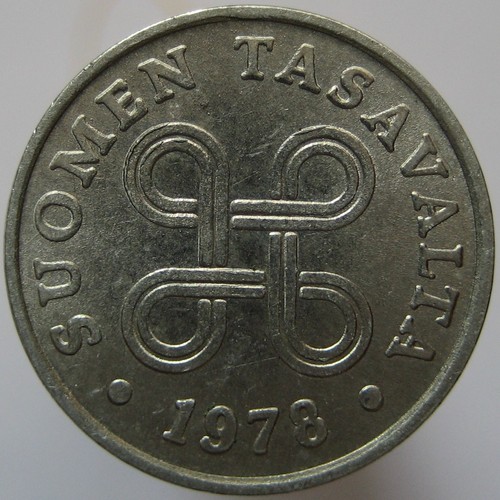
1 Penni
1969–1979
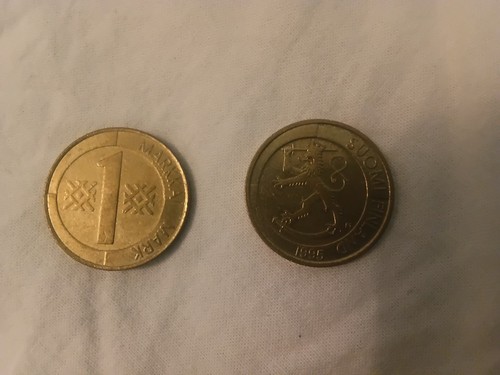
1 Markka
1993–2001
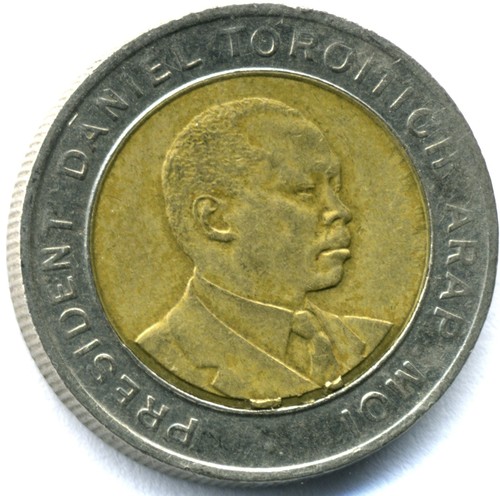
Kenya 5 Shillings
Bimetallic issues (2005–2010)
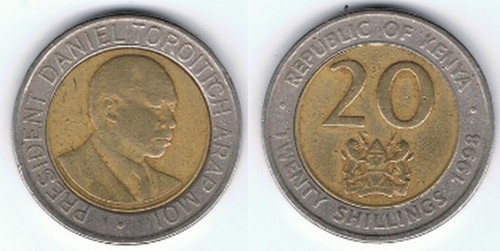
Kenya 20 Shillings
Modern issue (late 1990s–2000s)
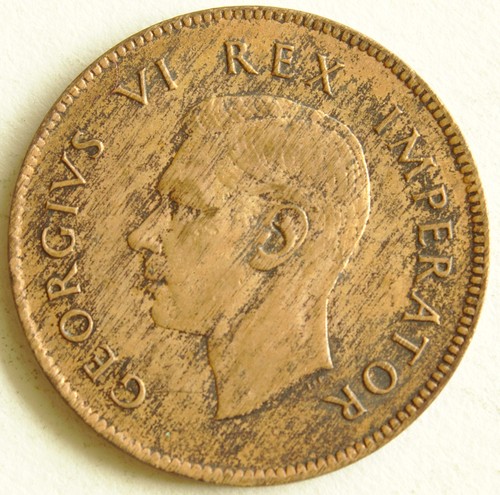
South Africa Farthing
1923-1960
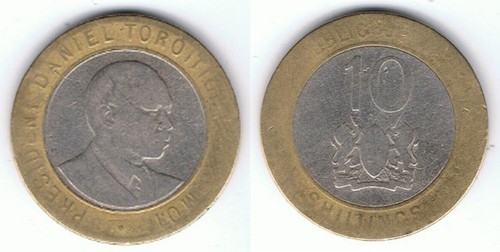
Kenya 10 Shillings
Republic of Kenya, bimetallic issues (mid-1990s to c. 2010)
Gold Sovereign
1817–present
Henri V Five Francs
1831