
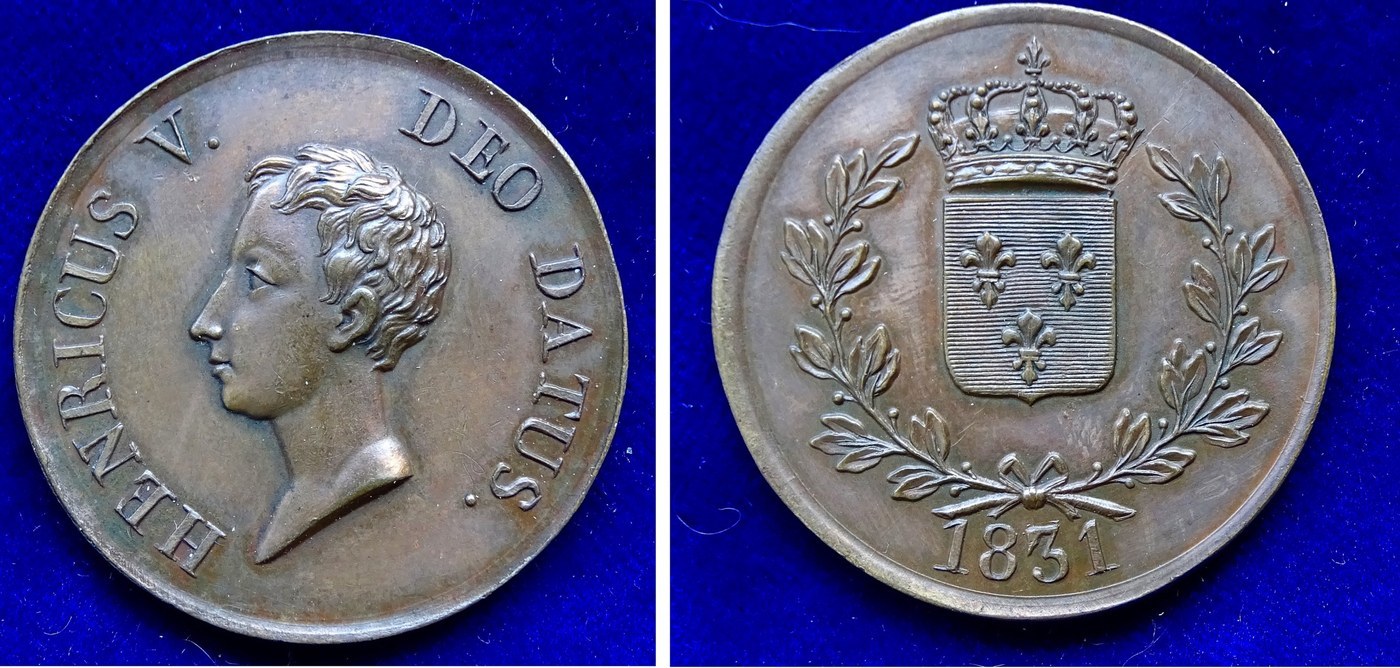
Henri V Five Francs
An 1831 French five-franc piece struck for the Legitimist pretender Henri V, showing his young profile and the royal fleur-de-lis shield.
- Country
- France
- Denomination
- 5 Francs
- Metal
- Bronze
Got a coin like this?
Identify any coin from a photo, free.
Overview
The Henri V Five Francs is a five-franc-sized French piece dated 1831 and struck in the name of Henri V, the Legitimist claimant to the French throne. The example shown here is in bronze. The obverse carries a youthful profile facing left with the Latin legend HENRICVS V, together with the words DEO (part of the royal formula "DEO GRATIA," by the grace of God).
The reverse shows the French royal arms — a shield charged with fleur-de-lis — in the classic Bourbon heraldic style, surrounded by lettering and the date. The overall look deliberately echoes the official five-franc écus of the restored Bourbon kings, but it names Henri V rather than a reigning monarch.
It is important to understand what this piece is. It was not an official coin of the French state and never circulated as legal-tender money. It belongs to a group of Legitimist pieces produced by supporters of the young pretender, and surviving examples are collected today as historical and political medallic issues rather than as ordinary currency.
History & Background
The July Revolution of 1830 forced the abdication of the Bourbon king Charles X. His supporters, the Legitimists, regarded Charles's grandson Henri d'Artois, Comte de Chambord (born 1820) as the rightful king and proclaimed him "Henri V." In practice the throne passed instead to Louis-Philippe of the Orléans line, so Henri V reigned only in the eyes of his partisans and never actually ruled.
Pieces dated 1831 bearing the legend HENRICVS V DEO GRATIA were produced in this Legitimist cause. They imitate the format of a French five-franc écu — royal profile on one side, fleur-de-lis arms on the other — as a statement of dynastic loyalty rather than as official coinage authorised by any mint of the state. Such pieces are generally described as patterns, essais, or propaganda strikings, and they exist in more than one metal.
The political situation gives the type its meaning: a coin-like object asserting a king who was never crowned. Henri, Comte de Chambord, lived until 1883 and remained the focus of Legitimist hopes for decades, which is why pieces in his name are prized as tangible relics of a lost royal claim.
How to Identify
Read the legends first. The obverse names HENRICVS V (the Latin form of Henri V) with DEO — shorthand for "DEO GRATIA," by the grace of God — around a left-facing youthful profile. That name is the decisive clue: no reigning French monarch of the period used it, so the legend marks this as a Legitimist piece for the Comte de Chambord rather than an official coin of Louis-Philippe.
The reverse displays the French royal shield charged with fleur-de-lis, the Bourbon arms, with the date 1831. Combined with the Henri V obverse, this heraldry confirms the type. Check the metal on the example in hand: this coin is bronze, a copper-toned alloy, which will look and weigh differently from the silver écus it imitates and should show no response to a magnet.
Because the design copies the layout of a genuine five-franc écu, the safest identifiers are the HENRICVS V name and the 1831 date rather than the general "portrait plus shield" arrangement, which many French pieces share. If a coin instead reads LOUIS PHILIPPE, CHARLES X, or a republic legend, it is a different type entirely.
Value & Collectibility
This is a scarce and historically charged Legitimist piece rather than a common circulating coin, so its value is driven almost entirely by collector demand, rarity of the specific metal and variety, and condition — not by any bullion content, since the example here is bronze. Values for pieces of this kind vary widely, and a bronze striking will generally trade differently from silver or gold versions of the same design.
Condition and originality matter a great deal. Sharp, unworn examples with clear legends command more than worn or damaged pieces, and provenance from a recognised collection or sale can add to desirability. Because the type imitates a well-known coin format, careful attribution of the exact variety strongly affects price.
Treat any figure as indicative only. For a piece like this, where reproductions and later restrikes exist and small differences in metal and die matter, obtain a written opinion from a specialist dealer in French coins or a reputable auction house before buying, selling, or insuring.
Frequently asked questions
Was the Henri V Five Francs a real circulating coin?
No. It was struck in the name of Henri V, the Legitimist pretender, and never served as legal-tender money. It is a political or pattern piece made by his supporters, not an official issue of the French state.
Who was Henri V?
Henri d'Artois, Comte de Chambord (1820–1883), grandson of Charles X. After the 1830 revolution his supporters proclaimed him King Henri V, but he never actually reigned; Louis-Philippe took the throne instead.
Why does the coin say HENRICVS V DEO?
HENRICVS V is Latin for Henri V, and DEO begins the formula DEO GRATIA, meaning by the grace of God. The wording mimics a royal coin legend to assert Henri's claim to the throne.
Is this piece made of silver?
The example shown here is bronze, a copper-based alloy. The design imitates the silver five-franc écu, but this striking is in bronze and carries no precious-metal bullion value.
How much is an Henri V Five Francs worth?
As a scarce Legitimist piece its value rests on collector demand, metal, variety, and condition rather than face value or bullion. Prices vary widely, so have a specific example appraised by a French-coin specialist.
Henri V Five Francs guides
In-depth guides for identifying, valuing, and collecting Henri V Five Francs.
Other coins you may enjoy
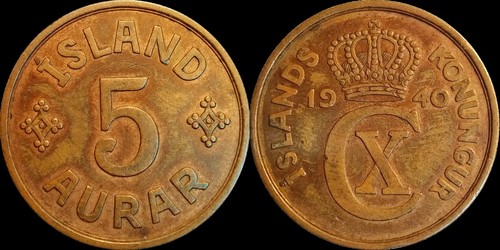
5 Aurar
1926-1942
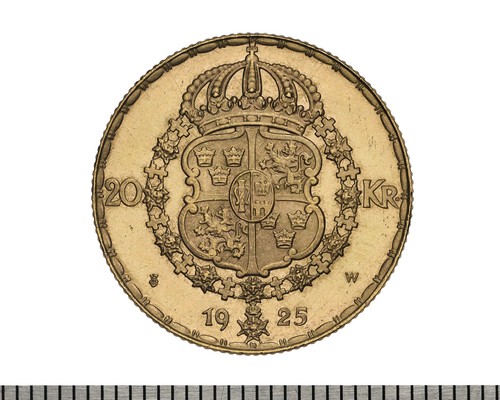
20 Kronor
1925 (denomination struck 1873-1925)
10 Markka
1993–2001
2 Kronor
1910-1940 (this example dated 1922)
1 Penni
1969–1979
1 Markka
1993–2001
Kenya 5 Shillings
Bimetallic issues (2005–2010)
Kenya 20 Shillings
Modern issue (late 1990s–2000s)
South Africa Farthing
1923-1960
Kenya 10 Shillings
Republic of Kenya, bimetallic issues (mid-1990s to c. 2010)
Gold Sovereign
1817–present
Tunisia 1 Millime
1960