
How to Identify the Henri V Five Francs
Collector checks for the 1831 Henri V piece: the HENRICVS V legend, fleur-de-lis shield, bronze metal, and cautions on restrikes.
Read the full Henri V Five Francs encyclopedia entry →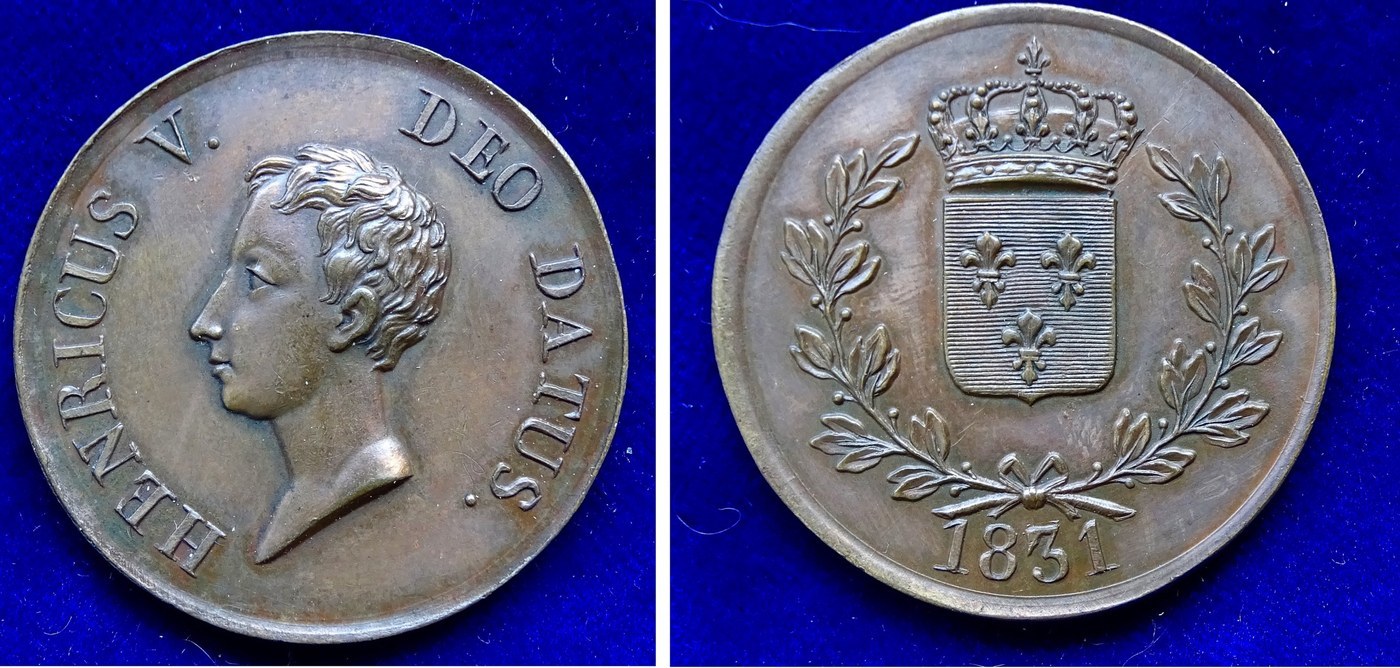
Start with the obverse legend, because it is what sets this piece apart. Look for the name HENRICVS V — the Latin form of Henri V — around a youthful left-facing profile, accompanied by DEO (from DEO GRATIA, by the grace of God). No French monarch actually reigning in 1831 used this name, so the legend immediately marks the piece as a Legitimist issue for the Comte de Chambord rather than an official coin. If the obverse instead reads LOUIS PHILIPPE, CHARLES X, or a republican legend, you have a different coin.
Turn to the reverse and confirm the heraldry. You should see the French royal shield charged with fleur-de-lis, the Bourbon arms, with the date 1831. This side deliberately imitates the reverse of a genuine five-franc écu, so treat the name and date as your primary identifiers, not the general portrait-and-shield layout that many French pieces share.
Check the metal and physical feel. The example here is bronze, a warm copper-toned alloy that looks and weighs differently from the silver five-franc coins it echoes; it should not be attracted to a magnet. Bronze, silver, and gold strikings of Henri V pieces are known, so noting the exact metal is part of correct attribution and directly affects what the piece is.
Be cautious about authenticity. Because Henri V pieces are collectable and imitate a familiar coin format, later restrikes, copies, and reproductions exist, and the same basic design appears across different metals and die varieties. Weight, diameter, edge, and the crispness of the legends are all worth recording. Do not assume a "5 Francs" plus fleur-de-lis automatically equals a genuine period striking.
When it matters, get expert help. For any piece you intend to buy, sell, or insure, have it examined by a specialist in French coins or a reputable auction house who can confirm the metal, variety, and period of manufacture. Attribution subtleties on Legitimist pieces are exactly the kind of thing a specialist catalogue or grading service is meant to resolve.
Frequently asked questions
What is the single clearest sign this is an Henri V piece?
The obverse legend HENRICVS V. That Latin name for Henri V does not appear on the official French coins of 1831, so it identifies the piece as a Legitimist issue for the Comte de Chambord.
How do I tell it apart from a real French five-franc écu?
The écu names a reigning king such as Louis-Philippe or Charles X and is struck in silver. This piece names Henri V, carries the fleur-de-lis royal shield, and the example here is bronze rather than silver.
Why does the metal matter for identification?
Henri V pieces exist in bronze, silver, and gold, and the metal is part of the correct attribution. Confirm what you have: the coin shown is bronze, a non-magnetic copper alloy with no bullion value.
Do I need to worry about fakes or restrikes?
Yes. Because the type is collectable and copies a familiar format, later restrikes and reproductions circulate. Record weight, size, and edge, and have any valuable example authenticated by a French-coin specialist.